Keyboard Fundamentals for Beginners
Keyboard Layout
The Keyboard's Landscape
Look at a piano or keyboard. You'll see a repeating pattern of white and black keys. This pattern is your map to playing music. The white keys are the foundation, representing the seven “natural” notes.

These seven notes have simple letter names: A, B, C, D, E, F, and G. After G, the pattern just starts over with A again. Think of it as a musical alphabet that repeats up and down the keyboard.
Navigating with Black Keys
The black keys seem random at first, but they have a clear structure. They are arranged in alternating groups of two and three. This pattern is the single most important landmark for finding your way around.
Find any group of two black keys. The white key immediately to the left of that group is always a C.
Try it now. Look for a group of two black keys, and find the C just to its left. Then find another group of two black keys and find the C next to it. Every single C on the keyboard can be found this way. This C is your anchor point.
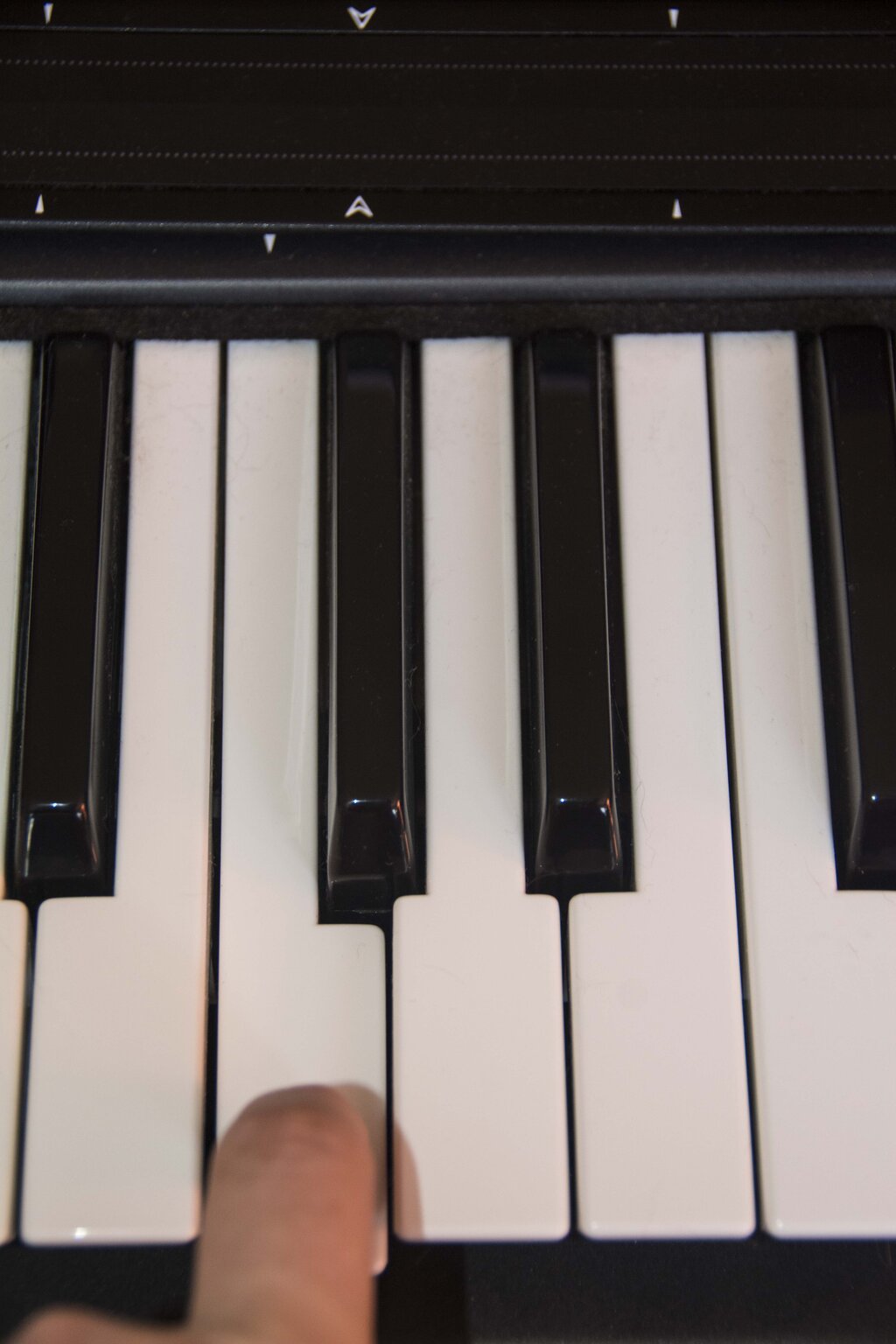
Once you've found C, you can name all the other white keys by moving to the right, one by one, through the musical alphabet: C, D, E, F, G, A, B. After B, you'll find the next C, located to the left of the next group of two black keys, and the pattern repeats.
Understanding Octaves
The distance from one C to the next C is called an octave. The word comes from the Latin for eight, because it spans eight white keys (C to C, inclusive). Every note within an octave sounds similar to its counterpart in other octaves, just higher or lower in pitch.
A C in one octave and the C in the next octave are fundamentally the same note, but they vibrate at different frequencies. This is why music feels consistent as it moves up and down the keyboard. You are simply moving through different octaves of the same basic set of notes.
Now that you can identify every white key, let's test your knowledge.
How are the black keys on a piano arranged?
Which white key is located immediately to the left of any group of two black keys?
With this foundation, you can navigate the entire keyboard with confidence. Next, we'll start exploring how to combine these notes to create scales.