Kepler's Laws of Planetary Motion
Introduction to Kepler's Laws
The Rules of Planetary Motion
For centuries, astronomers thought planets moved in perfect circles around the Sun. It was a beautiful, simple idea, but it didn't quite match what they observed. The planets' actual paths were a bit more complex. It took the meticulous work of Johannes Kepler to uncover the three fundamental laws that govern how planets travel through space.
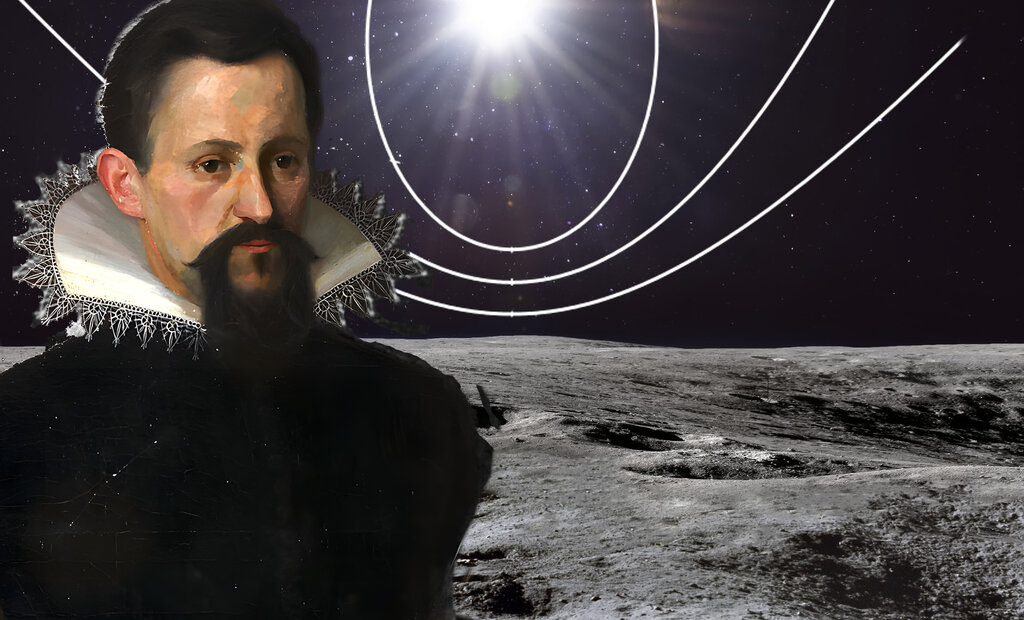
First Law: Orbits are Ellipses
Kepler's first breakthrough was realizing that planets don't move in circles at all. They follow a slightly flattened shape called an ellipse.
An ellipse has two special points inside it called foci (the plural of focus). For any planetary orbit, the Sun isn't at the center of the ellipse, but at one of these two foci. The other focus is just an empty point in space.
This means a planet's distance from the Sun is constantly changing. The point in the orbit where the planet is closest to the Sun is called the perihelion. The point where it is farthest away is the aphelion.
Second Law: Equal Areas in Equal Time
Kepler's second law explains how a planet's speed changes during its orbit. It's a clever idea: an imaginary line connecting a planet to the Sun sweeps out equal areas in equal intervals of time.
What does this mean in practice? When a planet is near the Sun (at its perihelion), it moves much faster. To sweep out the same area, the line connecting it to the sun traces a short, wide, fan-like shape. When the planet is far from the Sun (at its aphelion), it moves much slower, tracing a long, narrow fan shape. Both of these fan shapes have the exact same area, as long as they represent the same amount of time, like 30 days.
In short: A planet moves fastest when it is closest to the Sun and slowest when it is farthest away.
Third Law: The Cosmic Harmony
Kepler's third law is a bit more mathematical, but it reveals a beautiful relationship between a planet's distance from the Sun and how long it takes to complete one orbit. The law states that the square of a planet's orbital period () is directly proportional to the cube of its semi-major axis (), which is its average distance from the Sun.
This law is like a cosmic clock. If you know how long a planet takes to orbit the Sun, you can calculate its average distance. Or, if you know its average distance, you can figure out its orbital period. It shows that there's a predictable, harmonious order to the solar system. Planets that are farther from the Sun not only have a longer path to travel, but they also move more slowly, resulting in much, much longer orbital periods.
| Planet | Avg. Distance (a) in AU* | Period (P) in Years | ||
|---|---|---|---|---|
| Mercury | 0.39 | 0.24 | 0.06 | 0.06 |
| Venus | 0.72 | 0.62 | 0.38 | 0.37 |
| Earth | 1.00 | 1.00 | 1.00 | 1.00 |
| Mars | 1.52 | 1.88 | 3.53 | 3.51 |
| Jupiter | 5.20 | 11.86 | 140.7 | 140.6 |
*An AU, or Astronomical Unit, is the average distance from the Earth to the Sun.
Notice how the last two columns are nearly identical. This is Kepler's third law in action. These three laws painted a new, accurate picture of our solar system and laid the groundwork for future discoveries in physics, including Newton's law of universal gravitation.