Karate Technical Mastery
Power Mechanics
The Anatomy of a Powerful Strike
A powerful strike in Karate isn't about brute strength. A smaller practitioner can generate more impact than a larger, untrained person. The secret lies in using the entire body as a single, coordinated system. This system is known as the kinetic chain, a sequence of movements that transfers energy from the ground, up through your body, and into your target.
Imagine cracking a whip. The power doesn't come from your wrist; it starts in your shoulder and torso, flowing down the whip until it culminates in a loud crack at the tip. A Karate strike works the same way. The arm is just the tip of the whip. The real power is generated by the larger, stronger muscles in your legs and core.
Grounding and Kime
To start the kinetic chain, you need a stable base. This is called "grounding." By planting your feet firmly and sinking your weight, you use the floor as a backboard. Instead of your body moving backward from the force of your own punch, all that energy is directed forward into the target. A solid stance isn't passive; it's an active connection to the ground that anchors your entire technique.
Once the energy travels up the chain, it needs to be delivered with maximum effect. This is the role of Kime. It's the brief, sharp tensing of all the muscles in your body at the precise moment of impact. It’s not about staying rigid. It’s a rapid transition from a relaxed state during the motion to a sudden, total-body contraction, then back to relaxation. This focuses all the generated energy into a single point in time and space.
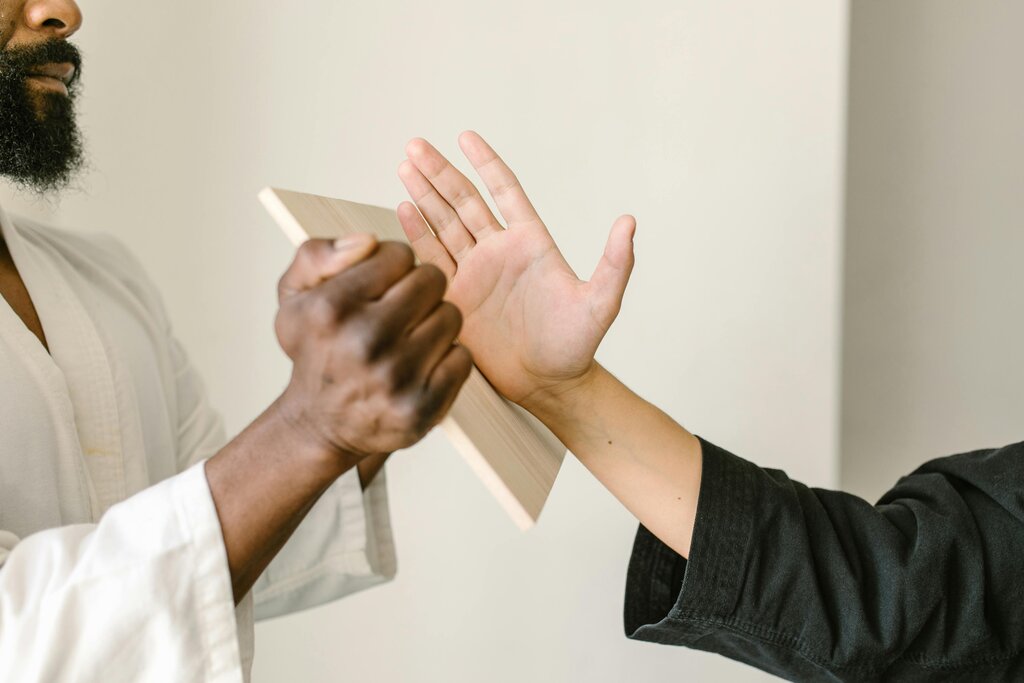
Think of Kime as the shutter of a camera. The body gathers light (energy) while relaxed and open, then the shutter clicks (contracts) for a split second to create the image (impact).
The Engine of Power
The link between your grounded legs and your striking arm is your core. The rotational torque generated by your hips is the true engine of your power. For a technique like the reverse punch, or , the punch is thrown with the rear hand. As you punch, your rear hip and shoulder rotate forward powerfully. This rotation multiplies the force initiated by your legs, adding significant momentum to the strike.
This core-driven movement ensures your body's alignment is correct. The bones of your arm, shoulder, and back line up to support the strike, preventing injury and ensuring that no energy is lost. Without this hip rotation and core engagement, a punch is just an arm movement. With it, it's a full-body expression of power.
Now, let's test your understanding of these mechanics.
What is the primary source of power in a powerful Karate strike?
In the context of a Karate strike, the 'kinetic chain' is best compared to:
By mastering these principles, you move beyond simply executing techniques and begin to truly understand the source of their power.