K-Means Clustering Explained
Introduction to Clustering
Finding Patterns in Data
Imagine you have a huge box of mixed LEGO bricks. Without looking at the instructions, you'd probably start sorting them. You might put all the red bricks in one pile, all the blue ones in another. You might group them by shape, putting all the 2x4 bricks together and all the 1x1 bricks in a different pile. You're creating groups of similar items without being told what the groups should be. This is the core idea behind clustering.
clustering
noun
The task of grouping a set of objects in such a way that objects in the same group (called a cluster) are more similar to each other than to those in other groups.
In machine learning, clustering is a form of unsupervised learning. The term "unsupervised" is key. It means we give the computer a dataset without any labels or correct answers. We don't tell it, "This is a cat," and "This is a dog." Instead, we just provide the data and ask the algorithm to find the interesting patterns and structures on its own. The algorithm's job is to discover the natural groupings that exist within the data.
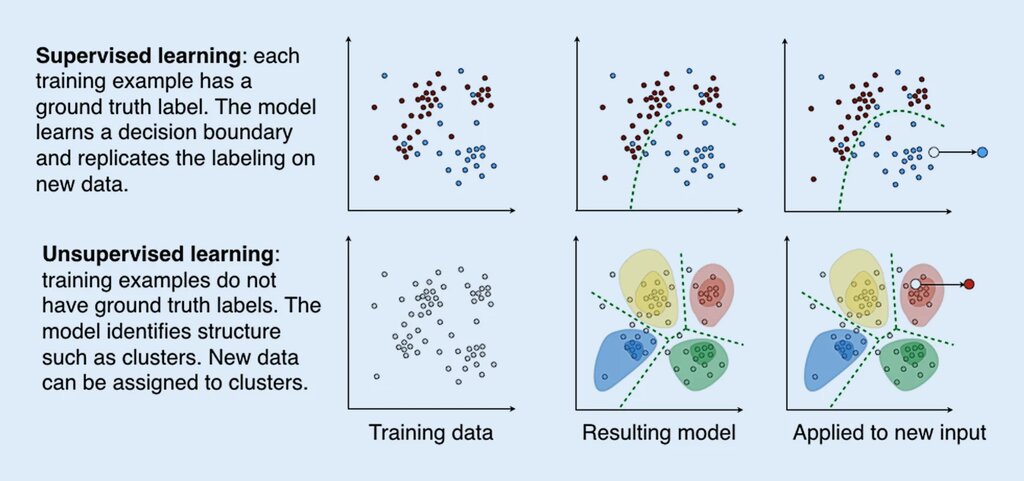
Why Group Things Together?
Clustering helps us make sense of complexity. The world is filled with vast amounts of raw, unorganized data. By grouping similar data points, we can turn a chaotic dataset into something more understandable. It's a way of summarizing information and discovering hidden relationships that aren't obvious at first glance.
The problem of taking a set of data and separating it into subgroups where the elements of each subgroup are more similar to each other than they are to elements not in the subgroup has been extensively studied through the methods of Cluster Analysis.
This process is fundamental for exploring a new dataset. Before you can make predictions, you often need to understand what kinds of data you have. Clustering is one of the first steps in that exploration, revealing the underlying structure of the information you're working with.
Clustering in the Real World
Clustering isn't just an abstract concept; it's used all around us.
Market Segmentation: Online retailers analyze your purchase history to group you with other customers who have similar tastes. If you buy a lot of running shoes and protein bars, you might be clustered into a "Fitness Enthusiast" segment. This allows companies to send you targeted recommendations and ads you're more likely to find useful.
Image Analysis: In medical imaging, clustering algorithms can group similar pixels together in an MRI or CT scan. This can help doctors automatically identify different types of tissue, organs, or potential tumors by highlighting areas with similar characteristics.
Document Sorting: News websites often use clustering to group articles into topics. An algorithm can scan thousands of articles and automatically identify clusters of stories about sports, politics, or technology without a human having to manually categorize each one. It does this by grouping articles that use similar words and phrases.
Essentially, clustering is about finding similarity. By identifying and grouping similar items, we can simplify complex data and unlock valuable insights.
Understanding this basic concept is the first step. Once you grasp the 'what' and 'why' of clustering, you can begin to explore the different algorithms that make it happen.