Journey Through Our Solar System
Solar System Formation
A Spinning Cloud of Dust
Our solar system began not with a bang, but with a slow collapse. About 4.6 billion years ago, a vast, cold cloud of gas and dust, known as a giant molecular cloud, drifted through our corner of the Milky Way. Something disturbed this quiet existence, perhaps the shockwave from a nearby supernova, causing a dense region within the cloud to begin contracting under its own gravity.
Billions of years ago, the dust and gas that would become our solar system existed only as an enormous cloud.
As this clump of material, called the solar nebula, collapsed, it began to spin faster. This is due to the conservation of angular momentum, the same principle that causes a spinning ice skater to speed up when they pull their arms in. This rapid rotation prevented all the material from simply falling into the center. Instead, most of it flattened out into a vast, rotating disk around the growing central mass. This structure is known as a protoplanetary disk.
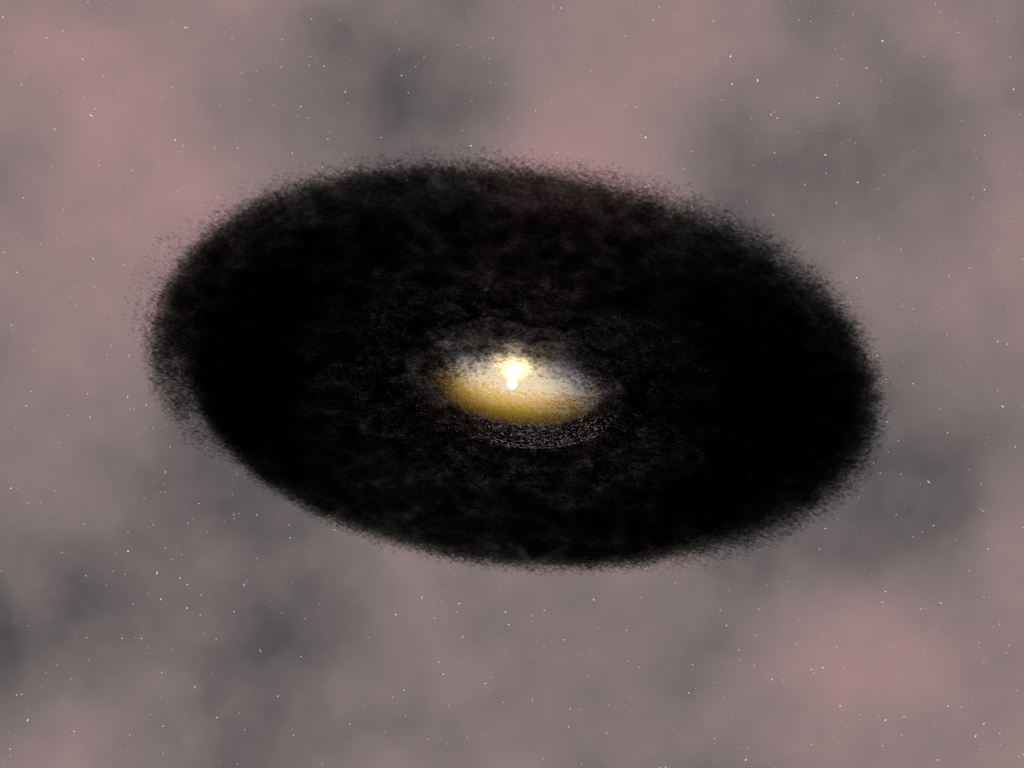
At the center of this spinning disk, pressure and temperature skyrocketed as more and more material fell inward. Eventually, the core became so hot and dense that nuclear fusion ignited. Hydrogen atoms began fusing into helium, releasing an immense amount of energy. Our Sun was born.
Building Planets Piece by Piece
While the Sun was forming at the center, the surrounding protoplanetary disk was a chaotic but creative place. It was filled with tiny grains of dust, ice, and gas. These particles began to stick together through electrostatic forces, much like dust bunnies forming under a bed.
Accretion
noun
The process by which particles and small bodies clump together under their mutual gravitational attraction to form larger bodies, such as planetesimals and eventually planets.
Through this process of accretion, these small clumps grew into kilometer-sized objects called planetesimals. Think of them as the building blocks of planets. Over millions of years, these planetesimals continued to collide and merge, their own gravity pulling in more and more material. The largest of these bodies grew into protoplanets, and eventually, into the planets we know today.
This process is called “accretion,” and resulted in the production of many planetesimals (small objects that build up into planets), and eventually, the planets themselves.
The protoplanetary disk wasn't just a random collection of stuff. The angular momentum of the initial cloud ensured that everything in the disk orbited the new Sun in the same direction and on roughly the same plane. This is why all the planets in our solar system orbit in the same direction and on a relatively flat plane called the ecliptic.
A Tale of Two Planet Types
The early solar system had a steep temperature gradient. It was scorching hot near the young Sun and freezing cold in the outer regions. This temperature difference created a crucial dividing line known as the frost line, which fell somewhere between the present-day orbits of Mars and Jupiter.
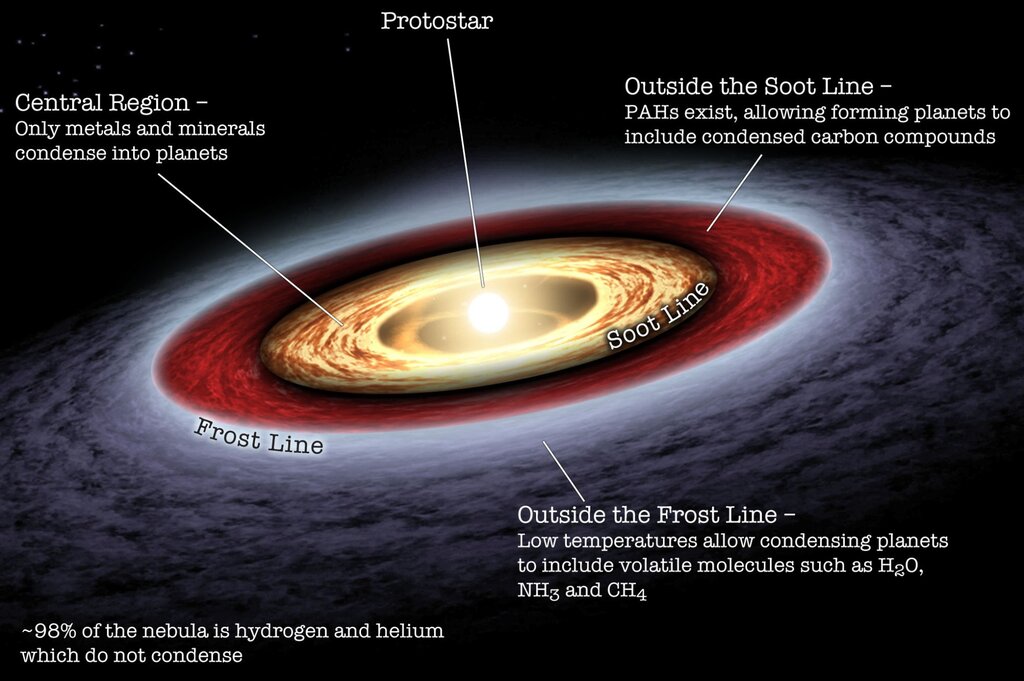
Inside the frost line, it was too hot for volatile compounds like water, ammonia, and methane to condense into solid ice. Only materials with high melting points, like rock and metal, could solidify. This is why the inner planets—Mercury, Venus, Earth, and Mars—are small, dense, and rocky. There simply wasn't as much solid material available for them to accrete.
Outside the frost line, it was a different story. It was cold enough for water, ammonia, and methane to freeze into solid ice particles. This dramatically increased the amount of solid material available for planet building. Protoplanets in this region grew massive enough to gravitationally capture the abundant hydrogen and helium gas from the nebula. This process formed the gas giants: Jupiter and Saturn, and the ice giants: Uranus and Neptune.
| Region | Temperature | Available Materials | Resulting Planets |
|---|---|---|---|
| Inner Solar System | Hot | Rock, Metal | Terrestrial Planets (Mercury, Venus, Earth, Mars) |
| Outer Solar System | Cold | Rock, Metal, Ice | Gas & Ice Giants (Jupiter, Saturn, Uranus, Neptune) |
After the planets formed, the Sun's powerful solar wind swept away most of the remaining gas and dust from the protoplanetary disk, leaving behind the relatively orderly system we see today. The leftovers from this formation process became the asteroids, comets, and other small bodies that still orbit our star.
What initiated the formation of our solar system approximately 4.6 billion years ago?
As the solar nebula collapsed, it began to spin faster and flatten into a disk. This phenomenon is a direct result of: