JLPT N4 Japanese Language Mastery
Review N5 Content
Strengthening Your Foundation
Before we dive into N4 material, let's take a moment to solidify your N5 knowledge. A strong foundation in the basics makes learning more complex concepts much easier. This review will quickly cover the core grammar, vocabulary, and kanji you've already learned.
JLPT N5 is the foundation level of Japanese proficiency, designed to test your ability to understand basic Japanese, including everyday expressions, simple grammar, vocabulary, and basic listening comprehension.
Core Grammar Patterns
N5 grammar is the skeleton of Japanese sentence structure. It's all about particles, simple verb forms, and basic sentence patterns. Mastering these makes everything else fall into place.
Particles are the small words that define the roles of other words in a sentence. They tell you who is doing what, where things are happening, and how objects relate to each other.
| Particle | Function | Example |
|---|---|---|
| は (wa) | Marks the topic | わたしはがくせいです。(Watashi wa gakusei desu.) - I am a student. |
| が (ga) | Marks the subject | ねこがいます。(Neko ga imasu.) - There is a cat. |
| を (o) | Marks the direct object | ごはんをたべます。(Gohan o tabemasu.) - I eat a meal. |
| に (ni) | Marks location, destination, or time | 6じにおきます。(Roku-ji ni okimasu.) - I wake up at 6 o'clock. |
| へ (e) | Marks direction of movement | がっこうへいきます。(Gakkou e ikimasu.) - I go to school. |
| で (de) | Marks location of an action or means | としょかんでべんきょうします。(Toshokan de benkyou shimasu.) - I study at the library. |
Next up are verbs. For N5, the most important form is the polite, non-past form, which ends in -ます (-masu). This is used in everyday polite conversation. You should also be comfortable with its negative form, -ません (-masen).
Let's look at a few examples.
| Verb Type | Dictionary Form | -masu Form (Polite) | Meaning |
|---|---|---|---|
| Group 1 (u-verb) | かく (kaku) | かきます (kakimasu) | To write |
| Group 2 (ru-verb) | たべる (taberu) | たべます (tabemasu) | To eat |
| Group 3 (irregular) | する (suru) | します (shimasu) | To do |
Finally, remember the basic sentence pattern: AはBです (A wa B desu), which means "A is B." This is fundamental for describing things and identifying yourself.
田中さんは日本人です。(Tanaka-san wa Nihonjin desu.) Mr. Tanaka is Japanese.
To turn a statement into a question, you simply add the particle か (ka) to the end.
あれはなんですか。(Are wa nan desu ka?) What is that?
Essential Vocabulary and Kanji
The N5 level requires you to know about 800 common words and around 100 basic kanji. This vocabulary covers essential topics for daily life: greetings, numbers, time, family, food, and places. These are the words you'd use to introduce yourself, ask for directions, or order a coffee.
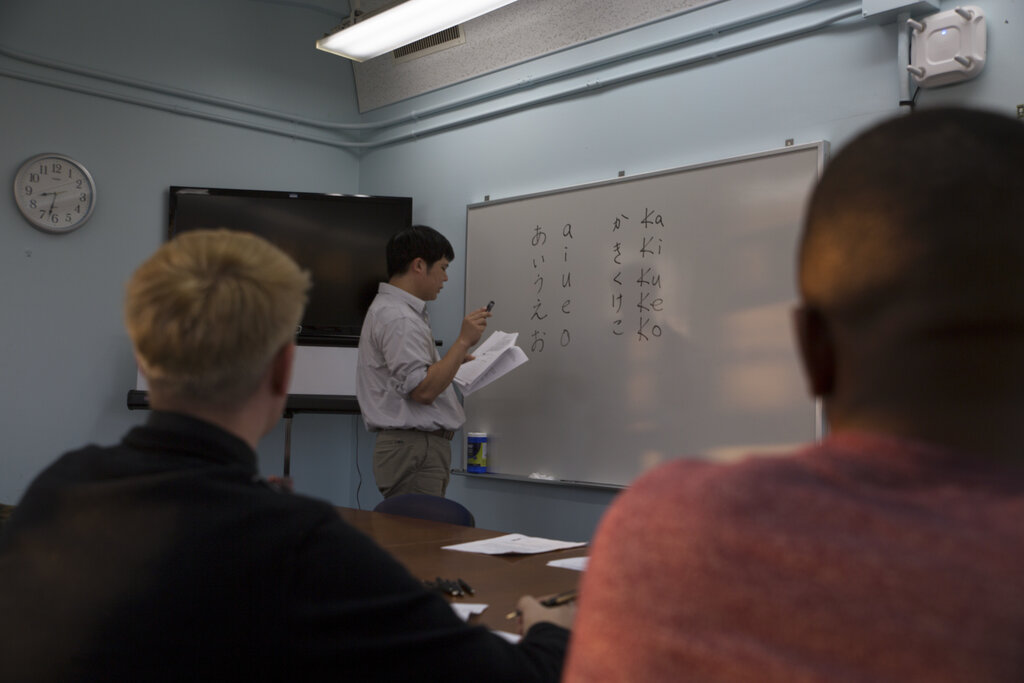
N5 kanji are the building blocks for reading. They often represent simple, concrete ideas like numbers, people, and elements of nature. They appear frequently, so recognizing them is crucial.
| Kanji | On'yomi (Chinese Reading) | Kun'yomi (Japanese Reading) | Meaning |
|---|---|---|---|
| 一 | ICHI | hito(tsu) | One |
| 人 | JIN, NIN | hito | Person |
| 日 | NICHI, JITSU | hi, -bi, -ka | Day, Sun |
| 大 | DAI, TAI | oo(kii) | Big |
| 年 | NEN | toshi | Year |
| 中 | CHUU | naka | Middle, Inside |
| 本 | HON | moto | Book, Origin |
Recognizing these kanji within the vocabulary you've learned is the key. For example, combining 人 (hito) and 大 (ookii) can create the word 大人 (otona), meaning "adult."
Ready to check your knowledge? This quick quiz will cover the grammar, vocabulary, and kanji we've just reviewed.
Choose the correct particle to complete the sentence: 私___学生です。(Watashi ___ gakusei desu.)
What is the polite, non-past negative form of the verb 食べます (tabemasu - to eat)?
With this review complete, your N5 foundation should be solid. Now you're ready to build upon it with new N4 concepts.