Jim Collins Business Frameworks
Building the Flywheel
From Thought to Momentum
Once you have your Hedgehog Concept, you've answered the question of what to do. The next question is how. Many leaders assume the answer lies in a single, bold stroke—a killer app, a visionary acquisition, or a dramatic restructuring. But great companies don't work that way.
They don't achieve a breakthrough and then build momentum. They build momentum and then achieve a breakthrough. This process is like pushing a giant, heavy flywheel. The first push barely moves it. You keep pushing, and it moves a few inches, then a few feet. You stay with it, and eventually, the flywheel's own weight starts working for you. It builds momentum, turn by turn, until its own force drives it forward, almost on its own.
Greatness is achieved by a cumulative process, step by step, action by action, decision by decision, turn by turn as the Flywheel Effect eventually adds up to sustained and spectacular results.
Each step in the process is a 'turn' of the flywheel. These aren't just random activities; they are part of an interconnected loop where each component logically follows from the one before it, creating a self-reinforcing cycle. Your Hedgehog Concept—that simple, powerful idea at the intersection of your passion, skill, and economic engine—defines the architecture of your flywheel.
Mapping Your Flywheel
A flywheel isn't just a list of good things to do. It’s a causal loop where each step inevitably leads to the next. The sequence matters. Getting it right creates momentum; getting it wrong creates friction.
Consider Amazon. Their flywheel, identified in the early 2000s, is a masterpiece of logical sequencing:
- Lower prices on more offerings lead to...
- Increased customer visits, which...
- Attracts more third-party sellers, which...
- Expands the store and selection, which...
- Grows revenues and economies of scale, allowing them to...
- Lower prices on more offerings.
Each component drives the next. More sellers mean more selection, which draws more customers, which attracts more sellers. The growth of Amazon Web Services (AWS) injected even more energy, providing massive cash flow to fund further price cuts and innovation, spinning the flywheel even faster.
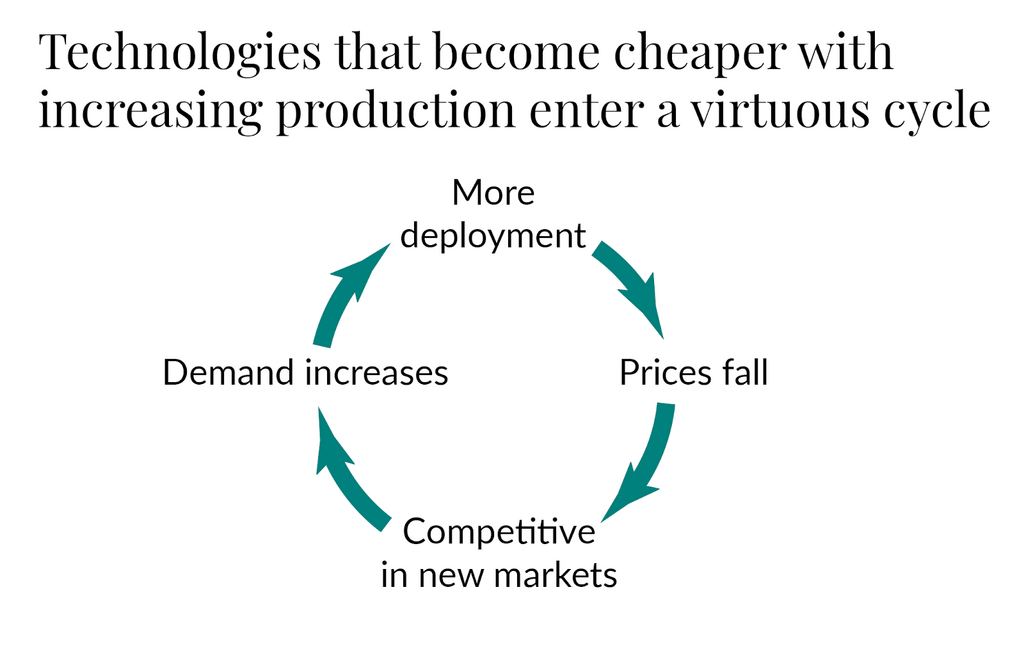
To map your own flywheel, start by identifying your most significant, replicable successes. What’s the one thing that, if you do it with excellence, leads directly to the next success? List 4-6 components. Then, debate the sequence. If we nail A, does it guarantee we get to B? Does B’s success propel C? The entire loop should feel undeniable. It shouldn't require leaps of faith.
Avoiding the Doom Loop
The opposite of the flywheel is the Doom Loop—a vicious cycle that drains momentum. Organizations stuck in the Doom Loop react to poor results with new, unrelated initiatives. They lurch from one program to another, hoping for a miracle moment that never comes. Instead of building cumulative momentum, they dissipate their energy in a dozen different directions.
This often happens when organizations skip the hard work of disciplined thought (the Hedgehog Concept) and jump straight to undisciplined action. They launch a new strategy, it fails to deliver instant results, and they panic. Leaders are replaced, another new vision is announced, and the cycle of disappointment continues. The company is constantly starting over, never getting the flywheel to complete a single turn.
The key to breaking free from the Doom Loop is consistency and discipline. Once you have your flywheel, you commit to it. You don't abandon it after one bad quarter. You push, turn by turn, until momentum takes over. This relentless focus on a single, coherent path is what separates good from great.
Small wins are not the goal. They are the process. Each small win is another push on the flywheel, compounding over time to create extraordinary results.
Radical change doesn't happen overnight. It happens when the flywheel builds up so much momentum that a breakthrough becomes inevitable. Think of Vanguard in the investment world. For decades, they pushed a simple flywheel: offer low-cost mutual funds, which delivers superior long-term returns to investors, which attracts more assets under management, which creates greater economies of scale, allowing them to lower costs even further. After decades of pushing, their momentum became an unstoppable force that reshaped the entire industry.
The flywheel turns slow, consistent effort into spectacular power. By defining your loop, committing to the sequence, and avoiding the reactive chaos of the Doom Loop, you move from just having good ideas to building an engine of enduring greatness.
According to the flywheel concept, when does a major breakthrough typically occur?
What is the primary characteristic of the 'Doom Loop'?