Jevons Paradox and AI Efficiency
Introduction to Jevons Paradox
The Efficiency Paradox
It seems logical: if you make a machine more efficient, it should use less fuel. If a car gets better gas mileage, you'll buy less gas. If a light bulb uses less electricity, your power bill will go down. This is often true for a single person or a single machine, but when you look at the whole economy, a strange and counterintuitive effect can happen.
Sometimes, making the use of a resource more efficient leads to an increase in the total consumption of that resource. This idea is known as the Jevons Paradox.
Jevons Paradox: An increase in efficiency in the use of a resource can lead to a greater overall consumption of that resource, rather than a decrease.
Coal, Steam, and a Puzzle
The story begins in 19th-century Britain during the height of the Industrial Revolution. The entire economy was powered by coal, and some people were starting to worry that the country would run out. The common assumption was that new, more efficient steam engines would be the solution. They would burn coal more slowly, stretching the nation's supply.

But an English economist named William Stanley Jevons noticed the opposite was happening. In his 1865 book The Coal Question, Jevons pointed out that as steam engines became more efficient, Britain's consumption of coal skyrocketed.
How could this be? The improved steam engine made coal a much more effective and cheaper source of power. Suddenly, steam power wasn't just for pumping water out of mines. It became practical for powering factories, locomotives, and steamships. The efficiency gains opened up entirely new applications for coal, and the total demand exploded. Jevons famously concluded it was a mistake to think that using fuel more economically meant using less of it.
Why Efficiency Isn't Enough
The Jevons Paradox isn't a magical rule; it's a result of basic economics. The key ingredient is something called the price elasticity of demand. This concept measures how much the quantity demanded of a good changes when its price changes.
elasticity
noun
A measure of how sensitive one economic variable is to a change in another. For example, the price elasticity of demand measures how the quantity demanded of a good responds to a change in its price.
When demand is inelastic, a change in price has a relatively small effect on the quantity people want. For example, the demand for gasoline is fairly inelastic in the short term. If the price goes up 10%, most people still need to drive to work, so they might not cut their consumption by a full 10%.
When demand is elastic, a change in price has a large effect on the quantity demanded. If the price of a particular brand of coffee drops by 10%, shoppers might buy much more than 10% more of it, switching from other brands.
Increased efficiency is like a price drop. A car that's twice as fuel-efficient effectively halves the fuel cost of driving a mile. The Jevons paradox occurs when this "price drop" causes demand to increase by a larger percentage than the efficiency gain.
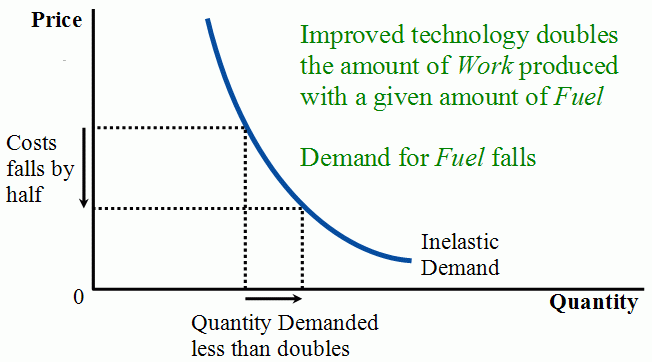
For the paradox to kick in, demand needs to be sufficiently elastic. The efficiency gain makes the activity cheaper, which encourages people to do it more. If they do it so much more that it cancels out the savings from efficiency, overall consumption rises.
Let's look at another example: refrigeration. The first home refrigerators were inefficient and expensive to run. People used them to store small amounts of essential items. As refrigerators became dramatically more efficient and cheaper, the "price" of refrigerated space plummeted. As a result, people didn't just keep their old habits and save money. Instead, the average size of refrigerators grew, and many families bought a second fridge or a standalone freezer. The total energy used for refrigeration in the country went up, even as each individual unit became more efficient.