Jazz Bass Foundations on a Precision Bass
Walking Bass Lines
The Steady Pulse of Jazz
A walking bass line is the rhythmic and harmonic backbone of a jazz tune. It’s a steady stream of notes, typically one per beat, that moves smoothly from one chord to the next. Think of it as creating a path through the song for the other instruments to follow. The line “walks” through the chord progression, outlining the harmony and providing a constant, forward-moving pulse.
The bass acts as a bridge between rhythm and harmony, tying together the drums and melodic elements.
This steady quarter-note rhythm is the foundation. It provides a solid groove that the whole band can lock into. Harmonically, it spells out the chords, so even if the piano or guitar isn't playing, the listener can still hear the progression. Your job as the bassist is to make this journey both clear and interesting.

Building with Chord Tones
The simplest and strongest way to build a walking bass line is with chord tones. These are the notes that make up the chord itself: the root, 3rd, 5th, and 7th. Playing these notes clearly establishes the harmony of the song.
Let’s look at a C Major 7 chord (Cmaj7). The chord tones are C (the root), E (the 3rd), G (the 5th), and B (the 7th). You can arrange these four notes in any order to create a one-bar bass line. In a 4/4 measure, you have four beats to fill. Using one chord tone per beat is a great starting point.
You could play them in order: C-E-G-B. Or you could mix them up: C-G-E-B. The strongest beat is usually beat one, so it's common to play the root of the chord there. This anchors the harmony for everyone. After that, you're free to explore the other chord tones.
Connecting the Chords
Music doesn't stay on one chord for long. The real art of the walking bass line is creating a smooth connection between chords. You want your line to lead seamlessly from the end of one chord to the beginning of the next. This is where approach notes and passing tones come in.
Passing Tone
noun
A note that isn't part of the chord but is used to connect two chord tones. It's usually part of the scale the chord is built from.
Let's say we're moving from a Cmaj7 chord to an Fmaj7 chord. We need our line to lead to F, the root of the next chord. A great way to do this is to use the last beat of the Cmaj7 measure to play a note that's close to F. This is our approach note.
You could use a note from the C major scale, like E, which is just a half step below F. Or you could use G, which is a whole step above F. A very common and effective technique is using a chromatic approach note—a note that is a half step above or below your target note.
To move from Cmaj7 to Fmaj7, you could play C-E-G-E over the Cmaj7 chord. The final E leads smoothly by a half step down to the F on beat one of the next measure.
Here's a simple two-bar phrase showing this in action. It covers a Cmaj7 chord in the first measure and an Fmaj7 in the second. Notice how the notes on the fourth beat lead into the next chord's root.
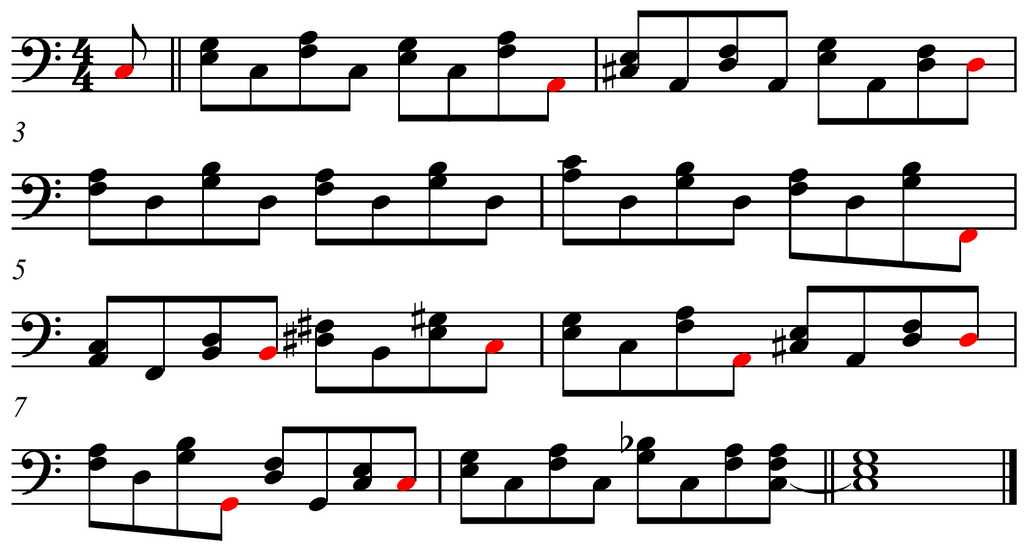
The line over Cmaj7 is C-E-G-E. The E on beat 4 is a half step below F. The line over Fmaj7 is F-A-C-B. The B on beat 4 is a half step above the C we'd return to if the progression repeated. This creates a strong, logical flow that's easy for the listener to follow.
A Common Progression
Let's apply these ideas to one of the most common progressions in jazz: the ii-V-I (two-five-one). In the key of C major, the chords are Dm7 (the ii), G7 (the V), and Cmaj7 (the I). Each chord often lasts for one measure.
Here's a sample walking bass line over a ii-V-I in C:
- Dm7: D - F - A - C (Root, 3rd, 5th, 7th)
- G7: G - B - D - F (Root, 3rd, 5th, 7th)
- Cmaj7: C (lands on beat one)
This is a good start, as it clearly outlines the chords. But it feels a bit disconnected. The jump from C (last note of Dm7) to G (first note of G7) is a perfect fifth, which is a bit wide. Let's smooth it out with approach notes.
| Measure | Beat 1 | Beat 2 | Beat 3 | Beat 4 | Target Note |
|---|---|---|---|---|---|
| Dm7 (ii) | D | F | A | F# (chromatic) | G |
| G7 (V) | G | B | D | B (scalar) | C |
| Cmaj7 (I) | C | (rest) | (rest) | (rest) |
In this improved version, we replaced the last note of each measure with an approach note.
Over the Dm7, we play D-F-A, then on beat four, we play F#. This F# is a half step below our target, G, creating a strong pull. Over the G7, we play G-B-D, and then on beat four, we play B. This B is a half step below our final target, C. The result is a line that flows much more musically.
Ready to test your knowledge? Let's see what you've learned about building walking bass lines.
What is the primary rhythmic characteristic of a walking bass line?
When building a bass line over a chord, which note is most commonly played on beat one to anchor the harmony?
The key is to practice these concepts over many different songs and chord progressions. Start slowly, thinking about each note choice. Over time, you'll develop an intuition for creating smooth, compelling bass lines on the fly.