JavaScript's Journey to Web Dominance
Key JavaScript Tools
The Age of Libraries and Frameworks
Once you have a handle on JavaScript's fundamentals, the next step is understanding the tools that make building complex web applications manageable. Raw JavaScript can do anything, but writing everything from scratch is slow and prone to error. That's where libraries and frameworks come in.
A library is a collection of pre-written code that you can call upon to perform common tasks. Think of it like a toolkit full of specialized wrenches and screwdrivers. You still build the project yourself, but you use the library's tools to do it faster. A framework, on the other hand, is more like a blueprint for a house. It provides the structure and rules you build within, saving you from making foundational decisions.
jQuery: The Game Changer
For many years, web developers had a major headache: different browsers implemented JavaScript and the Document Object Model (DOM) in slightly different ways. Writing code that worked on Internet Explorer, Firefox, and Safari often meant writing multiple versions of the same script. It was frustrating.
Then, in 2006, jQuery arrived. It was a fast, small, and feature-rich JavaScript library that simplified everything. Its motto was "write less, do more," and it delivered. jQuery smoothed over browser inconsistencies, allowing developers to write a single piece of code that worked everywhere.
jQuery's main strength was making it incredibly easy to find HTML elements on a page and do something with them—a process called DOM manipulation.
For example, to change the text of every paragraph with the class lead to "Hello world!" using standard JavaScript, you might write something like this:
const paragraphs = document.querySelectorAll('p.lead');
for (const p of paragraphs) {
  p.textContent = 'Hello world!';
}
With jQuery, you could achieve the same result in a single, elegant line:
$('p.lead').text('Hello world!');
This simplicity revolutionized web development. While modern JavaScript has adopted many of the features that made jQuery popular, its influence is undeniable. Many older websites and projects still rely on it heavily.
Frameworks and the Single-Page App
As web applications grew more complex, a new need arose: managing the application's state. State is essentially all the data that an application needs to keep track of at any given moment—who is logged in, what's in a shopping cart, which tab is active, and so on. As state changes, the user interface (UI) needs to update accordingly. Managing this manually can become a tangled mess.
This challenge led to the rise of powerful JavaScript frameworks designed to build Single-Page Applications (SPAs). SPAs are web apps that load a single HTML page and dynamically update content as the user interacts with them, providing a smoother, more app-like experience. Two of the most influential frameworks are Angular and React.
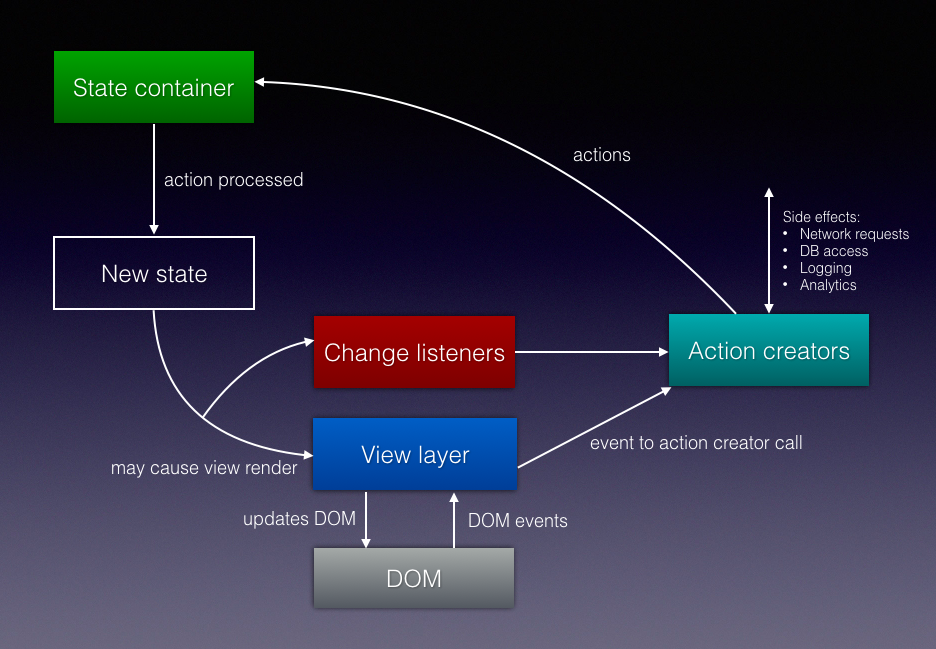
Angular Released by Google in 2010, Angular is a full-fledged framework. It's often described as "opinionated" because it provides a clear, structured way to build applications. It comes with a lot of built-in features, including a templating system, routing for navigating between views, and tools for making server requests.
React Introduced by Facebook in 2013, React is technically a library, not a framework. It focuses on one thing and does it very well: building user interfaces. React's core idea is to break the UI into reusable, independent pieces called components. A button, a search bar, or an entire user profile card could each be a component. This makes code easier to manage and reuse.
Because React focuses only on the UI, developers often pair it with other libraries to handle things like routing and state management, creating a customized development "stack."
| Feature | Angular | React |
|---|---|---|
| Type | Framework | Library |
| Maintained By | Meta (Facebook) | |
| Approach | Opinionated, all-in-one | Flexible, UI-focused |
| Data Flow | Two-way data binding | One-way data flow |
| Learning Curve | Steeper | More gradual |
Choosing between them often comes down to project needs and team preference. Angular provides a robust, out-of-the-box solution, while React offers more flexibility to pick and choose your tools.
JavaScript Beyond the Browser
For most of its history, JavaScript lived exclusively inside web browsers. Its job was to make websites interactive. But in 2009, a developer named Ryan Dahl had a groundbreaking idea: what if you could run JavaScript on a server?
The result was Node.js, a runtime environment that allows developers to write server-side code—the kind that handles databases, user authentication, and business logic—using JavaScript. This was a massive shift. Suddenly, developers could use the same language for both the front-end (what the user sees in the browser) and the back-end (the server logic).
Node.js is a runtime environment allowing developers to run JavaScript code outside the web browser.
Node.js excels at handling many simultaneous connections, making it perfect for real-time applications like chat apps, live collaboration tools, and streaming services. It also gave rise to npm (Node Package Manager), a massive ecosystem of open-source libraries that any JavaScript developer can use. With a simple command, you can install packages to handle almost any task imaginable, from processing images to connecting with databases.
The introduction of Node.js cemented JavaScript's role as one of the most versatile programming languages in the world. It enabled the creation of the "full-stack" JavaScript developer, capable of building an entire web application from end to end with a single language.
These tools—jQuery, Angular, React, and Node.js—represent major leaps in the evolution of JavaScript. They've made developers more productive and enabled the creation of the rich, dynamic web applications we use every day. Now let's test your knowledge of these essential tools.
Which statement best describes the conceptual difference between a JavaScript library and a framework?
What was the primary problem jQuery solved for web developers when it was first released?
Understanding these tools is a huge step in your journey as a developer. They form the foundation of modern web development.