Java Multithreading Essentials
Introduction to Multithreading
Programs That Multitask
Most computer programs are like a diligent cook following a recipe. They do one step, then the next, then the next. First, chop the onions. Second, brown the meat. Third, add the sauce. This sequential process works, but it can be slow if there's a lot to do.
What if our cook had help? One person could chop vegetables while another simmers the sauce. By working in parallel, the meal gets done much faster. This is the core idea behind multithreading.
thread
noun
The smallest sequence of programmed instructions that can be managed independently by a scheduler. Think of it as a single path of execution within a program.
A program starts with at least one thread, often called the main thread. Multithreading is the ability of a program to create and run multiple threads at the same time, or concurrently. Each thread can work on a different task, sharing the program's resources but running independently.
These threads are all part of the same parent program, just like the assistant chefs are all working in the same kitchen to prepare one meal.
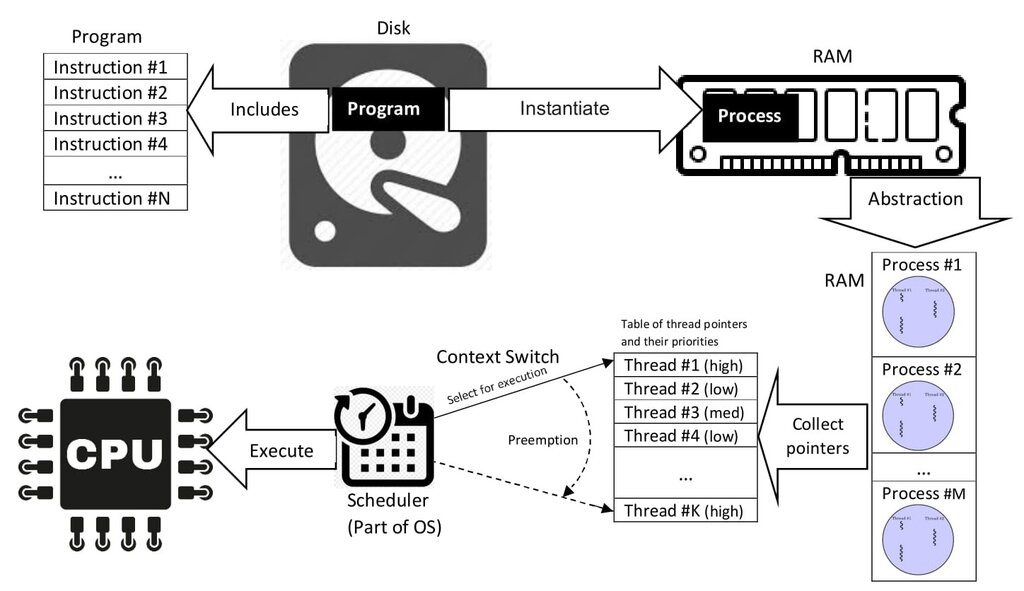
The Benefits of Concurrency
Why go through the trouble of managing multiple threads? The benefits are significant.
First, multithreading keeps applications responsive. Imagine a desktop application downloading a large file. In a single-threaded program, the entire user interface would freeze until the download is complete. You couldn't click buttons or even close the window. With multithreading, the download can happen on a background thread, while the main thread keeps the user interface running smoothly.
Multithreading is a technique that allows for concurrent (simultaneous) execution of two or more parts of a program for maximum utilization of a CPU.
Second, it allows for more efficient use of the CPU. Modern processors have multiple cores, each capable of running its own set of instructions. A single-threaded program can only ever use one core at a time, no matter how powerful the computer is. A multithreaded program can split its work across several cores, leading to a dramatic increase in performance for CPU-intensive tasks.
In Java, the Java Virtual Machine (JVM) and the operating system work together to manage threads. The JVM creates and manages the threads within the Java application, while the operating system's scheduler is responsible for assigning these threads to the CPU's available cores.
This cooperation allows Java programs to run efficiently across different types of hardware and operating systems without needing major code changes. You write the logic for your threads, and the system takes care of the low-level details of running them.
The provided text uses an analogy of a kitchen to explain multithreading. In this analogy, what does a single thread represent?
According to the text, what is a primary benefit of using a background thread to handle a large file download in an application?
This ability to handle multiple tasks at once is fundamental to modern software, from web servers handling thousands of users to video games rendering complex graphics while processing player input.