Java Loops for Beginners
Repetition Basics
Why Repeat Yourself?
Imagine your morning routine. You wake up, get dressed, and head to the bathroom to brush your teeth. You don't just scrub one tooth and call it a day. You brush each tooth, one after the other, until they're all clean. You are repeating an action: brushing. Computers often need to do the same thing: repeat a task over and over.
In programming, this process of repeating a set of instructions is called a name that simply means performing an action again. Without a way to automate repetition, a programmer would have to write the same line of code hundreds or even thousands of times. If you wanted a program to print "Hello!" five times, you'd have to write the instruction five times. This is tedious and inefficient.
The goal is to work smart, not hard. Loops let the computer handle the repetitive work for you.
This leads to a core philosophy in programming known as the Don't Repeat Yourself. The idea is to avoid duplicating code whenever possible. Instead of copying and pasting the same instructions, you write them once and tell the computer how many times to repeat them. This makes your code cleaner, easier to read, and much simpler to update. If you need to change the instruction, you only have to change it in one place.
The Anatomy of a Loop
So how does a computer know when to stop repeating? It follows a rule called a loop condition. This is the most important part of a loop. The condition is a simple true-or-false question that the computer checks before each iteration. If the answer is true, it runs the code inside the loop. If the answer is false, it stops and moves on.
Think of a track runner doing laps. Their coach tells them, "Run until you've completed 4 laps."
Each time the runner crosses the start line, they ask themselves, "Have I completed 4 laps yet?"
- After lap 1: "No." They keep running.
- After lap 2: "No." They keep running.
- After lap 3: "No." They keep running.
- After lap 4: "Yes." They stop running.
The instruction "run a lap" is the repeated action. The question "Have I completed 4 laps yet?" is the loop condition.
A basic loop has three key parts that work together:
| Part | Analogy (Running Laps) | Purpose |
|---|---|---|
| Initialization | Going to the starting line (Lap 0) | Sets up the starting point before the loop begins. |
| Condition | Have I finished all my laps? | The true/false check that decides if the loop should run again. |
| Update | Completing a lap and adding 1 to my lap count. | Changes something after each iteration so you get closer to the end. |
Without an update, the condition would never change, and the loop would run forever! This is called an infinite loop. It's like our runner deciding not to count their laps; they'd just keep going until they collapsed. In programming, an infinite loop can cause a program to freeze or crash.
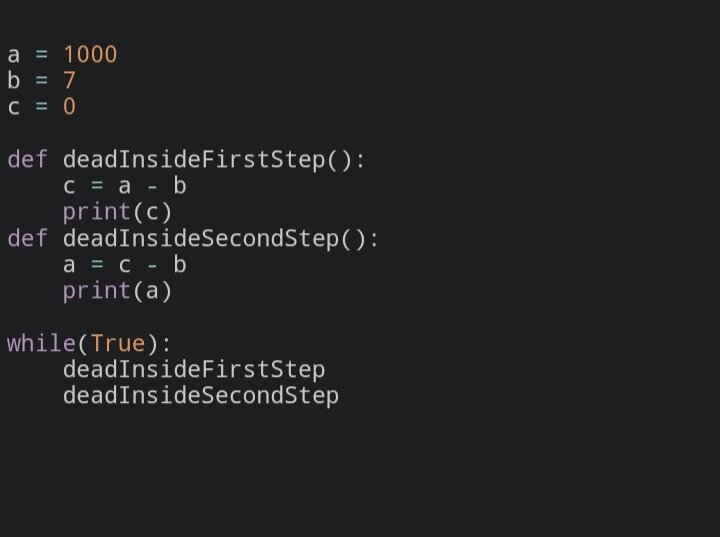
Understanding this simple structure of initializing, checking, and updating is the key to mastering loops. Every loop you'll encounter in Java and other programming languages is just a variation of this fundamental idea.
Ready to check your understanding?
In programming, what is the term for the process of repeating a set of instructions?
The "DRY" principle is a core philosophy in programming that advises developers to avoid duplicating code. What does "DRY" stand for?
Now that you understand why we use loops and the basic logic behind them, you're ready to see how they're written in Java.