Java for Systems and Scripting Veterans
JVM Runtime Dynamics
The Virtual Machine Heartbeat
Coming from Rust and Python, you're used to two different worlds. Rust compiles directly to machine code, giving you bare-metal performance. Python is interpreted, offering flexibility and rapid development. Java takes a middle path with the Java Virtual Machine (JVM), the engine behind its famous "Write Once, Run Anywhere" promise.
Instead of compiling to code for a specific operating system, the Java compiler (javac) transforms your .java source files into an intermediate format called bytecode and saves it in .class files. This bytecode is a set of instructions for the JVM, not for your actual CPU. Any machine with the correct JVM installed can understand and execute this bytecode, regardless of whether it's running Windows, macOS, or Linux.
From Source to Execution
Let's make this concrete. Here’s a simple Java program:
// HelloWorld.java
public class HelloWorld {
    public static void main(String[] args) {
        System.out.println("Hello, JVM!");
    }
}
You compile this using the Java compiler from your terminal:
javac HelloWorld.java
This creates a HelloWorld.class file. It's not human-readable, but we can use the javap (Java Class File Disassembler) tool to see the bytecode instructions inside:
javap -c HelloWorld
The output reveals the low-level steps the JVM will follow, translating your simple println statement into a sequence of operations like loading constants and invoking methods.
The bytecode is the portable foundation of Java. The JVM is the machine-specific program that translates that portable code into native machine instructions.
Inside the Machine
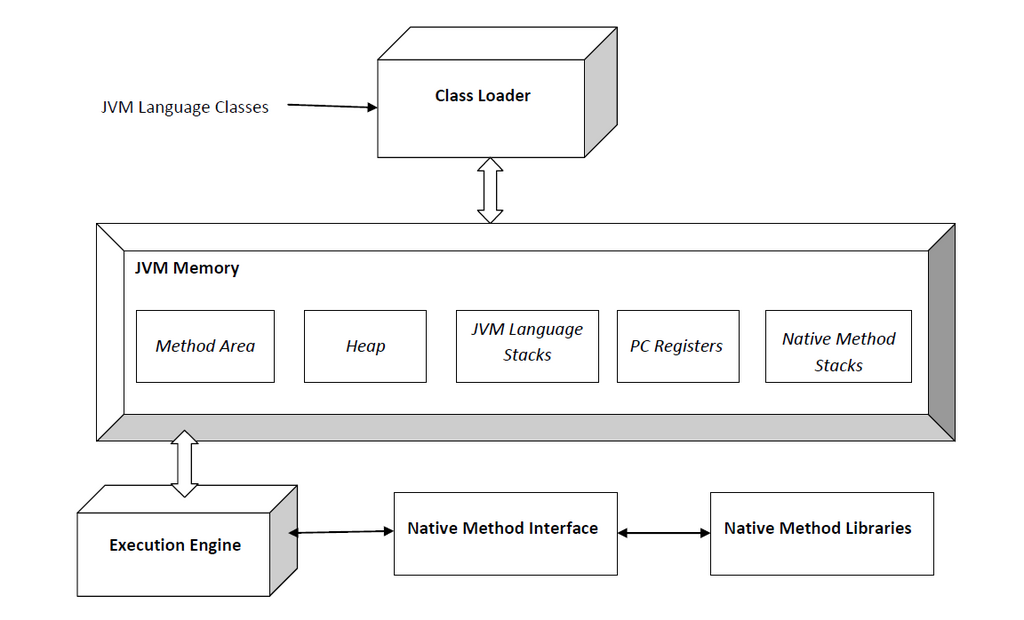
The JVM isn't a single monolithic block. It has three main parts working together:
- Class Loader Subsystem: Responsible for finding, loading, and linking your
.classfiles into memory when they are needed. - Runtime Data Areas: The memory spaces the JVM allocates during program execution. This includes the Heap, Method Area, and Stacks.
- Execution Engine: The component that actually runs the bytecode. It reads the loaded bytecode and executes it, instruction by instruction.
The Execution Engine is where the magic happens. Initially, it interprets the bytecode one line at a time, which is flexible but not very fast. To solve this, the JVM uses a running alongside the interpreter. It identifies "hotspots" — pieces of code that are executed frequently — and compiles them into highly optimized native machine code on the fly. Subsequent calls to that code will then use the fast, compiled version directly.
Memory: Managed vs. Owned
This is the biggest departure from your Rust experience. In Rust, the compiler enforces strict ownership and borrowing rules at compile time to guarantee memory safety without a runtime overhead. You are in full control.
Java operates on a different philosophy. The JVM manages memory for you automatically using a process called (GC). When you create an object, it's allocated on the Heap, one of the runtime data areas. The garbage collector periodically runs in the background, identifying and deleting objects that are no longer in use. You don't need to manually free memory.
Compared to Python's primary garbage collection mechanism (reference counting), the JVM's approach is typically more complex, often using mark-and-sweep algorithms. This allows it to handle reference cycles without issue, something that requires a separate cycle detector in Python.
The trade-off is clear: Java provides memory safety and convenience at the cost of some performance overhead and less predictable memory usage. Rust gives you maximum performance and control at the cost of a steeper learning curve and stricter compile-time rules.
Ready to test your knowledge of these core dynamics?
What is the intermediate format that the Java compiler (javac) produces from .java source files?
How does Java achieve its "Write Once, Run Anywhere" promise?
Understanding the JVM's role as a managed runtime is the key to thinking like a Java developer. It's an abstraction layer that provides portability and safety, shaping how you write and reason about your code.