Japanese Junior High Math Essentials
Numbers and Operations
Working With Integers
Let's start with the basics: integers. These are the whole numbers you know, but they also include their negative counterparts and zero. Think of them laid out on a number line, with zero in the middle. Positive numbers go to the right, and negative numbers go to the left.
Adding a positive number means moving right on the line. Subtracting a positive number (or adding a negative one) means moving left. For example, $5 + (-3)$ is the same as $5 - 3$. You start at 5 and move 3 steps to the left, landing on 2.
What about subtracting a negative number, like $4 - (-2)$? This is like removing a debt. It actually increases your value. So, subtracting a negative is the same as adding a positive: $4 - (-2) = 4 + 2 = 6$.
Key takeaway: Two negatives make a positive. This applies to both subtraction and multiplication.
Multiplication and division follow simple rules based on the signs of the numbers.
| Operation | Result Sign |
|---|---|
| positive × positive | positive |
| negative × negative | positive |
| positive × negative | negative |
| negative × positive | negative |
The same rules apply to division. If the signs are the same, the result is positive. If they're different, the result is negative.
Fractions and Decimals
Fractions and decimals are two ways of talking about parts of a whole. A decimal is really just a special kind of fraction where the denominator is a power of 10, like 10, 100, or 1000. For example, is the same as the fraction , which simplifies to .
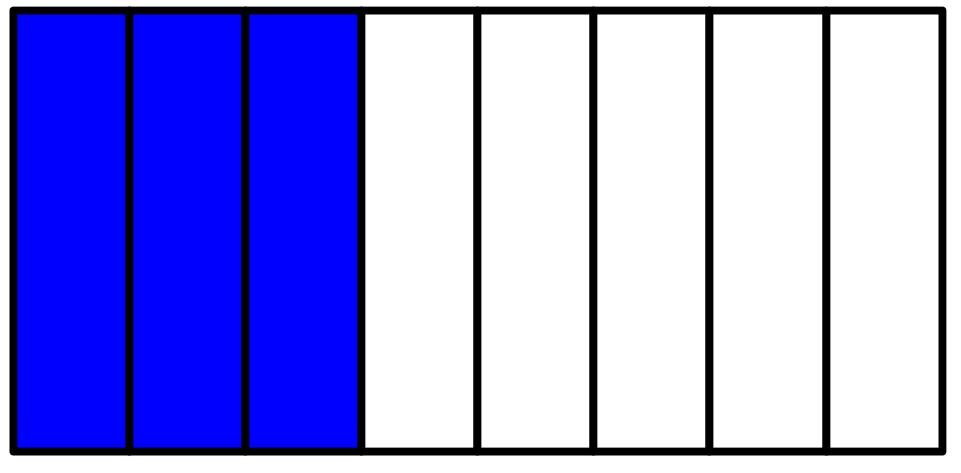
To add or subtract fractions, they must have a common denominator. This means the bottom number of both fractions needs to be the same. You find a common multiple of the two denominators and adjust the numerators to match.
Multiplying fractions is more direct. Just multiply the numerators together and the denominators together.
To divide by a fraction, you multiply by its reciprocal. That means you flip the second fraction upside down and then multiply.
For decimals, the rules are similar to whole numbers. When adding or subtracting, just make sure to line up the decimal points. When multiplying, multiply as usual, then count the total number of decimal places in the original numbers to place the decimal in the answer.
Building Blocks of Numbers
All integers (except 0 and 1) are built from smaller numbers called prime numbers. Understanding these building blocks is key to working with fractions and more advanced math.
factor
noun
A number that divides another number evenly, without a remainder.
A prime number is a positive integer greater than 1 that has exactly two factors: 1 and itself. Numbers like 2, 3, 5, 7, and 11 are prime. Any number that isn't prime is called a composite number.
The number 2 is the only even prime number. All other even numbers are divisible by 2.
We can break down any composite number into a unique product of prime numbers. This is called prime factorization. A factor tree is a great way to find it.
Prime factorization helps us find the Greatest Common Divisor (GCD) and the Least Common Multiple (LCM) of two or more numbers.
The Greatest Common Divisor (GCD) is the largest number that divides into two or more numbers without a remainder.
The Least Common Multiple (LCM) is the smallest number that is a multiple of two or more numbers.
Let's find the GCD and LCM of 12 and 18. First, find their prime factorizations: $12 = 2 × 2 × 3$ $18 = 2 × 3 × 3$
To find the GCD, multiply the prime factors they have in common. Both numbers share one 2 and one 3.
To find the LCM, multiply together the highest power of each prime factor that appears in either factorization. We need two 2s (from 12) and two 3s (from 18).
These concepts are crucial. The LCM, for example, is exactly what you need to find a common denominator for fractions.
What is the result of the calculation ?
To add or subtract fractions, what must be true about them?
These building blocks—integers, fractions, primes, and factors—are the foundation for everything that comes next in mathematics.