Japanese Hiragana and Katakana
Phonetic Fundamentals
The Grid of Sounds
The foundation of Japanese pronunciation is a grid of sounds called the (五十音), which translates to 'fifty sounds'. This system is your map. It logically arranges nearly every sound in the language into a neat 5x10 chart. Mastering this grid is the first step to reading and speaking Japanese fluently, as it connects sounds directly to the characters you'll learn.
The grid is built on five core vowels. Unlike English, Japanese vowels are pure, short, and consistent. There are no tricky diphthongs like the 'ou' in 'house'. Each vowel has one specific sound.
| Vowel | Romanisation | Pronunciation Guide |
|---|---|---|
| あ | a | Like the 'a' in 'father' |
| い | i | Like the 'ee' in 'see' |
| う | u | Like the 'oo' in 'flute', but with unrounded lips |
| え | e | Like the 'e' in 'get' |
| お | o | Like the 'o' in 'boat' |
It's crucial to keep these vowel sounds short and crisp. For example, the 'o' (お) is a quick sound, not drawn out like the English 'oh'. The length of a vowel can completely change a word's meaning, but for now, just focus on this short, standard pronunciation.
Building the Syllables
The Gojuon grid pairs these five vowels with nine consonant sounds: K, S, T, N, H, M, Y, R, and W. This creates rows of syllables. The first row is just the vowels. The second row adds a 'K' sound to each vowel, creating 'ka', 'ki', 'ku', 'ke', 'ko'. It’s a beautifully simple system.
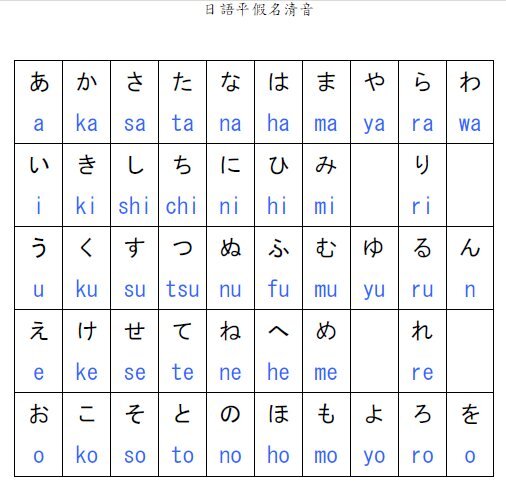
Here is how the first few rows look when mapped out. Notice the pattern: each column is defined by its vowel, and each row by its consonant.
| a | i | u | e | o | |
|---|---|---|---|---|---|
| (vowels) | a | i | u | e | o |
| K | ka | ki | ku | ke | ko |
| S | sa | shi | su | se | so |
| T | ta | chi | tsu | te | to |
Because of its phonetic nature, we will first learn Hiragana to also learn how to pronounce all the sounds in the Japanese language.
The Exceptions
While the grid is mostly regular, you've probably noticed a few odd ones out in the S and T rows. The system has a few quirks where the consonant sound changes slightly depending on the vowel that follows. These aren't mistakes; they're just natural phonetic shifts that have become part of the language.
Here are the main irregulars you need to know:
- shi (し): Instead of 'si', the sound is like the English 'she'.
- chi (ち): Instead of 'ti', the sound is like the 'ch' in 'cheese'.
- tsu (つ): Instead of 'tu', the sound is like the 'ts' in 'cats'.
- fu (ふ): This one is subtle. It's not a hard 'f' sound made with your teeth and lower lip. It's a softer sound, made by blowing air through , almost like blowing out a candle.
There are also a few 'empty' slots in the grid. The sounds 'yi', 'ye', and 'wu' don't exist in modern Japanese, so those positions are left blank. Finally, the consonant 'n' (ん) is unique because it's the only one that can exist without a vowel following it.
Understanding this phonetic map is the key. Every character you will learn in hiragana and katakana corresponds to exactly one of these sounds. Let's get ready to review them.
Time to check your understanding of these core concepts.
What is the Gojuon (五十音)?
Which statement best describes the core Japanese vowels?
With this phonetic foundation, you are now ready to start connecting these sounds to written characters.