Japanese For Holiday Travelers
Japanese Pronunciation Basics
The Five Vowel Sounds
Japanese pronunciation is remarkably consistent, built upon five core vowel sounds. Unlike English, where a single vowel can have multiple pronunciations, in Japanese, each vowel character represents one specific, unchanging sound. Mastering these five sounds is the first and most critical step towards clear communication.
Start with the five vowel sounds (あ, い, う, え, お) as they’re the foundation of hiragana pronunciation.
These sounds are represented by the first five characters of the hiragana script: あ, い, う, え, and お. Let's break down how each one sounds, using English words as a rough guide.
| Hiragana | Romaji | Pronunciation Guide |
|---|---|---|
| あ | a | Like the 'a' in 'father' |
| い | i | Like the 'ee' in 'see' |
| う | u | Like the 'oo' in 'flute', but with unrounded lips |
| え | e | Like the 'e' in 'get' |
| お | o | Like the 'o' in 'go' |
The sound for 'u' (う) is often the trickiest for English speakers. While it's similar to the 'oo' sound, the lips remain relaxed and unrounded. It's a subtle but important distinction for sounding natural.
Vowels in Practice
Once you're comfortable with the individual sounds, you can start combining them into simple words. Notice how the pronunciation of each vowel remains the same, regardless of its position in the word.
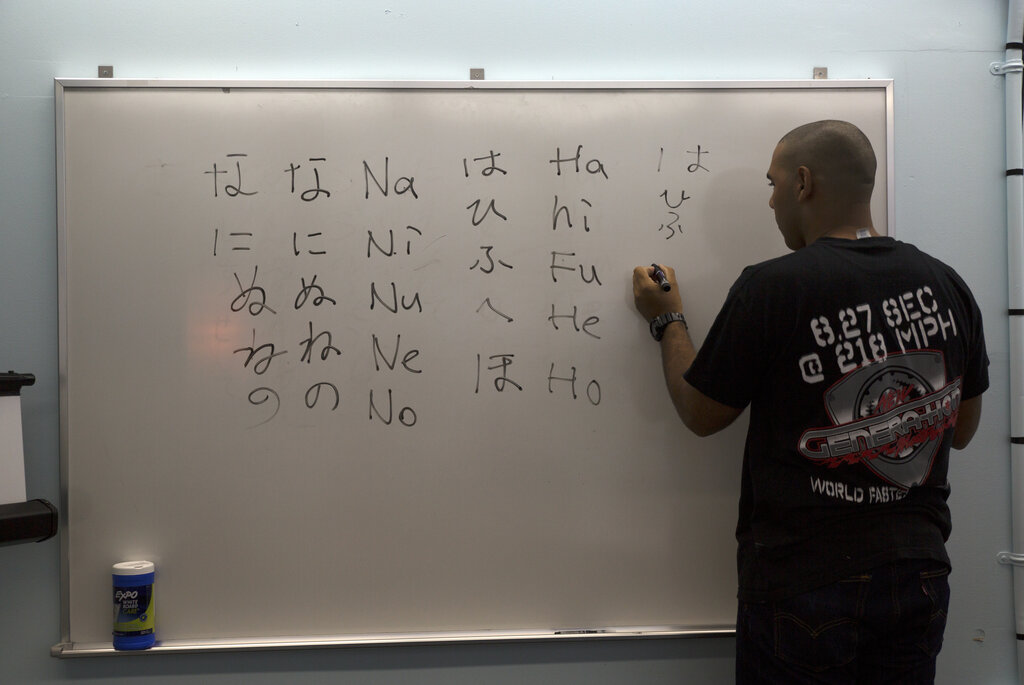
Here are a few examples to listen for and practice saying aloud:
- あい (ai): love
- いえ (ie): house
- うえ (ue): up, above
- あお (ao): blue
Notice how each sound flows into the next without changing its core quality. This phonetic consistency is a key feature of the language.
Short vs. Long Vowels
Another crucial aspect of Japanese pronunciation is vowel length. Some words are distinguished only by whether a vowel is held for a short or long duration. A long vowel is typically held for about twice as long as a short one. In writing, a long 'o' sound is often indicated by adding an 'う' (u) character, while other long vowels are shown by repeating the vowel character.
Getting this wrong can change the meaning of a word entirely.
おばさん (obasan): aunt (short 'a' sound)
おばあさん (obaasan): grandmother (long 'a' sound)
ゆき (yuki): snow (short 'u' sound)
ゆうき (yuuki): courage (long 'u' sound)
Pay close attention to vowel length when listening and speaking. It's a small detail that makes a big difference in comprehension.
How many core vowel sounds form the basis of Japanese pronunciation?
In Japanese, the pronunciation of a vowel character changes depending on the word it's in.