Japan Earthquake Monitoring and Prediction
Introduction to Seismology
What Makes the Ground Shake?
The Earth's surface isn't one solid piece. It's a jigsaw puzzle of enormous rock slabs called tectonic plates. These plates are constantly, slowly moving, grinding against and sliding past one another. The edges of these plates are called faults.
As the plates push against each other, stress builds up in the rock along the fault line. Think of bending a dry stick. You can feel the tension increasing as you bend it further. The rock along a fault behaves similarly, deforming under the immense pressure. This stored energy is called elastic strain.
Eventually, the stress becomes too great for the rock to handle. The rock snaps, and the plates suddenly slip past each other, releasing all that stored energy in an instant. This sudden release of energy creates seismic waves, which travel through the Earth and cause the shaking we feel as an earthquake.
Waves of Energy
The energy released during an earthquake travels outwards from the source in the form of seismic waves. There are two main categories of these waves: body waves, which travel through the Earth's interior, and surface waves, which travel along the ground.
Body waves come in two flavors. The first to arrive are P-waves, or primary waves. They are compressional waves, meaning they push and pull the rock in the same direction they are traveling, much like a Slinky being pushed at one end. They are the fastest seismic waves and can travel through solids, liquids, and gases.
Following the P-waves are the S-waves, or secondary waves. These waves are slower and move the ground up and down or side-to-side, perpendicular to their direction of travel. Imagine flicking one end of a rope. S-waves can only travel through solid rock; they can't pass through the liquid outer core of the Earth.
When body waves reach the surface, they create surface waves, which are the slowest and most destructive. Love waves shake the ground in a side-to-side, horizontal motion, which is particularly damaging to the foundations of buildings. Rayleigh waves make the ground move in a rolling, elliptical motion, like waves on the ocean. It's this combined shaking from surface waves that causes most of an earthquake's destruction.
Listening to the Earth
Scientists who study earthquakes are called seismologists, and they use instruments called seismographs to record the ground's motion. A seismograph produces a recording called a seismogram, which is the zig-zagging line that shows the shaking of the ground over time.
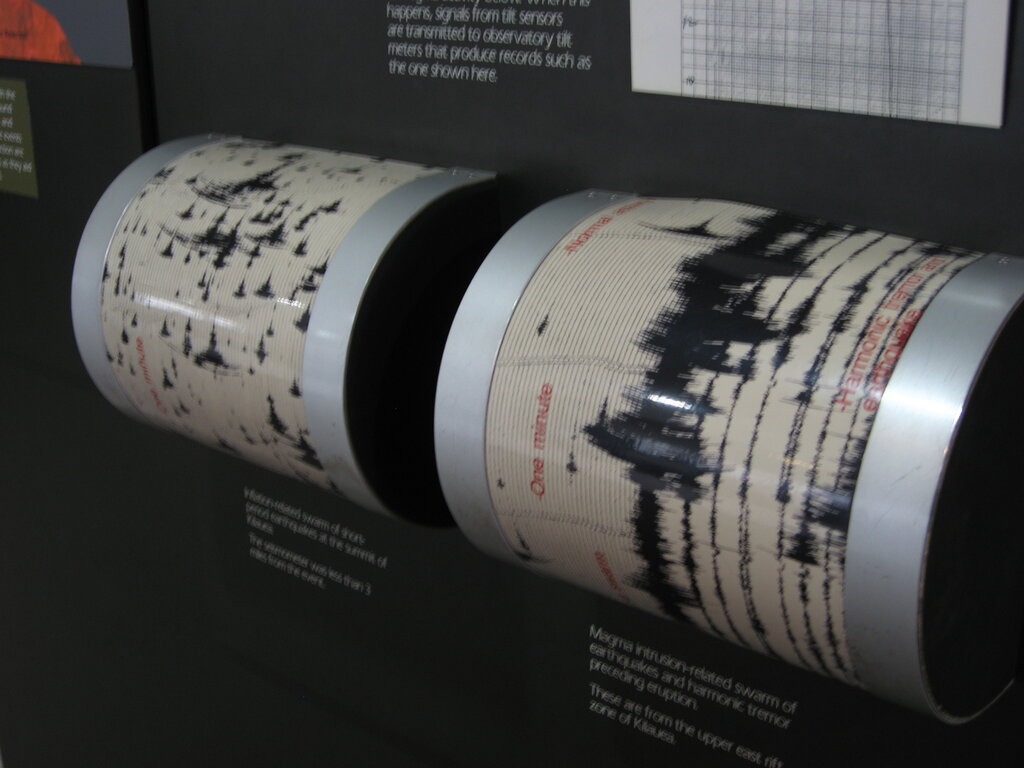
From a seismogram, scientists can determine two key things about an earthquake: its magnitude and its intensity.
- Magnitude measures the energy released at the earthquake's source. It's a single value, most commonly reported using the Moment Magnitude Scale. This scale is logarithmic, meaning a magnitude 6.0 earthquake releases about 32 times more energy than a 5.0.
- Intensity measures the strength of shaking at a specific location and the impact it has on people, buildings, and the environment. The same earthquake will have different intensity values at different places. An intensity scale, like the Modified Mercalli Intensity (MMI) scale, uses descriptive categories from "not felt" to "catastrophic destruction."
Pinpointing the Source
A seismogram doesn't just tell us how big an earthquake was; it also helps us find where it happened. Because P-waves travel faster than S-waves, they will always arrive at a seismograph station first. The greater the time difference between the arrival of the P-waves and the S-waves, the farther away the earthquake is.
By measuring this P-S time interval, seismologists can calculate the distance to the earthquake, but not the direction. To pinpoint the exact location, they need data from at least three different seismograph stations. This process is called triangulation.
Imagine one station tells you the earthquake is 100 miles away. It could be anywhere on a circle with a 100-mile radius. A second station gives its own distance, creating a second circle. These two circles will intersect at two points. Data from a third station provides a third circle, which will intersect one of the previous two points, revealing the earthquake's location.
The point on the Earth's surface directly above where the earthquake began is called the epicenter. The actual point within the Earth where the rock ruptured is called the hypocenter or focus.
Let's review the key terms we've covered.
Now, let's test your knowledge.
What is the primary cause of most earthquakes?
An earthquake's _____ measures the energy released at the source, while its _____ measures the strength of shaking at a specific location.
By understanding what causes earthquakes and how their energy travels, scientists can better assess seismic hazards and work toward mitigating their impact.