ITI Electrician First Year Theory Mastery
Circuit Law Mastery
Putting Laws into Practice
You already know the fundamentals of voltage, current, and resistance. Now, let's move beyond single resistors and apply Ohm's Law to circuits that look more like the ones you'll see on the job. Real-world electrical systems are rarely simple series or parallel lines. They're complex networks where components are interconnected in multiple ways.
To navigate these, we need two key principles developed by Gustav Kirchhoff in the 1840s. These laws aren't replacements for Ohm's Law; they're essential partners that let us analyze any DC circuit, no matter how complicated.
Kirchhoff’s Current Law
Kirchhoff’s Current Law, or KCL, is about how current behaves at a junction. Think of a point where multiple wires meet, which we call a . KCL states that the total amount of current flowing into a node must equal the total amount of current flowing out of it. Electricity doesn't just vanish or build up at a connection point.
Imagine water pipes joining together. The total flow of water entering the junction has to be the same as the total flow leaving it. Electrons in a circuit behave the same way.
This principle is especially useful for analyzing parallel branches. If you know the total current entering a parallel section and the current in all but one branch, you can easily find the unknown current.
For example, if 10 amps flow into a node and 4 amps flow out through one branch, the remaining branches must carry a total of 6 amps out.
Kirchhoff’s Voltage Law
Kirchhoff’s Voltage Law, or KVL, deals with voltage in any closed loop of a circuit. It states that if you trace a path around any closed loop, the sum of all the voltage rises (from sources like batteries) must equal the sum of all the (across components like resistors).
Think of it like walking around a building with multiple floors. If you go up some stairs (voltage rise) and down others (voltage drop) and end up back where you started, your net change in elevation is zero. The same is true for electrical potential in a closed loop.
This law is fundamental for series circuits. The total voltage supplied by the source is divided among all the components in the loop.
Analyzing Series-Parallel Networks
Most circuits are a mix of series and parallel sections. To analyze them, you combine these laws with a strategy of simplification. The goal is to calculate the total equivalent resistance () of the entire network to find the total current from the source. Once you have that, you can work backward to find the individual currents and voltage drops.
Here’s the general approach:
- Identify the parallel parts. Find sections where the current splits. Calculate the equivalent resistance for each parallel group.
- Redraw the circuit. Mentally or on paper, replace each parallel group with its single equivalent resistor.
- Calculate total series resistance. Your simplified circuit is now a simple series circuit. Add up all the resistances (including the equivalent ones you just calculated) to get the total resistance of the network.
- Find the total current. Use Ohm's Law () to find the total current leaving the power source.
- Work backward. Now that you know the total current, you can go back to your simplified circuit diagram to find the voltage drop across each series resistor and each parallel group. Then, use that group voltage and Ohm's law to find the current flowing through each individual branch of the original parallel sections.
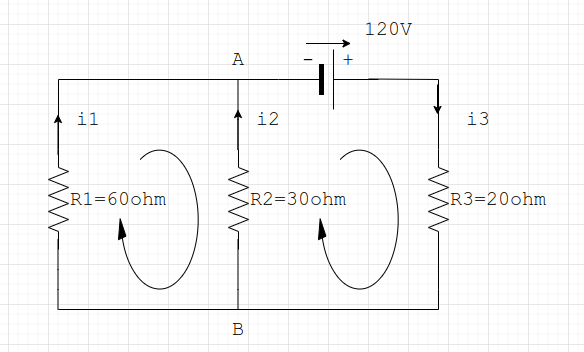
Let's look at the circuit above. Resistors R2 and R3 are in parallel with each other. This parallel combination is in series with resistor R1. To find the total resistance, we'd first find the equivalent resistance of the R2-R3 parallel pair, and then add that value to R1.
What is the fundamental principle of Kirchhoff’s Current Law (KCL)?
Kirchhoff’s Voltage Law (KVL) states that the sum of all voltage rises in a closed loop must equal the sum of all...
Mastering these laws turns a confusing web of wires into a solvable puzzle. By breaking down complex circuits into smaller, manageable parts, you can confidently calculate any value you need for design or troubleshooting.