ITI Electrician First Year Theory Mastery
Circuit Analysis Mathematics
Putting Ohm's Law to Work
You already know the relationship between voltage, current, and resistance: . Now, let's move beyond single resistors and apply this law to solve real-world circuit problems. In complex networks, Ohm's law helps us find unknown values in specific parts of the circuit, like the voltage drop across a single component or the current flowing through one branch.
Consider a simple series circuit with a 12V source and two resistors, and . To find the total current, you first find the total resistance, . In a series circuit, it's just the sum: . Now, use Ohm's law to find the total current: .
Because it's a series circuit, this 2A current is the same through both resistors. We can now calculate the voltage drop across each one individually.
Notice that the individual voltage drops () add up to the total source voltage (12V). This isn't a coincidence; it's the foundation of our next topic.
Kirchhoff's Laws
When circuits get more complex than a simple series or parallel arrangement, Ohm's law alone isn't enough. We need a more powerful set of tools. This is where 's laws come in. They provide a systematic way to analyze any circuit, no matter how tangled it looks.
Kirchhoff's laws are based on the conservation of charge and energy. They ensure that what goes into a circuit must come out, and that all the energy supplied is accounted for.
Kirchhoff’s Current Law (KCL)
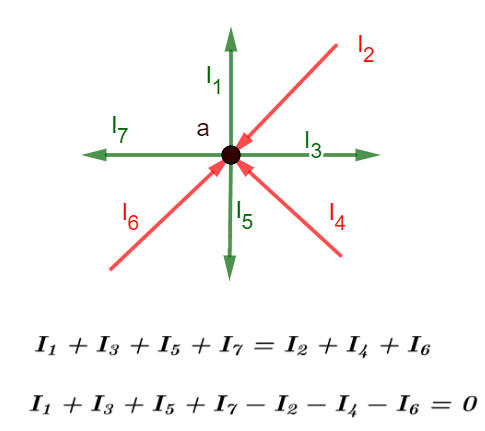
KCL deals with how current behaves at a junction, or a (a point where two or more wires connect). It states that the sum of currents entering a node must equal the sum of currents leaving it. Think of it like plumbing: the amount of water flowing into a pipe junction must equal the amount flowing out. No charge is lost or created at a node.
Kirchhoff’s Voltage Law (KVL)
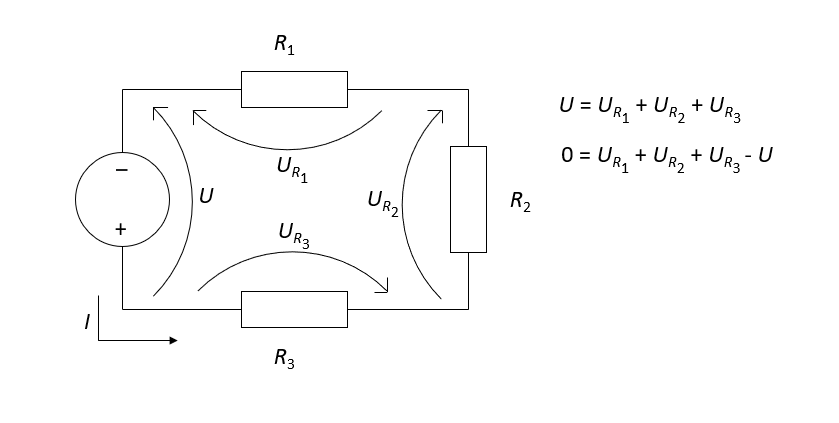
KVL applies to any closed loop in a circuit. It states that the sum of all voltage drops across components in a loop must equal the sum of all voltage sources in that same loop. In simpler terms, the total voltage supplied by the source is used up by the components in the loop. If you trace a path from the positive terminal of a battery, through the circuit, and back to the negative terminal, the net change in voltage is zero.
Solving Complex Circuits
Let's combine these laws to tackle a series-parallel network. The strategy is to simplify the circuit step-by-step until it becomes a simple series or parallel circuit. This is called
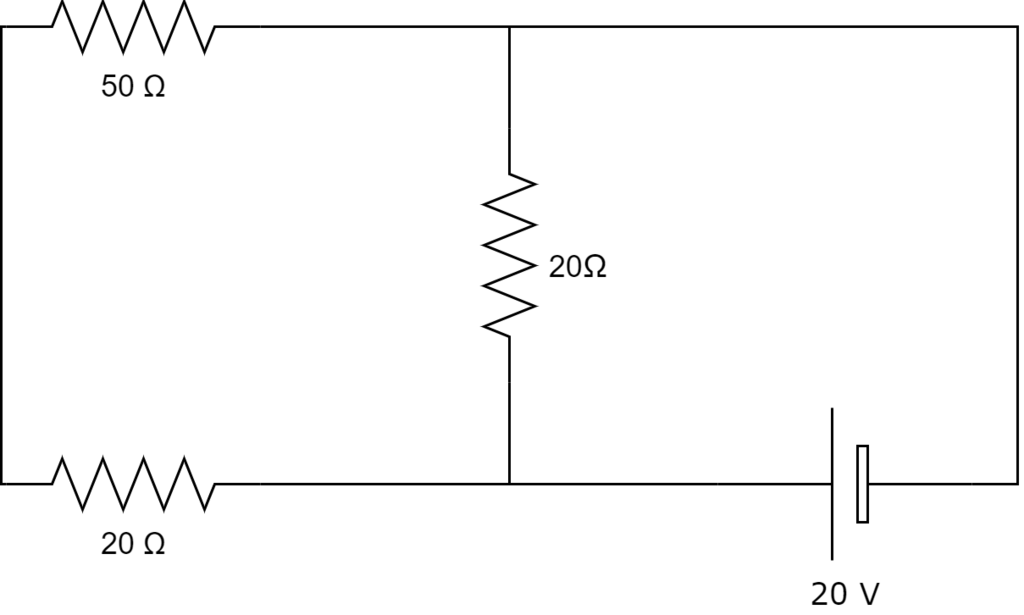
Imagine a 20V source connected to a 50Ω resistor () in series with a parallel branch. The parallel branch contains two 20Ω resistors ( and ).
-
Reduce the parallel branch: First, find the equivalent resistance () of the parallel resistors. The formula for two parallel resistors is:
-
Simplify to a series circuit: Now, our circuit is effectively the 20V source, the 50Ω resistor (), and our new 10Ω equivalent resistor () all in series.
-
Calculate total resistance and current: The total resistance is . The total current from the source is .
-
Work backwards to find voltage drops: This total current (0.333A) flows through . The voltage drop across it is . Using KVL, the remaining voltage must drop across the parallel branch: . This is the voltage across both and .
-
Find branch currents: Now use Ohm's law on the original parallel resistors:
As a check, KCL confirms that the currents leaving the node () equal the current entering it (), accounting for rounding.
Power and Practical Issues
Calculating voltage and current is only part of the job. We also need to know how much power each component consumes or dissipates. Power (), measured in watts, can be calculated using any of these formulas, derived from Ohm's Law:
Using our previous example, the power dissipated by is .
A crucial real-world application of this is understanding in industrial wiring. When you run a long cable to a heavy motor, the cable itself has resistance. The current drawn by the motor causes a voltage drop across this cable. If the drop is too significant, the motor receives a lower voltage than it's rated for, causing it to run inefficiently, overheat, or even fail to start. By calculating the expected voltage drop using Ohm's law (), electricians can select the correct gauge of wire to ensure equipment operates safely and effectively.
In a series circuit with a 12V source and two resistors, and , what is the voltage drop across ?
According to Kirchhoff’s Current Law (KCL), what is true about the currents at a junction (node) in a circuit?
Mastering these mathematical tools transforms you from someone who just connects wires to a true technician who can design, analyze, and troubleshoot complex electrical systems.