Italian Heritage and Modern Identity
Risorgimento and Unification
The Road to a United Italy
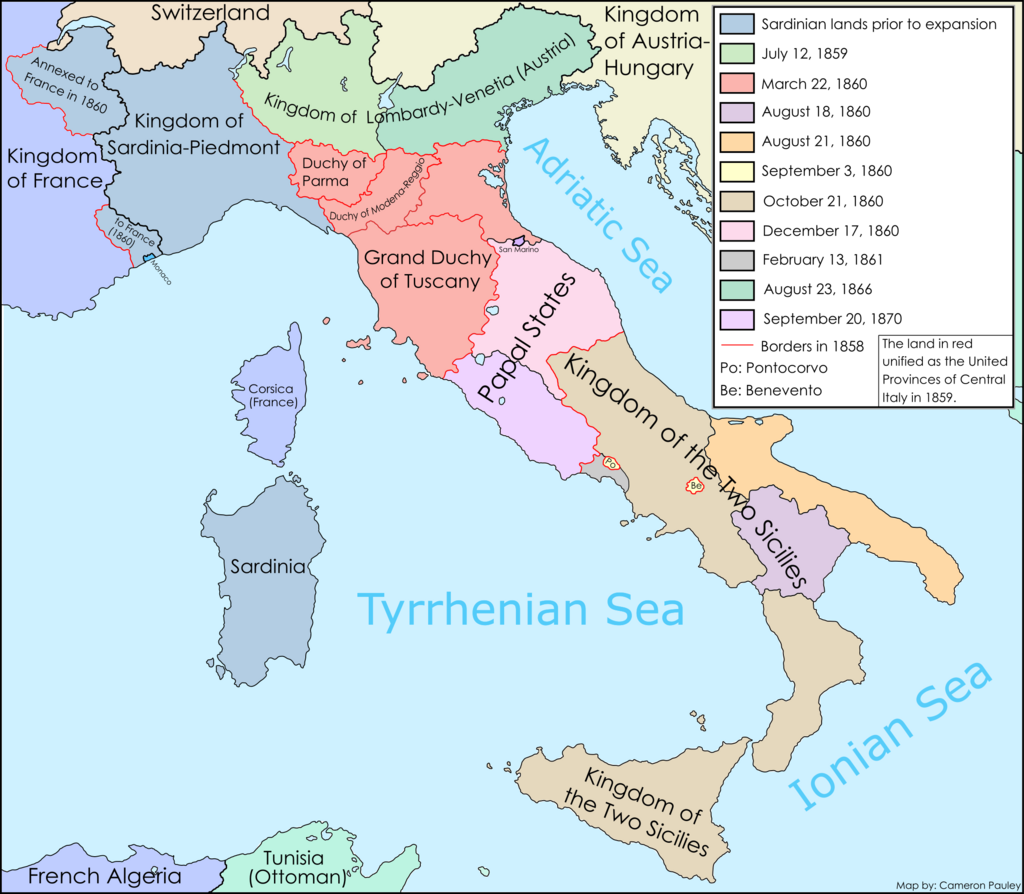
For centuries after the fall of the Roman Empire, the Italian peninsula was a patchwork of kingdoms, duchies, city-states, and papal territories. Foreign powers, particularly Austria and France, exerted heavy influence. The idea of a single, unified Italy was mostly a dream shared by poets and intellectuals. In the 19th century, this dream ignited into a political movement known as the Risorgimento, or "resurgence."
This movement wasn't a single, unified effort. It was a messy, decades-long struggle driven by competing ideologies and powerful personalities. The central question wasn't just if Italy could be united, but how it should be governed: as a monarchy led by a king, or as a republic built by the people.
Three Men, One Goal
Three key figures embody the different forces that shaped modern Italy. They rarely agreed on methods, but their combined efforts made unification possible.
First, there was Camillo Benso, Count of Cavour, the brilliant and pragmatic Prime Minister of the Kingdom of Piedmont-Sardinia. Cavour was the architect of unification from the top down. He wasn't a romantic revolutionary; he was a master of realpolitik, a political philosophy focused on practical power rather than ideology. His goal was to expand Piedmont's influence by modernizing its economy, building railways, and engaging in clever diplomacy. He allied with France to drive Austrian forces out of Northern Italy in 1859, a crucial first step.
Then there was Giuseppe Mazzini, the movement's ideological soul. A passionate writer and activist, Mazzini believed in a unified, republican Italy created by a popular uprising. He founded the secret society "Young Italy" to spread his ideas of nationalism and democracy. While his revolutionary attempts often failed, his writings inspired a generation of Italians to believe in the possibility of a nation.
Finally, there was Giuseppe Garibaldi, the charismatic military hero. A follower of Mazzini in his youth, Garibaldi was a man of action. He was the sword of unification, leading volunteer armies in brilliant, daring campaigns. While he shared Mazzini's republican sympathies, he was ultimately a pragmatist willing to compromise for the sake of a united Italy.
Through a combination of diplomacy (Cavour) and military action (Garibaldi), Italy unified from a patchwork of states and kingdoms into a single nation-state in 1861.
Unification by Sword and State
While Cavour maneuvered on the diplomatic stage, Garibaldi took direct action. In 1860, he launched his most famous campaign: the Expedition of the Thousand. With about a thousand red-shirted volunteers, he sailed from Genoa to Sicily to support a local revolt against the Bourbon king of the Kingdom of the Two Sicilies.
His campaign was astonishingly successful. The "Thousand" (whose numbers swelled with local recruits) defeated the larger Bourbon army and took control of Sicily. Garibaldi then crossed to the mainland and marched on Naples. The Bourbon kingdom crumbled.
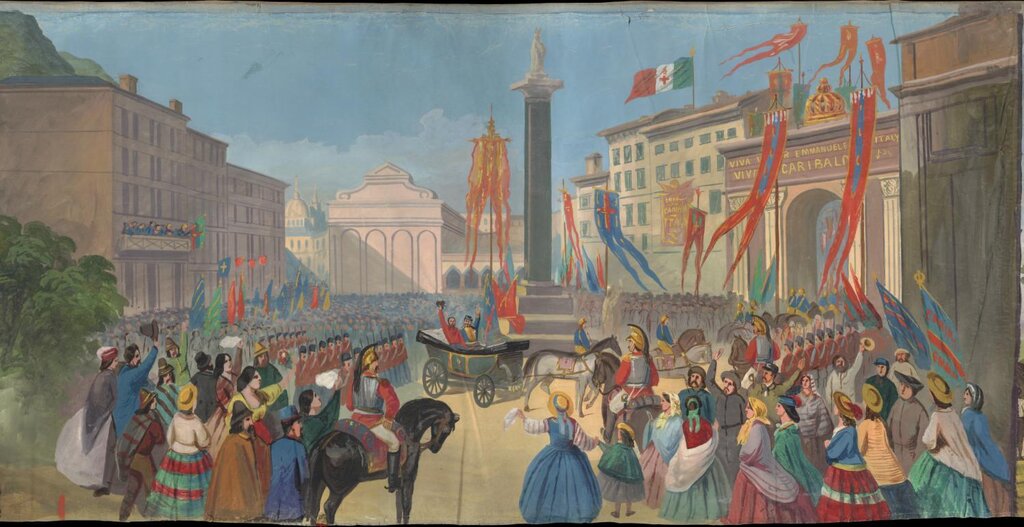
This created a tense situation. Garibaldi, a republican hero, now controlled half of Italy. Cavour, a monarchist, feared Garibaldi might march on Rome and establish a republic, which would alienate Catholic powers and unravel his carefully laid plans. Cavour sent the Piedmontese army south, not to fight Garibaldi, but to meet him. At a historic meeting, Garibaldi handed his conquests over to King Victor Emmanuel II of Piedmont-Sardinia, declaring, "I salute the first King of Italy." He chose unity under a king over his own republican ambitions.
One Nation, Many Problems
On March 17, 1861, the Kingdom of Italy was officially proclaimed, with Victor Emmanuel II as its king. However, the work was far from over. Venetia was still controlled by Austria (it would be annexed in 1866), and Rome remained under the Pope's control, protected by a French garrison.
The new nation also faced deep internal divisions. The process of unification was less a merger of equals and more of an expansion of Piedmont-Sardinia. This policy, known as , imposed the laws, administrative structures, and even tax systems of the northern kingdom onto the rest of the peninsula. Many in the south, which had a different history and economic structure, felt more conquered than liberated. This created a lasting north-south divide and fueled resentment.
The imposition of Piedmontese law and tax structures on diverse regions set the stage for future internal tensions.
The final piece fell into place due to events elsewhere in Europe. The ""—the dispute over the temporal power of the Pope and the status of Rome—was resolved by the Franco-Prussian War of 1870. When France needed its troops to fight Prussia, it withdrew its garrison from Rome. The Italian army entered the city, which then became the capital of a finally united Italy. The Papal States ceased to exist, and the Pope's temporal power was confined to the Vatican.
Now, let's test your understanding of how this complex process unfolded.
Who is considered the 'architect' of Italian unification, known for his pragmatic use of diplomacy and realpolitik as Prime Minister of Piedmont-Sardinia?
What famous military campaign, led by Giuseppe Garibaldi and his red-shirted volunteers, was instrumental in conquering the Kingdom of the Two Sicilies?
The unification of Italy was a monumental achievement, but the compromises made and the conflicts it created would shape the nation's politics and society for the next century.