ISS Engineering and Operations
Integrated Truss Mechanics
The Station's Backbone
The International Space Station isn't a single object but a collection of modules connected by a massive frame. This framework, the (ITS), is the station's functional backbone. It stretches 108 meters, roughly the length of an American football field, providing the structural support necessary to hold everything together in the vacuum of space.
The ITS is composed of 11 distinct segments. These segments are labeled based on their location relative to the station's center and direction of travel. Segments on the right side are designated 'S' for Starboard, while those on the left are 'P' for Port. A single, special segment, the Z1, is mounted in the 'Zenith' position, meaning it points directly away from Earth.
A Utility Superhighway
The ITS is much more than a simple scaffold. It functions as a complex utility bus, a superhighway for the resources that keep the station and its crew alive. Integrated channels and mounting points along its entire length carry vital conduits.
These include:
- Power Lines: Heavy-gauge wiring transmits electricity from the massive solar arrays to the rest of the station.
- Data Cables: Fiber optic and ethernet cables carry command, telemetry, and scientific data between modules and experiments.
- Cooling Lines: Pipes circulate liquid ammonia to collect waste heat from electronics and modules, transferring it to radiators that dissipate it into space.
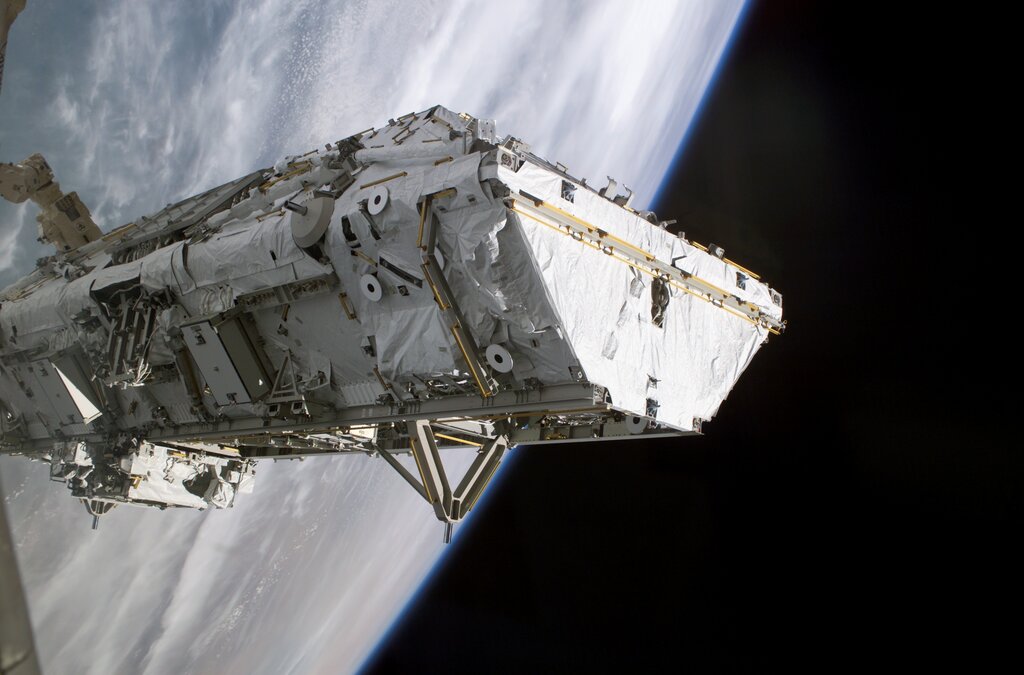
This integrated design is critical for efficiency and resilience. By routing all major utilities along a single, accessible structure, maintenance and upgrades during spacewalks become far more manageable. Astronauts can traverse the truss to access and repair specific lines without needing to interfere with the pressurized modules.
The Central Hub
At the very center of this structure lies the S0 truss. It's the keystone, connecting the port and starboard truss segments and, most importantly, serving as the primary structural interface to the station's pressurized modules via the Destiny Laboratory. This makes S0 the critical junction point where the external 'unpressurized' world of the truss meets the internal 'pressurized' world of the crew.
A truss is a plane that takes advantage of the inherent geometric stability of triangles. It distributes weight in harmony and handles changing compressions and tension.
The S0 truss also supports some of the heaviest and most dynamic external hardware. The Mobile Transporter (MT) is a railcar that rides along tracks on the S0, P1, and S1 segments, carrying the Canadarm2 robotic arm to worksites along the truss. The constant movement of this 885-kilogram platform, especially when carrying heavy payloads, introduces significant dynamic loads and vibrations that the truss structure must safely absorb.
The Z1 truss, mounted atop S0, played a vital role in the station's early assembly. Before the main solar arrays were delivered, the Z1 provided a temporary mounting point for the first U.S. solar array wings. Today, it continues to house crucial gyroscopes for attitude control and serves as a key routing point for communications equipment and power systems.
Maintaining structural integrity across this enormous, load-bearing span is a major engineering challenge. The truss must withstand the stresses of docking spacecraft, the torque from its own gyroscopes, and the thermal expansion and contraction caused by cycling in and out of Earth's shadow every 90 minutes. Its design allows it to flex and dampen these forces, ensuring the station remains a stable platform for science.
Let's test your understanding of the station's backbone.
What is the primary dual function of the Integrated Truss Structure (ITS) on the International Space Station?
The central segment of the truss that connects the port and starboard sides and interfaces with the pressurized modules is known as the _____ truss.
The Integrated Truss Structure is a masterpiece of engineering, enabling the ISS to function as a cohesive whole.