ISO Carbide Insert Codes Decoded
Insert Shapes
The Shape of the Cut
The first letter in an ISO turning insert code tells you its shape. This isn't just a label; the geometry of an insert is the single biggest factor in determining its strength and what kind of job it's suited for. A key aspect of an insert's shape is its included angle, or nose angle. This is the angle of the cutting corner.
A larger included angle means a stronger cutting edge. A smaller angle means a weaker but more precise cutting edge.
Think of it like kitchen knives. A heavy cleaver with a thick, wide blade is great for chopping through bone, but you wouldn't use it for delicate peeling. For that, you need a paring knife with a fine, sharp point. Turning inserts follow the same principle. Let's look at the most common shapes.
Strength vs Versatility
The included angle directly impacts the strength of the cutting corner. A wider angle distributes cutting forces over a larger area, making the insert more robust.
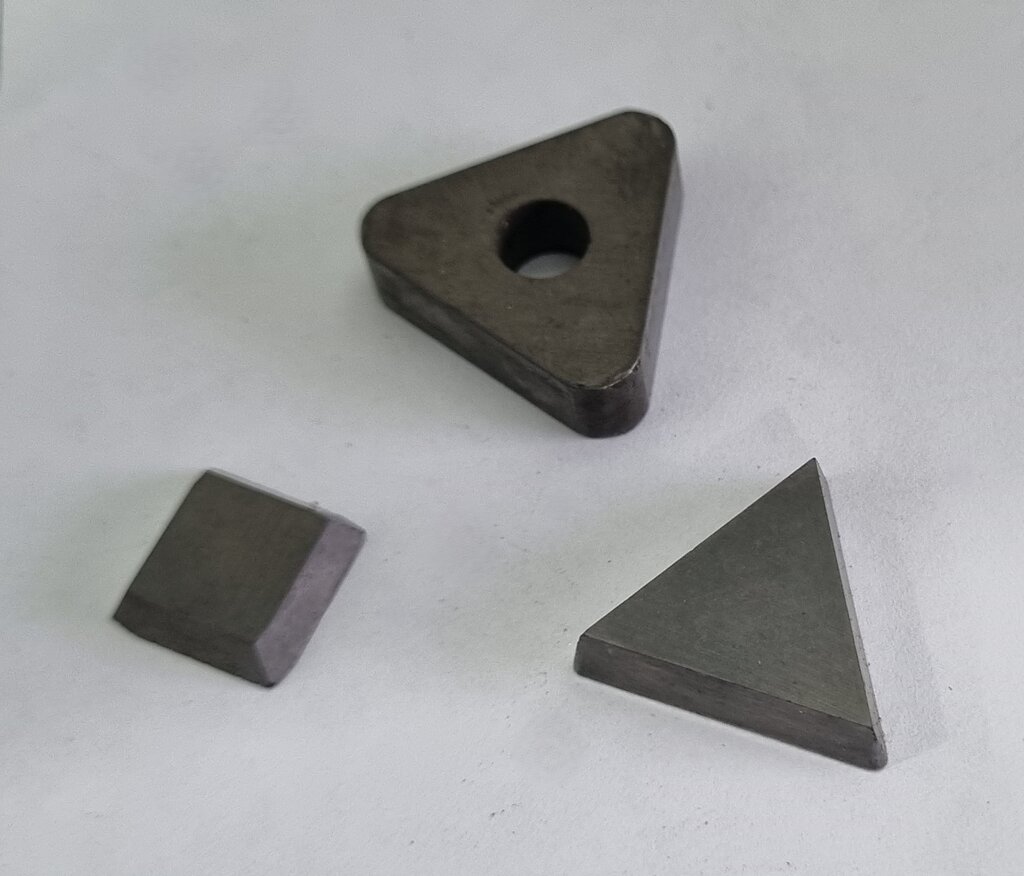
S (Square) inserts have a 90° angle, giving them a very strong cutting edge. This makes them ideal for roughing operations where you need to remove a lot of material quickly. The downside is that the large angle creates higher cutting forces, which can lead to vibration.
C (80° Diamond) and W (80° Trigon) inserts are popular, versatile choices. Their 80° angle provides a great balance of strength and sharpness. They are the workhorses of many machine shops, suitable for both roughing and finishing cuts in a wide range of applications.
T (Triangle) inserts have a 60° angle. They are less strong than square or 80° inserts but offer more clearance, allowing them to get into corners and perform profiling tasks that a square insert can't.
D (55° Diamond) inserts are a common choice for finishing and semi-finishing. Their smaller angle allows for more detailed profiling work than a T-shape.
V (35° Diamond) inserts have the smallest included angle of the common types. This makes them the weakest but also the most precise. They are used for finishing cuts, creating fine details, and machining complex profiles where other inserts simply won't fit.
Choosing the Right Shape
When selecting an insert, the rule of thumb is to choose the largest included angle possible that can still perform the required operation. This maximizes the tool's strength and reliability.
| Shape (Letter) | Included Angle | Strength | Primary Use |
|---|---|---|---|
| Square (S) | 90° | Very High | Roughing, Facing |
| Trigon (W) | 80° | High | General Purpose |
| Diamond (C) | 80° | High | General Purpose |
| Triangle (T) | 60° | Medium | Semi-finishing |
| Diamond (D) | 55° | Medium-Low | Finishing, Profiling |
| Diamond (V) | 35° | Low | Fine Finishing |
If your job is to simply reduce the diameter of a straight shaft (a basic turning operation), a strong S-shape insert is an excellent choice. But if you need to cut a groove or trace a complex contour, you'll need an insert with a smaller, more acute angle, like a D or V shape, to reach into the tight spaces.
What is the primary trade-off when selecting a turning insert with a smaller included angle (like a V-shape) over one with a larger angle (like an S-shape)?
For a heavy roughing operation on a large, straight shaft where the goal is to remove as much material as quickly as possible, which insert shape would be the strongest and most appropriate choice?
Understanding these basic shapes is the first step in decoding ISO inserts and choosing the right tool for the job.