IRR and Investment Theory
Investment Theory Basics
Why Money Now Is Worth More
Imagine a choice: you can have $100 today or $100 one year from now. Which would you pick? Most people would take the money today. It’s not just about impatience; it’s about opportunity. A dollar in your hand right now is worth more than a dollar you have to wait for. This is the core idea behind the time value of money.
Money you have today can be invested to earn more money. If you take the $100 and put it in a savings account with a 5% annual interest rate, you'll have $105 in a year. The $100 you were offered a year from now is still just $100. Your choice to take the money sooner made you $5 richer. This potential to earn a return is what gives today's money its extra value.
The time value of money states that a sum of money is worth more now than the same sum will be at a future date due to its earnings potential.
This concept is captured in a fundamental formula that calculates the future value () of an investment. It looks at the present value (), the interest rate (), and the number of periods ().
This isn't just for savings accounts. Investors use this principle to compare potential projects. They need to know if the future earnings from an investment are valuable enough to justify spending their money today. It helps answer the question: Is the future reward worth the present cost?
Risk and Return
Every investment carries some level of uncertainty. You might get back more than you put in, or you might get back less. This uncertainty is called risk. The extra money you hope to make from the investment is the return. In the world of finance, these two ideas are inseparable.
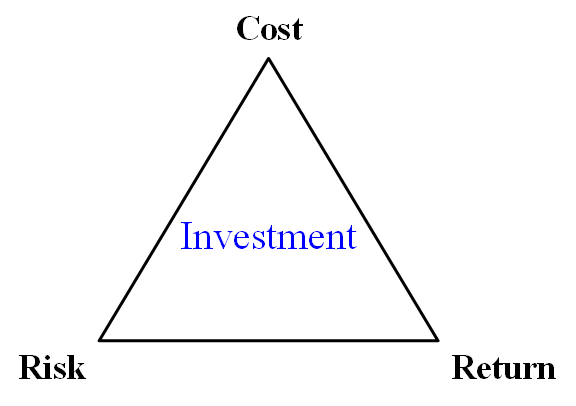
Generally, investments with higher potential returns also come with higher risk. A government bond is considered very safe, but its return is typically low. You’re very likely to get your money back with a little bit of interest. On the other hand, investing in a brand-new tech startup could potentially make you a fortune, but there's also a high chance the company could fail and you could lose your entire investment.
This relationship is often called the risk-return tradeoff. There's no such thing as a high-return, no-risk investment. Investors must decide how much risk they are comfortable taking in pursuit of a certain level of return. This choice depends on their financial goals, time horizon, and personal tolerance for uncertainty.
Follow the Cash
When evaluating an investment, it’s tempting to focus only on profit. But profit can be a tricky number, influenced by accounting rules. A more concrete way to judge an investment's health is by looking at its cash flow: the actual money moving in and out of a project or business.
cash flow
noun
The net amount of cash and cash-equivalents being transferred into and out of a business.
Cash flow analysis tracks this movement over time. It starts with an initial investment, which is a cash outflow (a negative number). Then, over the life of the investment, you track all the cash inflows (positive numbers) it generates, like revenue from sales. You also track any additional outflows, like maintenance costs.
Let’s say you buy a vending machine for $3,000. That’s your initial cash outflow. Each year, you collect $1,000 in sales (inflow) but spend $200 on inventory and upkeep (outflow). Your net cash flow for the year is $800.
| Year | Action | Cash Inflow | Cash Outflow | Net Cash Flow |
|---|---|---|---|---|
| 0 | Buy Machine | $0 | $3,000 | -$3,000 |
| 1 | Operate Machine | $1,000 | $200 | +$800 |
| 2 | Operate Machine | $1,000 | $200 | +$800 |
| 3 | Operate Machine | $1,000 | $200 | +$800 |
Investors, lenders and other creditors expectations about returns depend on their assessment of the amount, timing and uncertainty of (the prospects for) future net cash inflows to the entity.
This simple table tells a powerful story. It shows not just how much money is being made, but when. Understanding the timing of cash flows is critical. It allows investors to use principles like the time value of money to accurately weigh the value of those future earnings against the initial cost.
Ready to test your knowledge on these core investment ideas? Let's see what you've learned.
What is the core principle behind the 'time value of money'?
According to the risk-return tradeoff, an investment with a high potential return is likely to have low risk.
These three concepts—the time value of money, the risk-return tradeoff, and cash flow analysis—are the bedrock of investment theory. They provide a framework for making smart, informed decisions about where to put your money.