IoT System Design Fundamentals
IoT Architecture Overview
The Blueprint of a Connected World
Every Internet of Things (IoT) system, from a smart thermostat in your home to a network of sensors in a factory, is built on a foundational plan. This plan, or architecture, dictates how all the different pieces connect and communicate. Think of it as the blueprint that ensures a sensor in a field can successfully send its data to an app on your phone.
The Core Components
At its heart, a typical IoT system is made up of three main parts: the devices that sense the world, a gateway to bridge the gap, and the cloud where the real thinking happens. The flow of information is a one-way street from the device, through the gateway, and up to the cloud for processing.
Let’s break down each part.
1. Devices (The “Things”): These are the sensors and actuators that interact with the physical world. A sensor collects data, like temperature or motion. An actuator performs an action, like unlocking a door or turning on a light. They are the eyes, ears, and hands of the IoT system.
2. Gateway: Many IoT devices use low-power, short-range communication methods (like Bluetooth or Zigbee) to save battery. They can't connect directly to the internet. The gateway acts as a bridge. It gathers data from nearby devices and relays it to the cloud using a standard internet connection, like Wi-Fi or cellular.
3. Cloud: This is the powerful brain of the operation. Cloud services receive, store, and process the vast amounts of data sent from the gateways. This is where data is analyzed for insights, and where applications are run. When you check your smart home app, you're interacting with data processed in the cloud.
A Layered Approach
To manage this complexity, IoT architecture is often visualized as a series of layers, each with a specific job. This separation of concerns makes it easier to build and maintain the system. While models vary, a common approach uses four distinct layers.
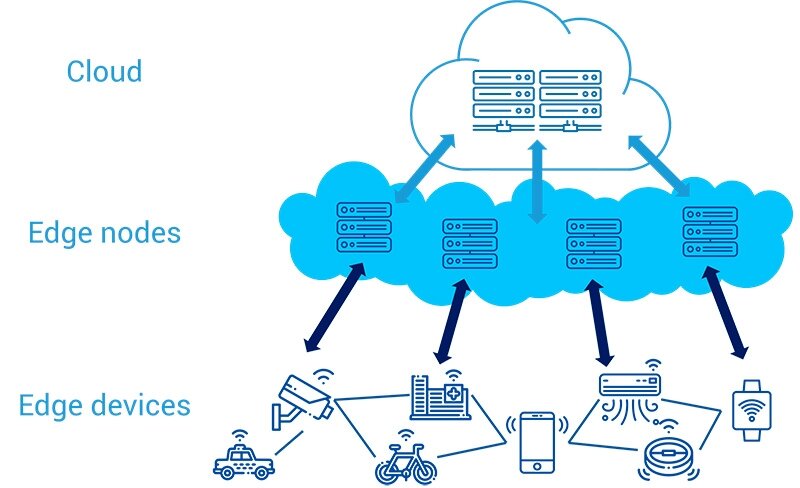
Device Layer: This is the physical hardware—the sensors and actuators gathering data or performing actions. It's the foundation of the entire system.
Connectivity Layer: This layer is all about data transmission. It includes the local connections between devices and gateways, and the internet connection from the gateway to the cloud. Its job is simply to move data from point A to point B.
Processing Layer: Also known as the cloud layer, this is where data is stored, managed, and analyzed. Powerful servers run complex algorithms to make sense of the incoming information, turning raw data into valuable insights.
Application Layer: This is the layer you interact with. It's the mobile app, web dashboard, or control panel that presents the data in a useful way and allows you to control the IoT devices. It makes the processed data meaningful to a human user.
Each layer has one job, and they work together to turn raw sensor data into useful action.
Now that you understand the basic structure, let's test your knowledge.
What is the primary role of the Gateway in an IoT system?
In a smart factory, a machine that performs a physical action, like turning a valve, is known as an _______.
Understanding this layered architecture is the first step in designing and building effective IoT solutions that can connect our world in new ways.