Ionization Energy of First Transition Metals
Atomic Structure
The Building Blocks of Matter
Everything around you, from the air you breathe to the screen you're reading this on, is made of atoms. Atoms are the fundamental units of chemical elements like oxygen, carbon, and gold. For a long time, people thought atoms were the smallest possible things, but we now know they're made of even smaller, or subatomic, particles.
At the center of every atom is a dense core called the nucleus. This is where most of the atom's mass is concentrated. Whizzing around the nucleus is a cloud of much lighter particles. Let's meet the three key players.
Proton
noun
A subatomic particle with a positive electrical charge, found within the atomic nucleus. The number of protons determines an element's identity.
Neutron
noun
A subatomic particle with no electrical charge (it's neutral), found within the atomic nucleus. Neutrons add mass to the atom but don't change its chemical identity.
Electron
noun
A subatomic particle with a negative electrical charge that moves in the space surrounding the nucleus. Electrons are involved in forming chemical bonds.
Protons and neutrons are bound together tightly in the nucleus. The much lighter electrons occupy a large volume of space around the nucleus. Since protons are positive and electrons are negative, they attract each other, which keeps the atom together. In a neutral atom, the number of electrons equals the number of protons, balancing the charges perfectly.
Electron Neighborhoods
Electrons don't just zoom around the nucleus randomly. They are organized into specific energy levels called shells. Think of it like a building with different floors. Electrons on the first floor (the shell closest to the nucleus) have the lowest energy. Electrons on higher floors have more energy.
Each shell can only hold a certain number of electrons. The first shell can hold up to 2 electrons, the second can hold 8, the third can hold 18, and so on. This arrangement is fundamental to understanding how atoms behave.
The arrangement of electrons in an atom's shells is called its electron configuration.
But the story gets a bit more detailed. Each shell, or energy level, is divided into one or more subshells. These are like different types of apartments on each floor of our building. Subshells are designated by the letters s, p, d, and f.
Orbitals The Rooms for Electrons
Within each subshell are regions of space where an electron is most likely to be found. These regions are called orbitals. Continuing our analogy, these are the individual rooms within each apartment. A crucial rule is that each orbital can hold a maximum of two electrons.
The subshells have a specific number of orbitals:
- An s subshell has 1 orbital (holding up to 2 electrons).
- A p subshell has 3 orbitals (holding up to 6 electrons).
- A d subshell has 5 orbitals (holding up to 10 electrons).
- An f subshell has 7 orbitals (holding up to 14 electrons).
These orbitals also have distinct shapes, which influence how atoms bond with each other.
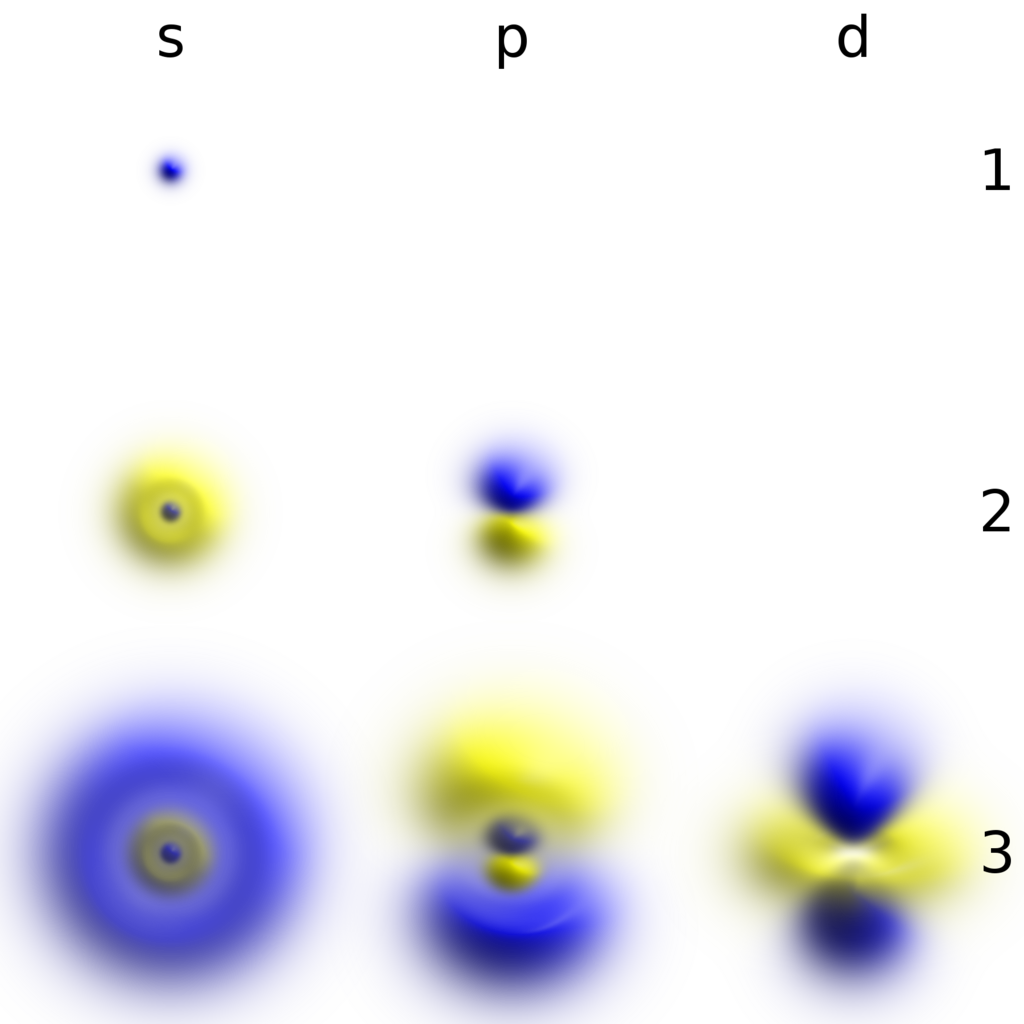
Electrons fill these orbitals in a specific order, starting with the lowest energy level first. They fill the 1s orbital, then the 2s, then the 2p, and so on. This predictable filling order is what gives the periodic table its structure.
Let's put it all together. A carbon atom has 6 electrons. Its electron configuration would be written as $1s^2 2s^2 2p^2$. This notation tells us:
- There are 2 electrons in the 1s orbital (first shell).
- There are 2 electrons in the 2s orbital (second shell).
- There are 2 electrons in the 2p orbitals (second shell).
This setup—a nucleus of protons and neutrons surrounded by electrons in specific shells, subshells, and orbitals—is the basic structure of every atom in the universe.
Ready to check your understanding of the atom's inner workings?
What are the three main subatomic particles that make up an atom?
True or False: In a neutral atom, the number of protons is equal to the number of electrons.
Knowing these fundamentals of atomic structure is the first step toward understanding why different elements have such unique properties and behaviors.