Investing in Small Modular Reactors
Introduction to SMRs
A New Scale for Nuclear Power
When you think of a nuclear power plant, you probably picture a massive, sprawling facility with huge cooling towers. For decades, that was accurate. But a new approach is changing the landscape of nuclear energy: Small Modular Reactors, or SMRs.
Small Modular Reactors (SMRs) are compact nuclear power plants that offer various advantages for energy generation in a sustainable way.
The name tells you the two most important things about them.
Small: SMRs generate less power than their traditional counterparts, typically defined as producing under 300 megawatts of electricity (MWe). For comparison, a conventional nuclear reactor often generates 1,000 MWe or more, enough to power a large city. An SMR might power a small town, a remote industrial site, or a large military base.
Modular: This is the key innovation. Instead of being built piece-by-piece on-site over many years, the major components of an SMR are manufactured in a factory. They are then transported to the power plant location and assembled. This process is more like building a car on an assembly line than constructing a skyscraper.
How SMRs Differ
The differences between SMRs and traditional reactors go far beyond just size and construction method. These distinctions lead to fundamental changes in how they are deployed, operated, and secured.
| Feature | Traditional Reactor | Small Modular Reactor |
|---|---|---|
| Power Output | 1,000+ MWe | Typically < 300 MWe |
| Physical Size | Large footprint (many acres) | Small footprint |
| Construction | Stick-built on-site over years | Factory-fabricated, assembled on-site |
| Location | Requires large water source, away from cities | More flexible, can be sited closer to demand |
| Safety Systems | Active systems (pumps, external power) | Passive systems (gravity, natural circulation) |
| Scalability | One large unit | Can add modules as demand grows |
The smaller size and modular build make SMRs more flexible. Because they don't require as much land or cooling water, they can be built in a wider variety of locations, including places that could never support a giant, traditional plant. They can also be scaled up over time. A utility could install one module to start and then add more later if energy needs increase.
Simpler and Safer by Design
SMRs aren't just shrunken-down versions of old designs. They are engineered from the ground up with different principles in mind, primarily simplicity and safety.
Many SMR designs integrate the reactor core, steam generators, and pressurizers into a single vessel. This reduces the amount of piping and the number of potential failure points.
Perhaps the most significant design feature is the emphasis on passive safety. Traditional reactors often rely on active safety systems—things like large, powerful pumps that need electricity to circulate coolant and prevent overheating. If the plant loses power, these systems need backup diesel generators to function.
SMRs, on the other hand, are designed to use natural forces. In many designs, if the reactor needs to be shut down, cooling happens automatically through gravity, natural convection, and pressure differences. No pumps, no external power, and no human intervention is needed to keep the reactor in a safe state.
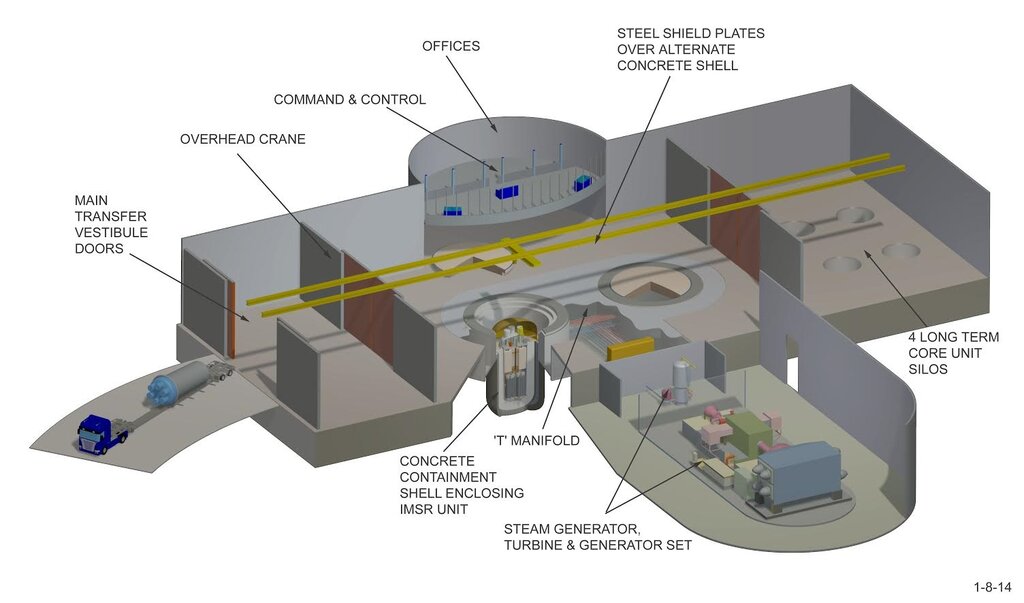
These core principles—small size, modularity, and passive safety—are what define this new generation of nuclear technology. They open up possibilities for cleaner energy in more places, with a different approach to construction and safety.
Now, let's check your understanding of these core concepts.
What is the typical maximum power output that defines a Small Modular Reactor (SMR)?
The "modular" aspect of SMRs primarily refers to which of the following processes?
By rethinking scale and design, SMRs present a new path forward for nuclear energy, built on factory precision and inherent safety.