Investing in Quantum Computing
Quantum Mechanics Basics
The Quantum Realm
At our scale, the world is predictable. A dropped ball falls down, a flipped coin lands as heads or tails. But shrink down to the size of atoms and electrons, and you enter a world where the rules are completely different. This is the realm of quantum mechanics, and it's built on a few core ideas that challenge our everyday intuition.
Waves and Particles in One
One of the most mind-bending ideas is wave-particle duality. In our world, something is either a particle, like a grain of sand, or a wave, like a ripple in a pond. In the quantum world, things can be both at the same time.
A classic experiment shows this in action. If you fire a stream of electrons, one by one, at a barrier with two thin slits, you might expect to see two lines of electron impacts on a screen behind it. Instead, you get a pattern of many lines, like the interference pattern created when two waves overlap.
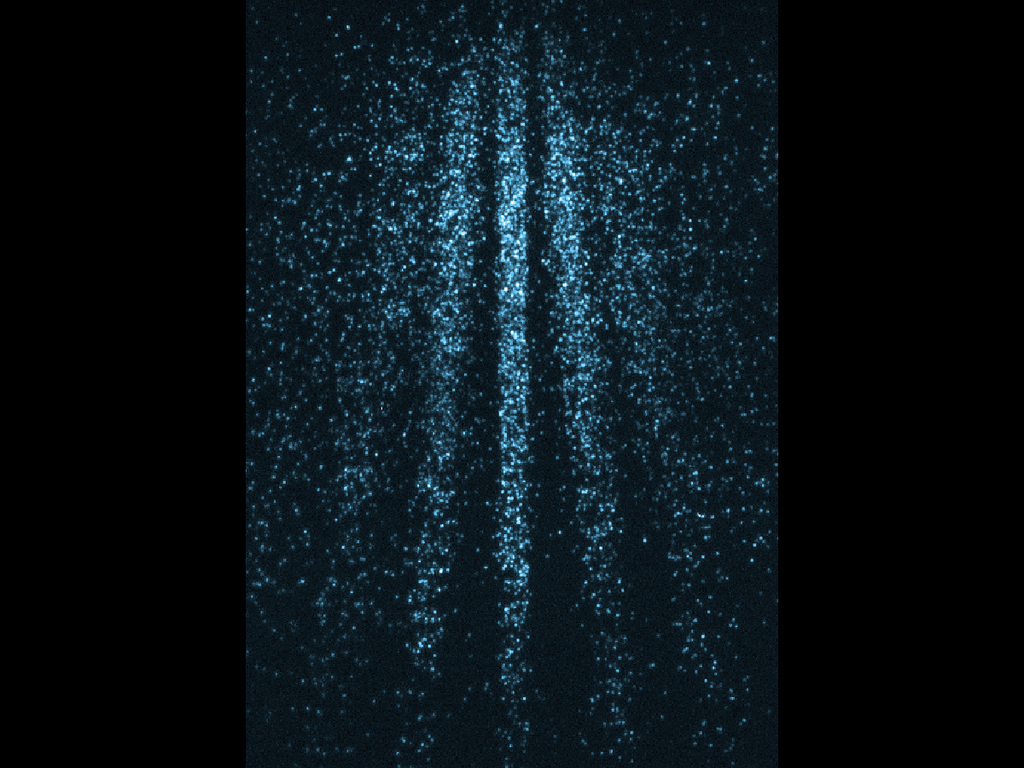
Each electron seems to travel through both slits at once, as a wave of probability, and interfere with itself. But here's the strange part. If you place a detector at the slits to see which one the electron goes through, the wave behavior vanishes. The interference pattern disappears, and you get just two lines. The very act of observing forces the electron to “choose” a path and act like a particle.
In the quantum world, particles like electrons behave as waves of possibility until they are measured.
Everything Comes in Packets
Another core principle is quantization. This means that certain properties, like energy, don't exist on a continuous spectrum. Instead, they come in discrete, countable packets called quanta. Think of it like a staircase versus a ramp. On a ramp, you can stand at any height. On a staircase, you can only stand on one step or another, never in between.
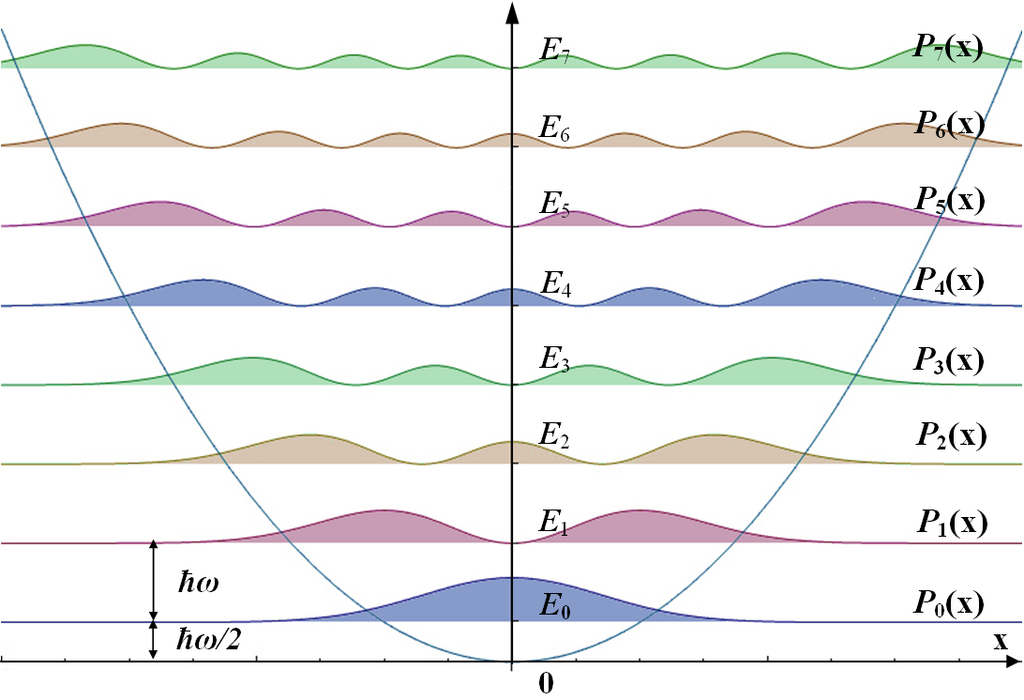
In an atom, an electron can't just have any amount of energy. It can only occupy specific energy levels, like the rungs of a ladder. To move from one level to another, it must absorb or release a precise amount of energy, a quantum of energy, often in the form of a photon of light.
More Than One State at a Time
Superposition builds on these ideas. It states that a quantum system can exist in a combination of multiple states at once. It’s not one thing or the other; it’s a mixture of all possibilities simultaneously.
Imagine a spinning coin. Before it lands, it’s not definitively heads or tails. It's in a state that contains both possibilities. For a quantum particle, this isn't just an analogy. A particle can have a spin that is both 'up' and 'down' at the same time. This is represented mathematically by a state vector.
Here, represents the quantum state, while and are the two possible basis states (like heads and tails). The symbols and are probability amplitudes. They tell us the likelihood of finding the system in either state once we measure it. The probability of finding the state to be is , and the probability of finding is . These probabilities must always add up to 1.
The moment we measure the system, the superposition collapses. The spinning coin lands. The particle is forced to “pick” one state, and we will find it to be either or , according to the probabilities.
Spooky Connections
Entanglement is perhaps the most famous quantum phenomenon. It occurs when two or more quantum particles become linked in such a way that their fates are intertwined, no matter how far apart they are. If you have two entangled particles, measuring a property of one particle instantly influences the corresponding property of the other.
For example, if you have two entangled particles with opposite spins and you measure the first one to be 'spin-up', you instantly know the other is 'spin-down'. This connection is immediate, whether the particles are in the same room or on opposite sides of the galaxy. Albert Einstein famously called this "spooky action at a distance."
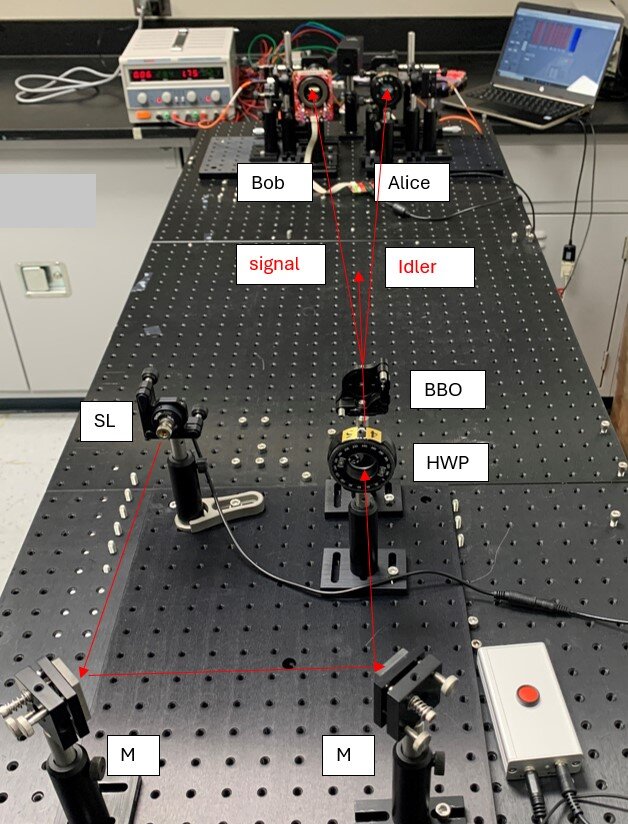
Entanglement doesn't allow for faster-than-light communication, because you still need to classically communicate the results of your measurement to know what the other person should see. But it represents a deep connection between particles that defies classical explanation.
The Limit of Knowledge
Finally, there is the Heisenberg Uncertainty Principle. This fundamental principle states that there's a limit to how precisely we can know certain pairs of properties of a particle at the same time. The most common example is position and momentum.
The more precisely you measure a particle's position, the less precisely you can know its momentum (which is its mass times its velocity), and vice versa. It’s not a limitation of our measurement tools; it’s an inherent property of the universe.
In this formula, is the uncertainty in position, is the uncertainty in momentum, and is a tiny physical constant. The formula shows that as the uncertainty of one value gets smaller (more precise), the uncertainty of the other must get larger. You can know where a particle is, or where it's going, but you can't know both perfectly at the same time.
Let's check your understanding of these fundamental concepts.
In the double-slit experiment, if a detector is placed at the slits to observe which one an electron goes through, what happens to the pattern on the screen behind the barrier?
The principle of quantization implies that an electron in an atom can only exist at specific, discrete energy levels, not in between them.
These principles form the foundation of quantum mechanics. They describe a world of probabilities, dualities, and strange connections that, while counterintuitive, provide the basis for new technologies like quantum computing.