Investing Fundamentals
Introduction to Investing
What Is Investing?
Investing is the process of using your money to buy something with the hope that it will be worth more in the future. Think of it like planting a seed. You put a small seed (your money) into the ground (an investment) and nurture it over time, hoping it grows into a big tree that provides fruit (a return).
This is different from saving. Saving is putting money aside in a safe place, like a bank account, for short-term goals or emergencies. It’s secure, but it usually doesn’t grow much. Investing is about putting your money to work for long-term growth. The goal isn't just to keep your money safe, but to increase its value.
Return
noun
The profit or loss on an investment over a certain period.
When you invest, you're essentially buying a piece of an asset you believe will become more valuable. This could be a small share of a company, a piece of property, or other financial instruments. If the asset's value increases, the value of your investment grows with it.
The Risk and Return Trade-off
Every investment comes with a fundamental trade-off: the relationship between risk and potential return. In simple terms, the higher the potential return you hope to get, the more risk you generally have to accept. There’s no such thing as a high-return, no-risk investment.
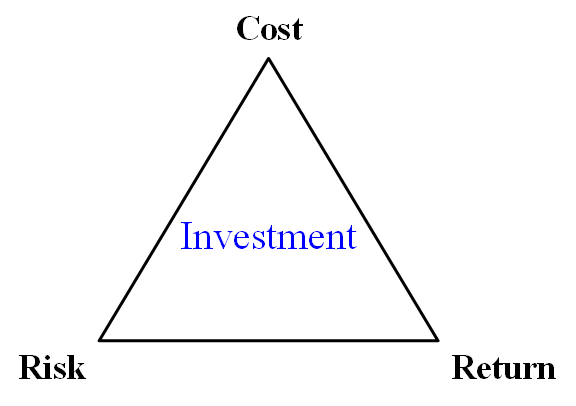
Risk is the chance that your investment will lose value or not perform as you expected. A high-risk investment has a wider range of possible outcomes. It could lead to huge gains, but it could also lead to significant losses. A low-risk investment, like a government bond, is much more predictable, but its potential for growth is also much lower.
Think of it this way: a lottery ticket has an extremely high potential return but also an extremely high risk of losing everything. A savings account has a very low return, but the risk of losing your money is nearly zero.
Understanding your own comfort level with this trade-off is a key first step in investing. This is often called your risk tolerance. It depends on your financial situation, your goals, and your personality.
Don't Put All Eggs in One Basket
You’ve probably heard the saying, "Don't put all your eggs in one basket." This is the core idea behind one of the most important principles in investing: diversification.
Diversification is a cornerstone of investment risk management, embodying the timeless wisdom of “don’t put all your eggs in one basket”.
Diversification means spreading your money across different types of investments. The goal is to reduce your risk without sacrificing too much potential return. Different assets often react differently to the same economic events. If one part of your portfolio is performing poorly, another part might be doing well, helping to balance out the overall performance.
Imagine you only invest in a single company that makes umbrellas. If there’s a long, sunny drought, your investment will likely suffer. But if you also invested in a sunscreen company, its success during the drought could help offset the losses from your umbrella stock. That's diversification in action.
By holding a mix of assets, you smooth out the ups and downs. While diversification can't guarantee you won't lose money, it's a proven strategy for managing risk over the long term.
Your Time Horizon Matters
Your time horizon is the length of time you expect to hold an investment before you need the money. Are you investing for retirement in 30 years, or for a down payment on a house in five years? The answer dramatically changes your investment strategy.
A longer time horizon generally allows you to take on more risk. If you have decades before you need the money, you have time to recover from any market downturns. Short-term price swings matter less because you're focused on long-term growth.
Someone saving for retirement in 40 years can afford to ride out the market's ups and downs. Someone saving to buy a car next year cannot, and should choose safer, less volatile investments.
Conversely, a shorter time horizon calls for a more conservative approach. If you need the cash soon, you can't afford to risk a major loss right before you plan to withdraw it. For short-term goals, investments that preserve your capital are usually a better choice than those that aim for high growth.
Understanding these basic principles—the purpose of investing, the risk-return trade-off, diversification, and your time horizon—provides the foundation for making smart decisions about your money.
What is the primary difference between investing and saving?
Which statement best describes the fundamental trade-off between risk and return?