Introduction to Wave Phenomena
Wave Basics
Energy on the Move
A wave is a disturbance that transfers energy from one place to another. Think about flicking one end of a rope. A bump travels down the rope, but the rope itself doesn't move forward. The individual pieces of the rope just move up and down. Only the energy you put in travels to the other end. It’s the same with a human wave in a stadium. People stand up and sit down, but they don't run around the stadium. The wave of motion does.
The key idea is that waves move energy, not matter. The medium the wave travels through might oscillate, but it doesn't experience a net displacement.
The Anatomy of a Wave
To describe a wave, we use a few key properties. These measurements help us understand its size, length, and speed. Imagine a simple wave, like the ripples on a pond. It has high points, called crests, and low points, called troughs.
Here are the core properties you need to know:
Amplitude
noun
The maximum displacement or distance moved by a point on a vibrating body or wave measured from its equilibrium position. It's essentially the wave's height.
Wavelength
noun
The distance between corresponding points of two consecutive waves, such as from one crest to the next. It is usually denoted by the Greek letter lambda, .
Besides its physical dimensions, we also describe a wave by how it behaves over time.
Frequency
noun
The number of crests (or complete cycles) of a wave that pass a point in a unit of time. It is measured in Hertz (Hz), where 1 Hz is one cycle per second.
Period
noun
The time it takes for one full wavelength to pass a certain point. It's the inverse of frequency.
Frequency and period are inversely related. If a wave has a high frequency, it has a short period, and vice versa. We can write this relationship as a simple formula, where is the period and is the frequency.
Waves That Need a Medium
Not all waves are the same. One major difference is what they travel through. Mechanical waves are the kind that need a medium, which is just a substance or material to carry them.
Sound is a perfect example. It travels through the air, water, or solids by vibrating the particles of the medium. In the vacuum of space, there are no particles to vibrate, which is why there's no sound.
Electromagnetic waves, on the other hand, do not need a medium. They can travel through the vacuum of space. These waves are disturbances in electric and magnetic fields. Light, microwaves, X-rays, and radio waves are all forms of electromagnetic radiation.
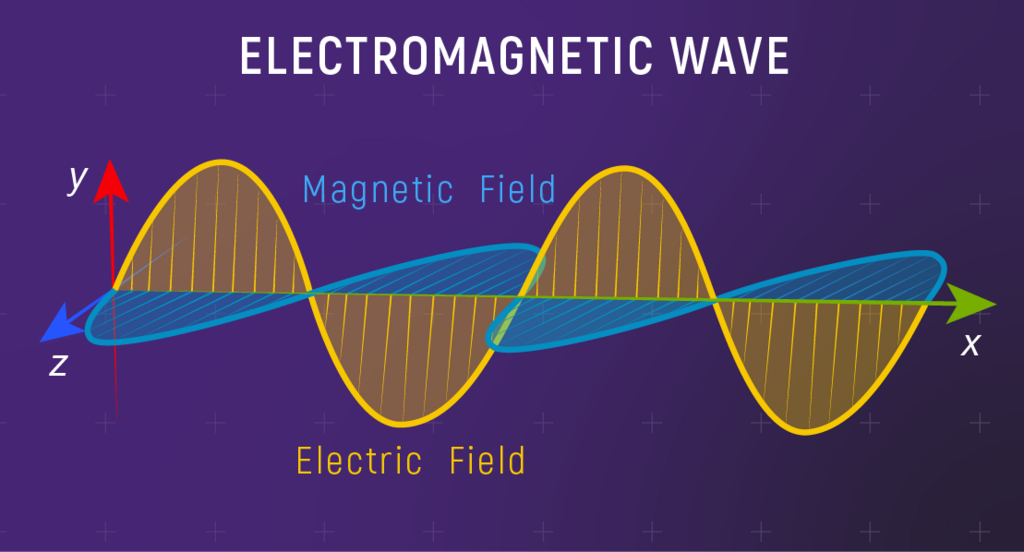
| Feature | Mechanical Waves | Electromagnetic Waves |
|---|---|---|
| Medium | Require a medium | Do not require a medium |
| Examples | Sound, ocean waves, seismic waves | Light, radio waves, X-rays |
| Nature | Oscillation of matter | Oscillation of fields |
| Speed | Varies by medium | Constant in a vacuum (speed of light) |
This distinction is fundamental. The waves that let us hear music are fundamentally different from the waves that let us see the band.
Ready to check your understanding?
What does a wave primarily transfer from one location to another?
The distance from a wave's equilibrium position to its crest is known as its what?
With these basics down, you're ready to explore the different types of waves and their fascinating behaviors.