Introduction to Vectors
Vector Basics
Magnitude and Direction
Some quantities in the world can be described with a single number. Your height, the temperature outside, or the price of a banana are all examples. These are called scalars. A scalar has only one property: magnitude, which is just another word for size or amount.
A scalar has magnitude only.
But what if you need to describe something more complex, like motion? If you say you're traveling 60 miles per hour, that's your speed, a scalar quantity. But if you say you're traveling 60 miles per hour east, you've just described your velocity. Velocity is a vector.
vector
noun
A quantity having both magnitude and direction.
Vectors are essential for describing anything that has both a size and a direction. Think about a force pushing a box, the flow of wind, or the path of a plane. All of these require two pieces of information: how much (magnitude) and which way (direction).
| Scalar | Vector |
|---|---|
| Speed (10 m/s) | Velocity (10 m/s North) |
| Distance (5 miles) | Displacement (5 miles East) |
| Temperature (20°C) | Force (15 Newtons downward) |
Representing Vectors
Since vectors have direction, we can visualize them as arrows. The arrow's length represents the vector's magnitude, and the direction it points represents the vector's direction. The starting point of the arrow is called the tail, and the pointy end is the head.
When writing about vectors, we use special notation to distinguish them from scalars. You might see a vector represented as a bold letter, like v, or with a small arrow on top, like . In coordinate form, we can describe the vector from the diagram above by its endpoint, since it starts at the origin. We use angle brackets for this: . This tells us the vector's head is located 4 units to the right and 3 units up from its tail.
Unit Vectors
Sometimes, we only care about direction, not magnitude. For this, we use a special tool called a unit vector. A unit vector is any vector that has a magnitude of exactly one. Its only purpose is to point.
A unit vector has a magnitude of 1. It specifies a direction.
We denote a unit vector with a 'hat' symbol, like . This tells us it's a vector with a length of one that points in the same direction as the original vector v.
There are two very common unit vectors that get their own special names. In a 2D coordinate system, the vector is a unit vector that points along the positive x-axis, . The vector points along the positive y-axis, .
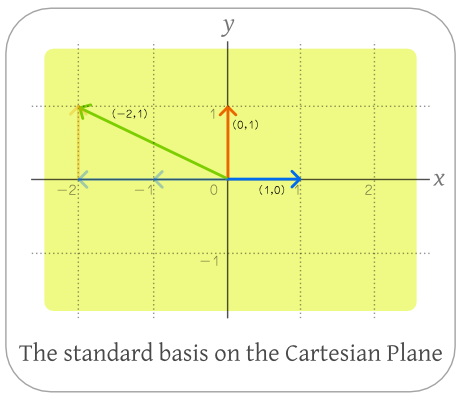
These basic unit vectors act like building blocks. Any other vector in the plane can be described as a combination of them, but we'll get into that later. For now, the key takeaway is that vectors have both magnitude and direction, while scalars only have magnitude. This distinction is the foundation for everything else in vector algebra.