Introduction to Vectors
Vector Basics
More Than Just a Number
Some quantities in the world can be described with a single number. Your height, the temperature outside, or the price of a coffee are all examples. These are called scalars. They tell you “how much” of something there is.
But what if you need to give someone directions? Saying “walk 500 feet” isn't very helpful. You need to specify a direction: “walk 500 feet north.” This combination of a magnitude (500 feet) and a direction (north) is a vector.
A vector is a quantity that has both magnitude and direction. A scalar has only magnitude.
| Scalar Examples | Vector Examples |
|---|---|
| Speed (60 mph) | Velocity (60 mph east) |
| Mass (10 kg) | Force (10 newtons downward) |
| Temperature (25°C) | Displacement (3 meters left) |
Drawing and Describing Vectors
We visualize vectors as arrows. The length of the arrow represents the vector's magnitude, and the way it points shows its direction. The starting point of a vector is called its tail, and the arrow end is its head.
In a coordinate system, we can describe a vector more precisely using components. A 2D vector can be broken down into how far it travels along the x-axis and how far it travels along the y-axis. This is called its component form.
For the vector shown above, its component form is . This notation tells us the vector moves 4 units in the positive x-direction and 3 units in the positive y-direction.
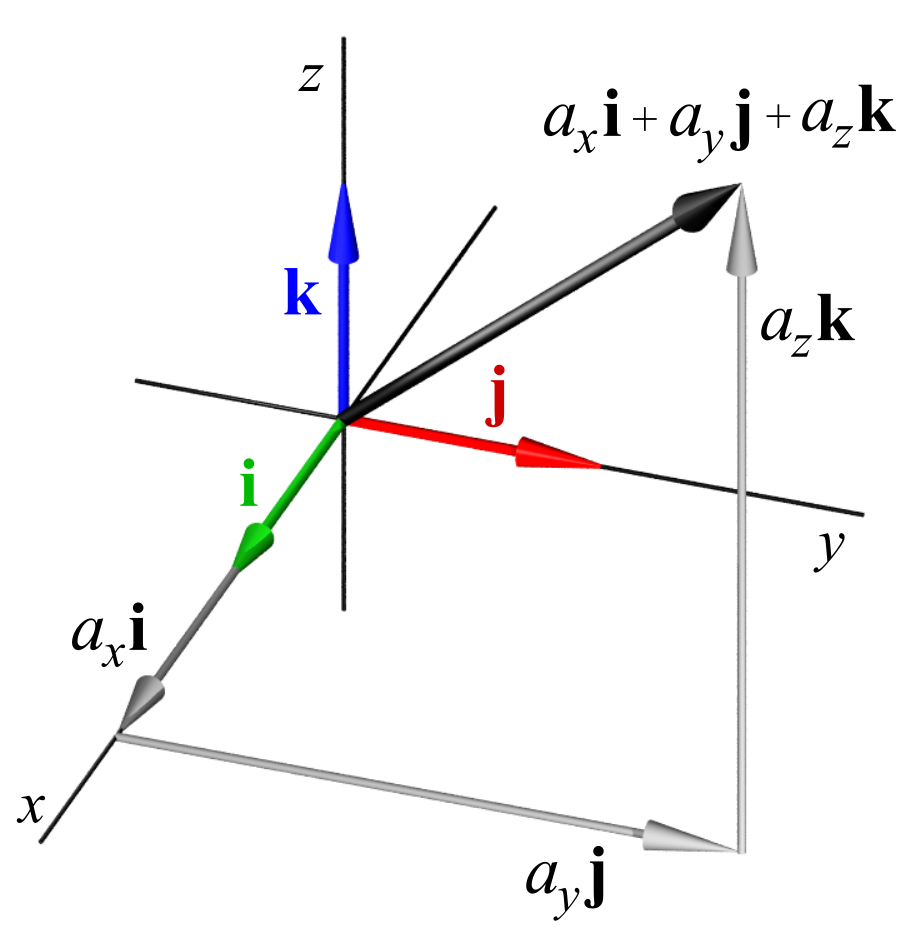
The same idea extends to three dimensions. A 3D vector has an x-component, a y-component, and a z-component, which tells us how far it moves along each of the three axes.
Unit Vectors
Sometimes, we only care about direction, not magnitude. For this, we use unit vectors. A unit vector is any vector with a magnitude (length) of exactly 1.
Think of a unit vector as a pure direction-pointer.
There are three special unit vectors that are particularly useful. They point directly along the positive x, y, and z axes. They have special names: , , and (pronounced "i-hat", "j-hat", and "k-hat").
| Unit Vector | Direction | Component Form |
|---|---|---|
| Positive x-axis | ||
| Positive y-axis | ||
| Positive z-axis |
Using these, we can write any vector as a combination of its components and these standard unit vectors. For example, the vector can also be written as . This means "4 units in the x-direction plus 3 units in the y-direction."
For a 3D vector like , the notation is .
Let's check what you've learned about the fundamentals of vectors.
Which of the following is an example of a scalar quantity?
The component form of a 2D vector is . How can this be interpreted?