Introduction to Vector Spaces
Introduction to Vectors
More Than Just a Number
Imagine you're giving a friend directions. If you say, "Walk for ten minutes," you've given them a magnitude, or a size. But you haven't told them which way to go. This single piece of information is a scalar.
Now, if you say, "Walk three blocks east and four blocks north," you've given them both a magnitude (the total distance) and a direction. That's a vector. It's a quantity that has both.
A scalar has only magnitude. A vector has both magnitude and direction.
In physics and math, we use vectors to describe things like velocity (how fast and in what direction), force (how much push and in what direction), and displacement (how far and in what direction something has moved).
Putting Vectors on the Map
The easiest way to visualize a vector is as an arrow on a coordinate system. Let's take our direction: "three blocks east and four blocks north." We can represent this as a vector pointing from the origin (0,0) to the point (3,4).
The numbers 3 and 4 are the vector's components. We write this vector, which we can call , in a couple of common ways:
An important idea is that a vector isn't tied to a specific location. It only represents a magnitude and a direction. An arrow from (0,0) to (3,4) is the exact same vector as an arrow from (5,1) to (8,5). Both represent a movement of 3 units right and 4 units up.
Basic Vector Math
We can perform mathematical operations with vectors, just like with regular numbers. Let's look at the three basic ones.
Vector operations are usually done component by component.
Addition
Suppose you walk along vector and then immediately walk along vector . Where do you end up relative to your starting point? To find out, you just add the corresponding components.
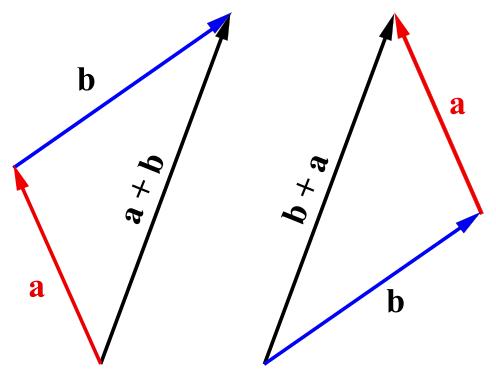
Visually, this is called the "tip-to-tail" method. You place the tail of the second vector at the tip of the first. The resulting vector goes from the first tail to the second tip.
Subtraction
Vector subtraction works the same way, component by component. If and :
Subtracting a vector is the same as adding its negative. The vector has the same length as but points in the exact opposite direction. So, is the same as .
Scalar Multiplication
What if you wanted to walk three times as far in the direction of vector ? You would multiply the vector by the scalar 3. This means multiplying each component by 3.
The new vector points in the same direction but is three times longer. If you multiply by a negative scalar, like -2, the new vector points in the opposite direction and is twice as long.
These simple operations are the building blocks for almost everything else in linear algebra.
Which of the following quantities is a vector?
A vector is represented by an arrow starting at point (2, 3) and ending at point (6, 8). An identical vector starts at point (0, 0). Where does it end?