Introduction to Vector Databases
Introduction to Vector Databases
Databases That Understand Meaning
Traditional databases are great at finding exact matches. If you search for the word “apple,” a standard database will find every instance of “apple.” It's precise, but it's also literal. It won't find “fuji,” “gala,” or “fruit that grows on trees.” It lacks an understanding of context and relationships.
Vector databases work differently. Instead of searching for exact matches, they search for similarity. This allows them to find things that are conceptually related, even if the words or pixels are different. It’s like searching for a song by humming the tune instead of needing to know the exact title.
Vector databases store and retrieve high-dimensional numerical representations of data, known as embeddings.
The magic behind this is a concept called vector embeddings. An embedding is a list of numbers—a vector—that represents a piece of data, like a word, a sentence, an image, or a song. This isn't just a random list; it’s created by an AI model that has learned the intricate relationships within a vast amount of data.
In essence, an embedding translates the complex, nuanced meaning of data into a universal mathematical language.
Think of these vectors as coordinates. Just as is a point on a 2D map, a vector embedding with hundreds of numbers is a point in a high-dimensional space. In this space, distance equals meaning. Objects with similar meanings, like the words “cat” and “kitten,” will have vectors that place them close together. An unrelated word like “car” will be located far away.
Why Is This Useful?
This ability to search by meaning unlocks powerful new capabilities. Two of the most common applications are similarity search and recommendation systems.
Similarity search, also called semantic search, lets you find items based on their conceptual content. You could upload a picture of a shirt and find similar-looking shirts without typing a single word. Or you could search a library of scientific papers for a concept, and the system would return papers related to that idea, even if they don't use your exact keywords.
Recommendation systems use vector embeddings to figure out what you might like. When you watch a movie, listen to a song, or buy a product, your actions are represented as vectors. The system then looks for items whose vectors are close to your interest vector. That’s how a music service can recommend a new band you've never heard of that perfectly matches your taste.
How They Work
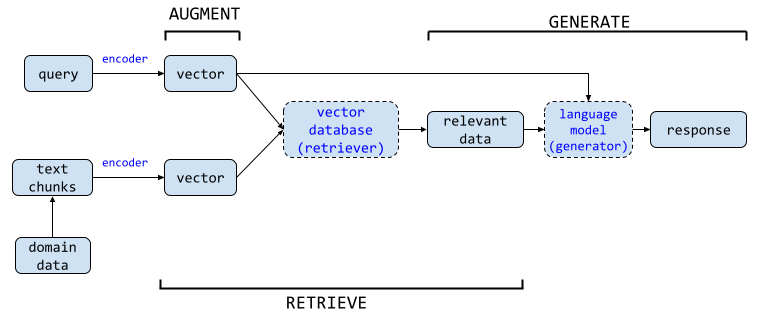
Vector databases perform three main jobs: storing, indexing, and querying vectors.
First, they store the vector embeddings. Each vector is typically stored alongside a reference to the original data it represents, like the ID of a product or the text of a document.
Next comes indexing. Searching through billions of vectors one by one to find the closest match would be incredibly slow. To speed this up, vector databases use special indexing algorithms. These algorithms group similar vectors together, much like a librarian organizes books by genre. When a search comes in, the database can quickly narrow its focus to the relevant 'neighborhood' of vectors instead of searching the entire collection.
Finally, the database handles querying. When you perform a search, your query (whether it's text, an image, or something else) is first converted into a vector embedding using the same AI model. The database then uses its index to efficiently find the vectors in its storage that are 'nearest' to your query vector. The corresponding data for these nearest vectors is then returned as the result.