Introduction to UX Design
Introduction to UX Design
What is User Experience?
Think about the last time you used a new app. Did you navigate it easily, or did you get stuck trying to find a simple feature? That feeling, whether of satisfaction or frustration, is the user experience. It’s not just about how something looks, but how it works and feels to use.
User experience (UX) design is the process of making a product, like a website or an app, easy, enjoyable, and useful for people to interact with.
The goal is to create a seamless journey for the user, from the moment they open the app to the moment they accomplish their goal. It's about understanding what users need and designing a product that meets those needs without any friction. A good UX is often invisible—you only notice it when it's bad.
UX vs UI
People often confuse User Experience (UX) with User Interface (UI) design. While they are closely related and work together, they focus on different aspects of a product.
Think of building a house. UX design is the architectural blueprint. It defines the structure, the flow from room to room, and ensures the house is functional and livable. It's about the foundation and the overall plan.
UI design, on the other hand, is the interior decoration. It’s the color of the paint, the style of the furniture, the placement of light switches, and the look of the doorknobs. It’s all the visual and interactive elements that you see and touch.
A product can look beautiful (good UI) but be difficult to use (bad UX). For example, a stylish chair that is incredibly uncomfortable. Conversely, a product can be very functional (good UX) but look dated and unappealing (bad UI). The magic happens when both UX and UI are excellent, creating an experience that is both easy to use and beautiful to look at.
Key Principles of UX
Effective UX design is guided by a few core principles. While there are many, three of the most important are usability, accessibility, and desirability.
| Principle | Description | Example |
|---|---|---|
| Usability | How easy and intuitive is the product to use? | A website with a clear navigation menu allows users to find information quickly. |
| Accessibility | Can people with disabilities use the product? | A video includes closed captions for users who are deaf or hard of hearing. |
| Desirability | Does the product evoke a positive emotional response? | An app with a clean design and smooth animations makes the experience enjoyable. |
These principles ensure that the final product not only functions correctly but also serves the widest possible audience and leaves a positive impression.
User-centric design places the end user at the forefront of product development.
The UX Design Process
UX design is not a single step but an iterative process. It generally follows a path of understanding the problem, exploring solutions, and refining the final product based on feedback. A popular model for this is the "Double Diamond."
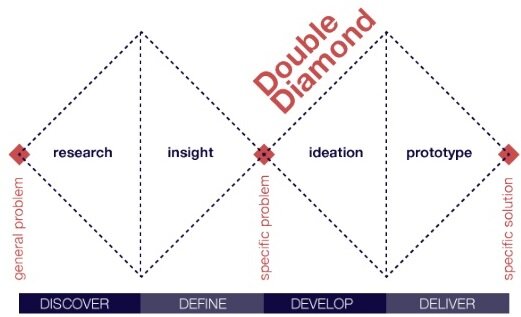
This process can be broken down into four main phases:
-
Discover: The first phase is about research. Designers learn about the users, their needs, and the problems they face. This involves interviews, surveys, and competitive analysis.
-
Define: Based on the research, the team defines the core problem they need to solve. This creates a clear focus for the project.
-
Develop: Here, designers start brainstorming and creating potential solutions. This is a creative phase involving sketching, wireframing, and building prototypes.
-
Deliver: In the final phase, the chosen solution is tested with real users, refined based on feedback, and prepared for launch. Because the process is iterative, insights from testing can send the team back to an earlier phase to make improvements.
Now, let's test your understanding of these foundational concepts.
Which of the following best describes the primary goal of User Experience (UX) design?
Using the analogy of building a house, what does User Interface (UI) design represent?