Introduction to Urdu Language
Urdu Script
The Urdu Alphabet
Welcome to the Urdu script. It may look intricate at first, but it's built on a logical system. The Urdu alphabet has 38 letters. It’s written in a beautiful, flowing style called Nastaliq script, which gives it a distinct, elegant look.
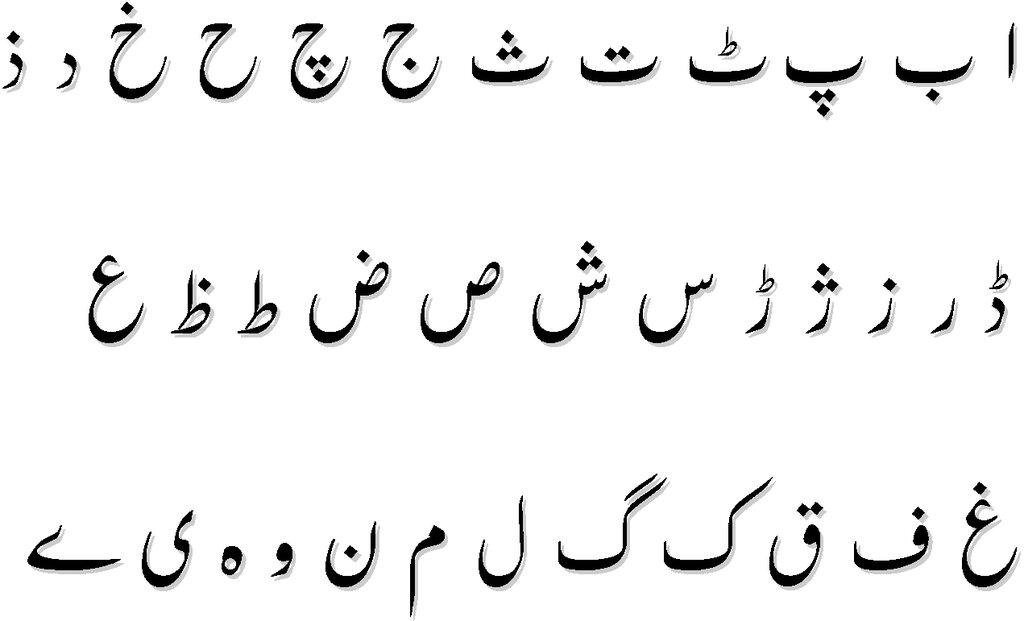
The most important thing to remember is that Urdu is written from right to left. This will feel backward if you're used to English, but you'll get the hang of it quickly. Think of it like rewinding a movie; you're just moving in the opposite direction.
For those whose mother tongue is written from left to right, one of the challenges of learning Urdu is getting used to reading right to left.
Letters That Change Shape
One of the key features of the Urdu script is that letters are cursive, meaning they connect to each other within a word. Because of this, most letters have different forms depending on their position. A letter can look different at the beginning (initial), middle (medial), or end (final) of a word. When a letter stands alone, it uses its isolated form.
Think of it like English cursive, where a letter like 'b' might have a little connector stroke when it's in the middle of a word like "about," but it looks slightly different when it stands alone or at the end of "tub."
Let’s look at an example with the letter ب (be), which makes a 'b' sound. It has four forms:
| Position | Form | Example | Meaning |
|---|---|---|---|
| Isolated | ب | --- | --- |
| Initial | بـ | بہت | Very |
| Medial | ـبـ | سب | All |
| Final | ـب | جب | When |
Notice how the basic shape stays consistent, but it adapts to connect to its neighbors. The dot underneath is the key identifier. Most letters follow this pattern, though a few don't connect to the letter that follows them.
This diagram shows how individual letters combine to form a single, flowing word. Mastering these contextual forms is the key to reading and writing Urdu fluently.
The Nastaliq Script
Urdu is almost exclusively written in the Nastaliq ( نستعلیق ) script. This style is known for its rounded shapes and its distinct top-right to bottom-left slant. You can see how the letters in a word don't sit flat on a line but cascade downwards.
Nastaliq
This slant gives written Urdu its characteristic beauty and makes it an art form in its own right. While it can take a bit of practice to get the flow right, it's also quite forgiving.
Let's try writing a simple word. How about "Urdu" itself? It's made of four letters: ا (alif), ر (re), د (dāl), and و (wā'o).
Word: اردو (Urdu) Letters: ا (a) + ر (r) + د (d) + و (u)
Interestingly, all of these letters are part of a small group that doesn't connect to the letter that comes after them. So, to write "Urdu," you just write each letter in its final/isolated form, right next to each other, moving from right to left. Grab a pen and paper and give it a try!
Time to test what you've learned about the Urdu script.
In which direction is the Urdu script written?
The elegant, flowing script used for writing Urdu is called:
Learning a new script is a big step. By understanding the right-to-left direction and the way letters change shape, you've already grasped the most fundamental concepts of written Urdu.