Introduction to Trigonometry
Trigonometric Functions
Angles and Sides
Trigonometry is all about the relationship between angles and side lengths in triangles. For any right-angled triangle, we can define three core functions that connect an angle to the ratio of two of its sides.
These three functions are sine, cosine, and tangent. Their definitions are straightforward:
A common way to remember this is with the mnemonic SOH CAH TOA. While useful, this triangle-based view only works for angles between 0° and 90°. To understand trigonometry for any angle, we need a more powerful tool.
The Unit Circle
Imagine a circle with a radius of exactly 1, centered at the origin of a graph. This is the unit circle. We can represent any angle by drawing a line from the origin, rotating counter-clockwise from the positive x-axis.
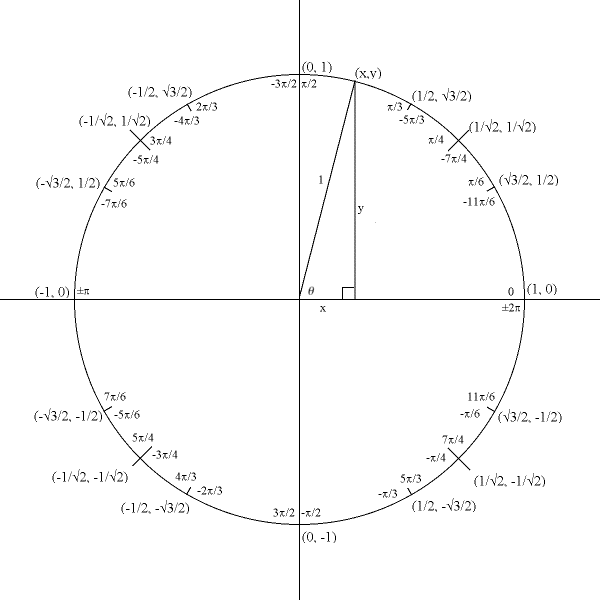
Where this line hits the edge of the circle, there's a point with coordinates . These coordinates give us new, more powerful definitions for sine and cosine.
For any angle :
- The cosine is the x-coordinate.
- The sine is the y-coordinate.
This simple idea expands trigonometry to cover angles of any size, including negative ones. The tangent is the ratio of sine to cosine, which is also the slope of the line.
These three functions have partners, which are simply their reciprocals.
The Reciprocal Functions
For each of the main functions, there is a corresponding reciprocal function: cosecant, secant, and cotangent.
| Function | Reciprocal of | Definition |
|---|---|---|
| Cosecant (csc) | Sine (sin) | |
| Secant (sec) | Cosine (cos) | |
| Cotangent (cot) | Tangent (tan) |
These complete the set of six fundamental trigonometric functions. They might seem less common, but they are essential in many areas of math and physics, especially in calculus.
Waves and Cycles
One of the most important properties of trigonometric functions is that they are periodic. As you travel around the unit circle, the x and y values repeat in a predictable pattern. After a full 360° (or radians), you're back where you started, and the values for sine and cosine begin to repeat.
This cyclical behavior is why these functions are perfect for modeling anything that repeats over time.
Think of sound waves, the alternating current in your home's outlets, the tides, or the orbit of a planet. All of these can be described using trigonometric functions.
If you trace the y-coordinate (the sine value) as you move around the circle and plot it against the angle, you get a smooth, repeating wave.
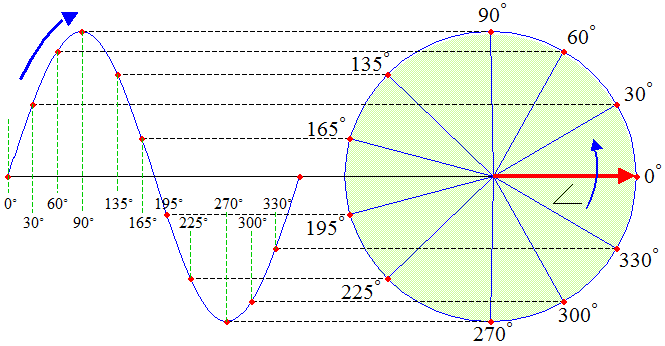
These functions also have symmetry. For example, the cosine of a negative angle is the same as the cosine of the positive version of that angle, since the x-coordinate doesn't change if you go clockwise instead of counter-clockwise. However, the sine of a negative angle is the negative of the original sine, because the y-coordinate flips across the x-axis.
Understanding these six functions opens up a new way to analyze the world, from the smallest waves to the largest orbits.
In a right-angled triangle, what does the 'SOH' in the mnemonic 'SOH CAH TOA' represent?
On the unit circle, for any given angle , what does the x-coordinate of the point where the angle's terminal side intersects the circle represent?