Introduction to Transcriptomic Analysis
Introduction to Transcriptomics
What is Transcriptomics?
Your body contains trillions of cells, and almost every one of them has the same instruction manual: your DNA. But if the instructions are the same, why is a brain cell so different from a skin cell? The answer lies in which instructions are being read at any given time. Transcriptomics is the study of all the RNA molecules in a cell, which are essentially the working copies of specific instructions from the DNA manual. This complete set of RNA is called the transcriptome.
Think of your DNA as a giant library of cookbooks. You wouldn't cook every recipe at once. Instead, you'd photocopy the specific recipes you need for tonight's dinner. These photocopies are like RNA transcripts. By looking at which recipes have been copied, someone could figure out what you're cooking. Similarly, by studying the transcriptome, scientists can get a snapshot of which genes are active in a cell and what that cell is doing.
From Genes to Function
The flow of information in a cell is a fundamental concept known as the central dogma of molecular biology. It describes how the instructions in DNA are used to create functional products, like proteins.
DNA contains the genes. These genes are transcribed into RNA. RNA is then translated into protein.
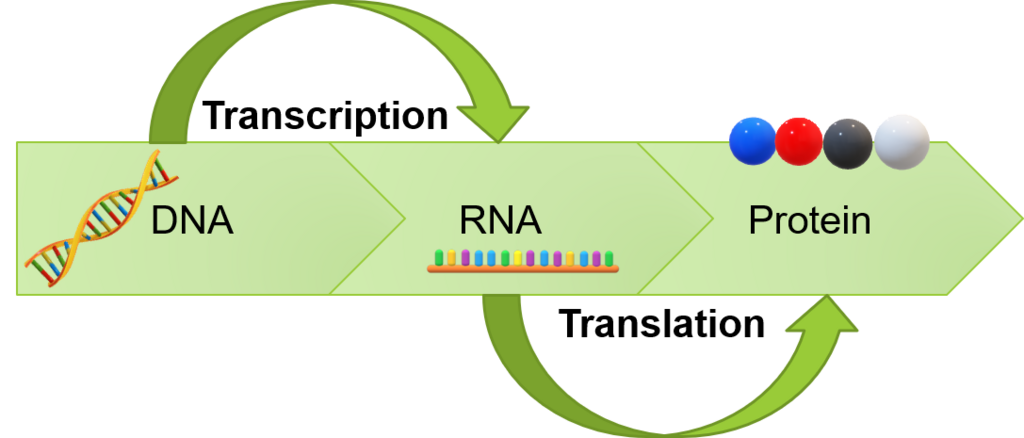
The first step, transcription, is where our story focuses. An enzyme called RNA polymerase reads a gene in the DNA and creates a complementary RNA copy. This process is highly regulated. A cell in your pancreas will transcribe the gene for insulin, but a neuron in your brain won't. This selective gene expression is what allows cells to specialize and perform different jobs. The transcriptome isn't static; it changes constantly in response to the environment, developmental stage, or disease.
The Cast of RNA Molecules
While we often talk about RNA as a single entity, there are several different types, each with a specific role. They work together like a well-organized production team to build proteins and manage the cell.
| RNA Type | Abbreviation | Function |
|---|---|---|
| Messenger RNA | mRNA | Carries the genetic code from DNA to the ribosome to serve as a template for making protein. |
| Transfer RNA | tRNA | Acts as a molecular delivery truck, bringing the correct amino acids to the ribosome. |
| Ribosomal RNA | rRNA | A key structural component of ribosomes, the cellular machinery that builds proteins. |
| Non-coding RNA | ncRNA | A broad category of RNAs that are not translated into protein but have other jobs, like regulating gene expression. |
Messenger RNA (mRNA) is the star of protein synthesis, as it contains the direct instructions. However, the other types are just as crucial. Without rRNA and tRNA, the message in the mRNA would be unreadable. And non-coding RNAs add a fascinating layer of control, acting as switches and dials to fine-tune cellular processes.
How We Study the Transcriptome
To get a picture of a cell's transcriptome, scientists use powerful technologies. The two most common methods are microarrays and RNA sequencing (RNA-Seq).
Microarray
noun
A tool used to measure the expression levels of large numbers of genes simultaneously. It consists of a small chip with thousands of known DNA sequences attached as probes.
With microarrays, scientists convert the cell's RNA into a labeled form that can stick, or hybridize, to the matching DNA probes on the chip. The amount of light emitted from each spot on the chip reveals how much of that specific RNA was present in the sample. It's like having a massive board of specific keyholes and seeing which keys from your sample fit.
A more recent and powerful technology is RNA sequencing (RNA-Seq). Instead of using probes for known genes, RNA-Seq directly reads the sequence of all the RNA molecules in a sample. This approach is unbiased, meaning it can discover new genes or RNA variants that weren't previously known. It provides a more comprehensive and detailed view of the transcriptome, telling us not only which genes are on but also exactly how they are being read.
Now, let's test your understanding of these core concepts.
What is the primary subject of study in transcriptomics?
If a skin cell and a brain cell from the same person have identical DNA, why do they have such different functions?
By studying the transcriptome, we gain a dynamic view of how cells interpret their genetic code to function, adapt, and respond to the world around them.