Introduction to the World of Science
Introduction to Science
What Is Science?
Science isn't just a collection of facts in a textbook. It's a way of understanding the world. At its heart, science is a systematic process for building and organizing knowledge. It does this by creating explanations and predictions that can be tested.
The goal is simple: to understand how the natural world works, based on evidence.
This approach applies to everything from the smallest particles to the vastness of space. If a question can be answered by observing and testing, it falls within the scope of science. It’s not about opinions or beliefs, but about what we can demonstrate to be true.
Evidence Is Everything
The foundation of all science is empiricism. This is the idea that knowledge comes from experience and observation. A scientific claim isn't just a good idea; it must be backed by empirical evidence. This evidence has to be observable and measurable, either directly with our senses or with the help of instruments.
Evidence-based reasoning is what separates science from other ways of knowing. If someone claims a new medicine works, scientists will ask for the data from experiments. If an idea can't be tested or supported by evidence, it's not considered scientific.
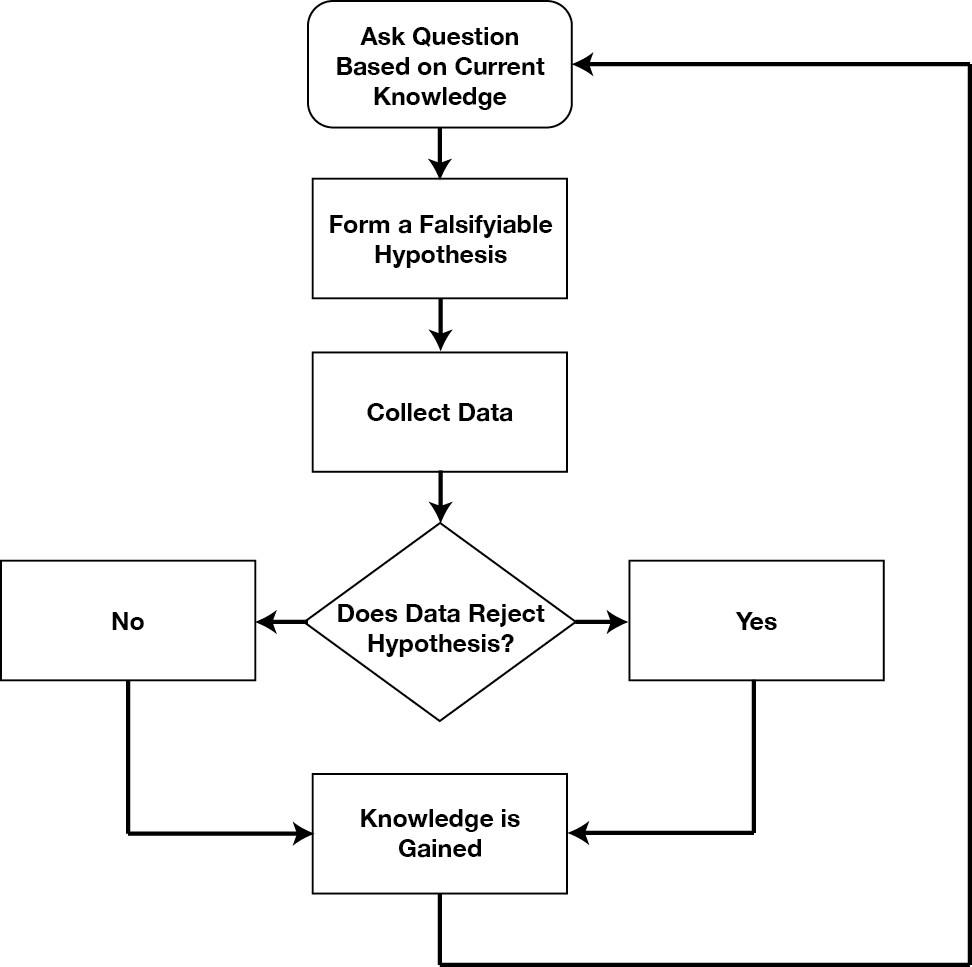
This constant demand for proof is a strength, not a weakness. It allows scientific knowledge to correct itself and become more accurate over time. New evidence can challenge old ideas, leading to a deeper and more refined understanding of the universe.
A Brief History of Knowing
The way we think about science has evolved. Ancient Greek philosophers like Aristotle were brilliant observers of nature, but their approach relied more on logic and reason than on experimentation. They would reason out how the world should work, but they didn't always test if it actually did.
A major shift occurred during the Scientific Revolution, starting in the 16th century. Thinkers like Nicolaus Copernicus, Galileo Galilei, and Isaac Newton changed the game. They insisted that ideas must be tested through systematic observation and experimentation. Galileo didn't just argue that the earth moved; he used a telescope to gather evidence that challenged the old view.
This new emphasis on testing ideas with real-world data laid the foundation for modern science. It transformed human society, leading to incredible advances in technology, medicine, and our basic understanding of reality.
Science vs. Pseudoscience
Not everything that sounds scientific actually is. Pseudoscience is a claim, belief, or practice presented as scientific, but which does not adhere to the scientific method. It often lacks evidence, cannot be reliably tested, and is not open to being proven false.
Pseudoscience
noun
A collection of beliefs or practices mistakenly regarded as being based on the scientific method.
The key difference lies in a concept called falsifiability. A genuinely scientific idea must be testable in a way that it could be proven wrong. For example, Einstein's theory of relativity made specific predictions that, if they hadn't been observed, would have disproven the theory. Pseudoscientific claims, however, are often so vague or have so many built-in excuses that they can never be proven false.
| Feature | Science | Pseudoscience |
|---|---|---|
| Testing | Relies on testable and repeatable experiments. | Avoids rigorous testing; relies on anecdotes. |
| Evidence | Changes with new evidence. | Ignores or explains away contrary evidence. |
| Falsifiability | Ideas can be proven false. | Claims are often too vague to be falsified. |
| Progress | Knowledge builds and self-corrects over time. | Stays largely unchanged for decades or centuries. |
Recognizing the difference is a crucial skill. It helps us make informed decisions about our health, our world, and the information we trust.
What is the core principle of science, distinguishing it from other ways of knowing?
The fundamental idea that knowledge should be based on observation and experience is called:
Science is a powerful tool for discovery. It's a commitment to letting evidence, not preconceived notions, guide our quest for knowledge.