Introduction to the Wild World
Animal Classification
Sorting Life's Library
The animal kingdom is home to millions of different species, from tiny insects to massive whales. To make sense of this incredible diversity, scientists sort animals into groups, much like a library organizes books by genre. This system of classification is called taxonomy.
Taxonomy
noun
The science of naming, defining, and classifying groups of biological organisms based on shared characteristics.
Taxonomy uses a series of ranks to narrow down an organism's place in the world. Think of it like a home address, starting with a country and getting more specific until you arrive at a single house. There are seven main ranks.
The Ranks of Life
The seven major taxonomic ranks move from the most general to the most specific. They are Kingdom, Phylum, Class, Order, Family, Genus, and Species.
A common way to remember the order is with a mnemonic like, King Philip Came Over For Good Soup.
The Kingdom is the broadest category. For example, all animals belong to the Kingdom Animalia. The species is the most specific, referring to a group of organisms that can reproduce with one another. Let's see how this works for a familiar animal, the gray wolf.
| Rank | Gray Wolf Classification |
|---|---|
| Kingdom | Animalia (All animals) |
| Phylum | Chordata (Animals with a backbone) |
| Class | Mammalia (Mammals that have hair and produce milk) |
| Order | Carnivora (Meat-eaters) |
| Family | Canidae (Dog family) |
| Genus | Canis (Includes dogs, wolves, coyotes) |
| Species | lupus (The gray wolf) |
The scientific name for an organism is a combination of its genus and species. For the gray wolf, that's Canis lupus.
The Great Divide
One of the first and most fundamental splits in the animal kingdom is between animals with a backbone and those without. This simple difference creates two massive groups: vertebrates and invertebrates.
Vertebrates include mammals, birds, reptiles, amphibians, and fish. Invertebrates are a much larger group, covering everything from insects and spiders to jellyfish and worms.
A Quick Tour of Phyla
A phylum is the next major rank after kingdom. While there are over 30 animal phyla, most animals fall into just a handful of major ones. All vertebrates belong to a single phylum, Chordata, but invertebrates are split among many.
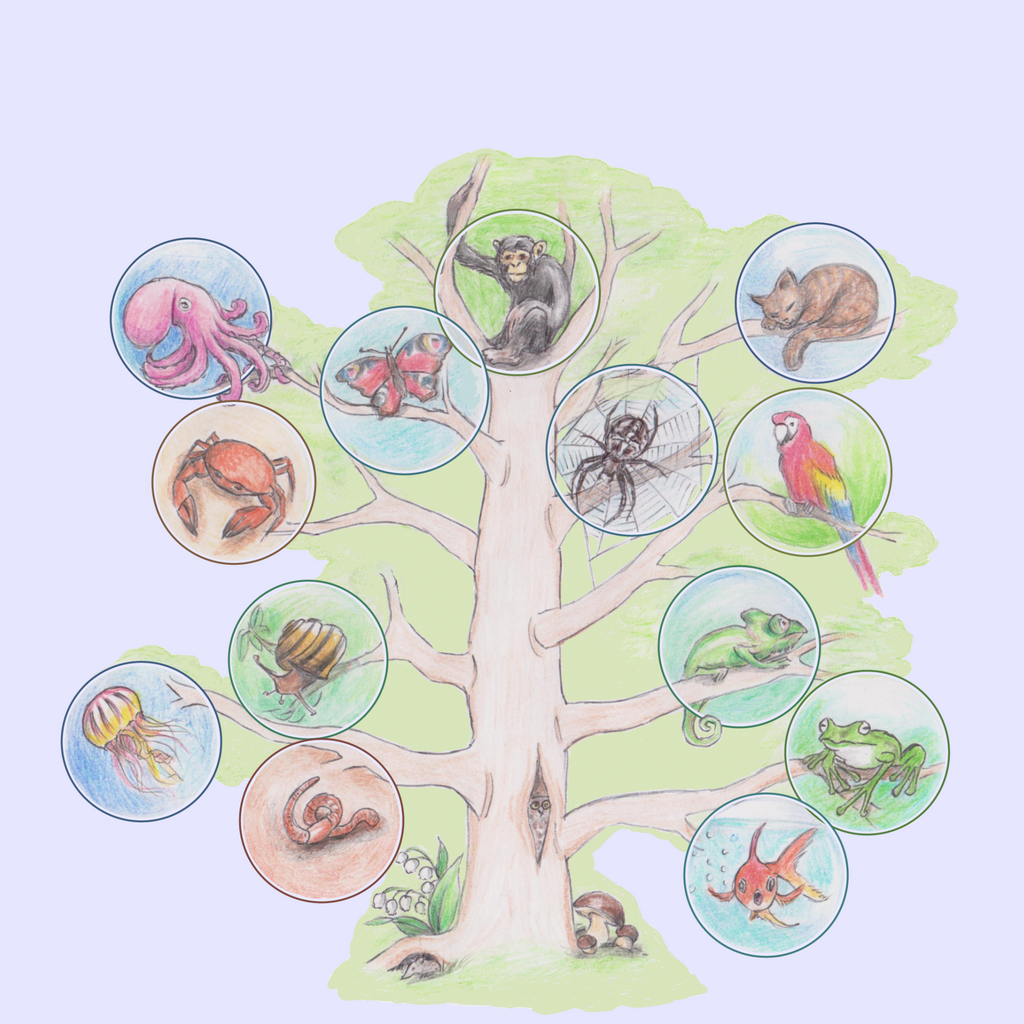
Here are a few of the most well-known phyla:
| Phylum | Key Characteristic(s) | Group | Example |
|---|---|---|---|
| Chordata | Have a backbone (at some life stage) | Vertebrates | Human |
| Arthropoda | Exoskeleton, jointed legs | Invertebrates | Spider |
| Mollusca | Soft body, often with a shell | Invertebrates | Snail |
| Cnidaria | Stinging cells | Invertebrates | Jellyfish |
| Annelida | Segmented body | Invertebrates | Earthworm |
Understanding these broad categories is the first step to appreciating the incredible and orderly diversity of the animal kingdom.
What is the primary characteristic that distinguishes vertebrates from invertebrates?
Which of the following taxonomic ranks is the most specific?