Introduction to the Stock Market
Stock Market Basics
What Is a Stock Market?
Think of the stock market as a huge, global marketplace. But instead of buying and selling fruit or furniture, people trade tiny pieces of ownership in companies. These pieces are called stocks or shares.
When you buy a stock, you're buying a small slice of that company. If the company does well and grows, the value of your slice can grow too. For companies, selling these slices is a way to raise money to fund new projects, hire more people, or expand their business. For investors, it's a chance to share in the success of those companies.
The stock market connects companies that need money to grow with people who have money to invest.
The Key Players
A few key groups make the stock market work.
First, you have the companies. These are the businesses that issue stocks to the public. They range from giant corporations you see every day to smaller, up-and-coming firms.
Then there are investors. This includes individuals, like you and me, as well as large institutions like pension funds and banks. They are the ones buying the stocks, hoping their value will increase over time.
To connect buyers and sellers, you need brokers. A broker is a person or firm that's licensed to trade stocks on your behalf. In the past, you'd call a broker on the phone. Today, most people use online brokerage apps on their phones or computers.
Finally, there are the stock exchanges. These are the organized venues where all the buying and selling actually happens.
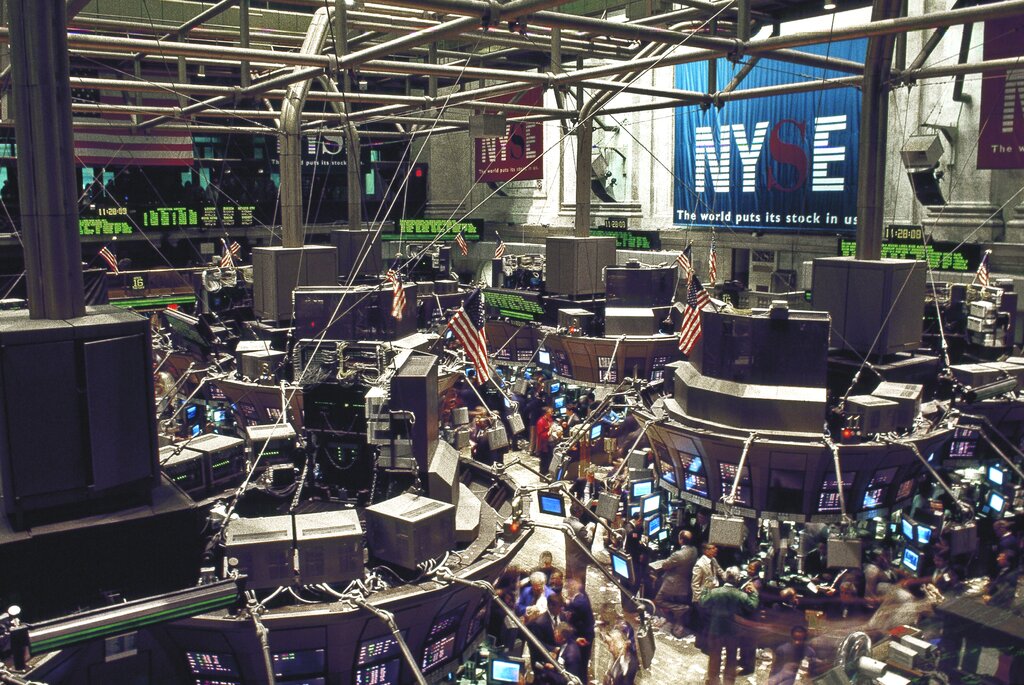
The most famous exchanges in the U.S. are the New York Stock Exchange (NYSE) and the Nasdaq. The NYSE is known for its physical trading floor, though most trading is now electronic. The Nasdaq is an all-electronic exchange, home to many of the world's biggest technology companies.
Measuring the Market
With thousands of companies to follow, how do you get a quick sense of how the market is doing? That's where stock indices come in.
An index is like a snapshot of a particular part of the market. It tracks the performance of a group of stocks, giving you a general idea of the market's direction. It’s a lot easier than tracking thousands of individual companies.
The two most-watched indices in the U.S. are:
-
The Dow Jones Industrial Average (DJIA): Often just called "the Dow," this index tracks 30 large, well-established U.S. companies.
-
The S&P 500: This index is much broader, tracking 500 of the largest U.S. companies. Because it includes more companies, many see it as a better representation of the overall market.
Price and Value
A stock's price is simply what someone is willing to pay for it at any given moment. But what determines a company's total value in the market?
This is measured by market capitalization, or "market cap."
A company with a $50 stock price and 100 million shares outstanding has a market cap of $5 billion. This figure gives you a better sense of a company's size than its share price alone. A company with a $1,000 stock price might seem expensive, but if it only has a few shares, it could be much smaller than a company with a $20 stock price and billions of shares.
Stock prices are constantly changing. They're influenced by a huge range of factors, from company-specific news like a great earnings report to broad economic trends like interest rates and inflation. Even global events and investor sentiment can push prices up or down.
Time to test your knowledge.
What does owning a share of a company's stock represent?
What is the primary function of a stock exchange like the NYSE or Nasdaq?
Understanding these core concepts is the first step. They provide the foundation for making sense of how this complex system works.