Introduction to the Japanese Language
Hiragana and Katakana
The Two Kana Scripts
The Japanese writing system might seem intimidating, but it starts with two simple, phonetic scripts: Hiragana and Katakana. Together, they are known as kana. Think of them as the Japanese equivalent of the alphabet. Each character represents a syllable, like 'ka', 'shi', or 'mo'.
The first challenge is mastering hiragana (ひらがな) and katakana (カタカナ), the two basic writing systems used in Japanese.
Almost every Japanese sentence uses a mix of these kana scripts and more complex characters called kanji. For now, we'll focus entirely on the kana. Mastering them is the first big step to reading and writing Japanese.
Syllabary
noun
A set of written characters representing syllables, which make up words. Unlike an alphabet where letters represent individual sounds (like 'b' or 't'), a syllabary's characters represent full syllables (like 'ba' or 'ta').
Hiragana: The Everyday Script
Hiragana (ひらがな) is the workhorse of the Japanese language. Its characters are curvy and flowing. You'll see it everywhere, used for native Japanese words, grammatical particles that connect words in a sentence, and verb and adjective endings.
Here are the basic hiragana characters. They are organised in a grid called a gojūon (五十音), which literally means 'fifty sounds'.
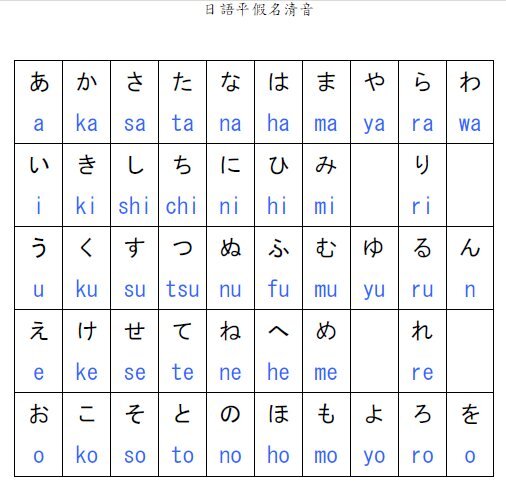
Each character has a consistent sound. For example, あ is always pronounced 'ah', and か is always 'ka'. Once you learn the sounds, you can read any hiragana word you see. Notice the pattern in the chart: columns are grouped by vowel sounds (a, i, u, e, o) and rows are grouped by consonant sounds.
The key to learning hiragana is consistent practice. Try writing the characters yourself, paying attention to the flow and shape of each one.
Hello
This common greeting is written entirely in hiragana.
Katakana: For Foreign Words and Emphasis
Katakana (カタカナ) is the second syllabary. It has the exact same set of sounds as hiragana, but the characters look different. They are more angular and sharp.
Katakana's main job is to write words borrowed from other languages. This includes everything from country names to your name (if it's not Japanese) to words like 'computer' or 'coffee'.
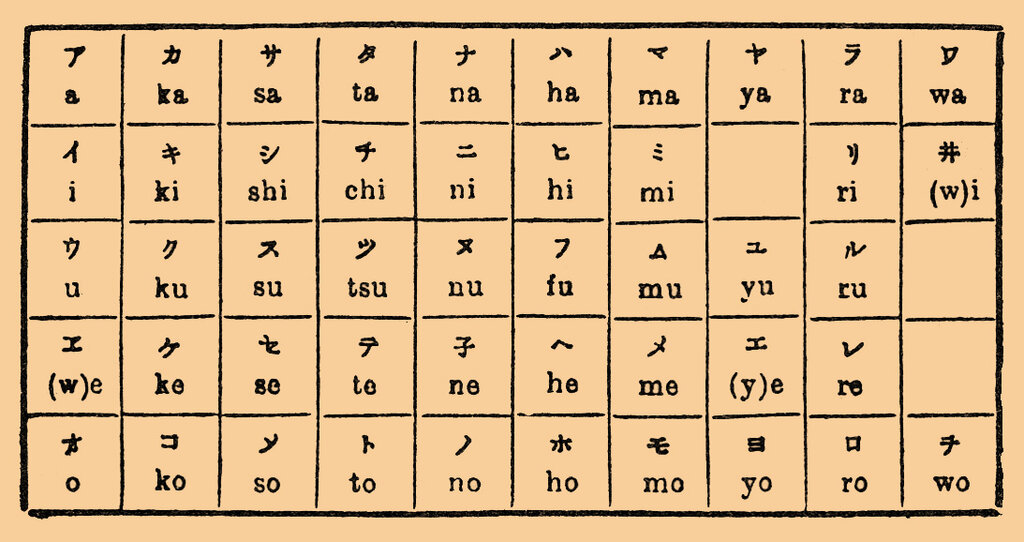
For example, the English word 'coffee' becomes:
Coffee
Besides loanwords, katakana is also used for onomatopoeia (sound words), technical terms, and for adding emphasis to a word, much like using italics in English.
| Use Case | Hiragana (ひらがな) | Katakana (カタカナ) |
|---|---|---|
| Appearance | Round and curvy | Sharp and angular |
| Primary Use | Native words, grammar | Foreign loanwords, names |
| Example | ねこ (neko, cat) | バス (basu, bus) |
| Other Uses | Verb/adjective endings | Emphasis, onomatopoeia |
Learning both sets of characters is essential because they are not interchangeable. A word will be written in one or the other depending on its origin and function in the sentence.
Ready to test your knowledge of Hiragana and Katakana?
What is the collective name for the two phonetic scripts, Hiragana and Katakana?
Which of the following best describes the main function of Katakana?
Learning the kana is a fundamental skill. With these two scripts, you unlock the ability to read and write a huge portion of the Japanese language. Keep practicing, and you'll be reading them with ease in no time.