Introduction to the German Language
German Alphabet and Pronunciation
The German Alphabet
Getting started with German is easier than you might think. The German alphabet uses the same 26 letters as English, so you already have a head start. The key difference lies in the pronunciation, which is much more consistent. Once you learn the sound each letter makes, you can reliably pronounce most German words you see.
| Letter | German Name | Pronunciation Guide |
|---|---|---|
| A a | Ah | Like 'a' in 'father' |
| B b | Bay | Like 'b' in 'bed' |
| C c | Tsay | Like 'ts' in 'cats', or 'k' in 'car' |
| D d | Day | Like 'd' in 'dog' |
| E e | Ay | Like 'e' in 'bed' or 'ay' in 'hay' |
| F f | Eff | Like 'f' in 'fish' |
| G g | Gay | Like 'g' in 'go' |
| H h | Hah | Like 'h' in 'hat' |
| I i | Ee | Like 'ee' in 'see' |
| J j | Yot | Like 'y' in 'yes' |
| K k | Kah | Like 'k' in 'kite' |
| L l | Ell | Like 'l' in 'love' |
| M m | Emm | Like 'm' in 'man' |
| N n | Enn | Like 'n' in 'no' |
| O o | Oh | Like 'o' in 'open' |
| P p | Pay | Like 'p' in 'pen' |
| Q q | Koo | Like 'kv' in English |
| R r | Err | A rolled or guttural 'r' sound |
| S s | Ess | Like 'z' in 'zoo' before a vowel; otherwise 's' in 'sun' |
| T t | Tay | Like 't' in 'top' |
| U u | Oo | Like 'oo' in 'moon' |
| V v | Fow | Like 'f' in 'fan' |
| W w | Vay | Like 'v' in 'van' |
| X x | Iks | Like 'x' in 'fox' |
| Y y | Upsilon | Like the German 'ü' sound |
| Z z | Tsett | Like 'ts' in 'cats' |
Besides these 26 letters, German has four special characters that you'll need to know. Three are vowels with dots on top, called Umlauts, and one is a unique consonant.
Special Characters
The four special characters in German are ä, ö, ü, and ß. Let's break them down.
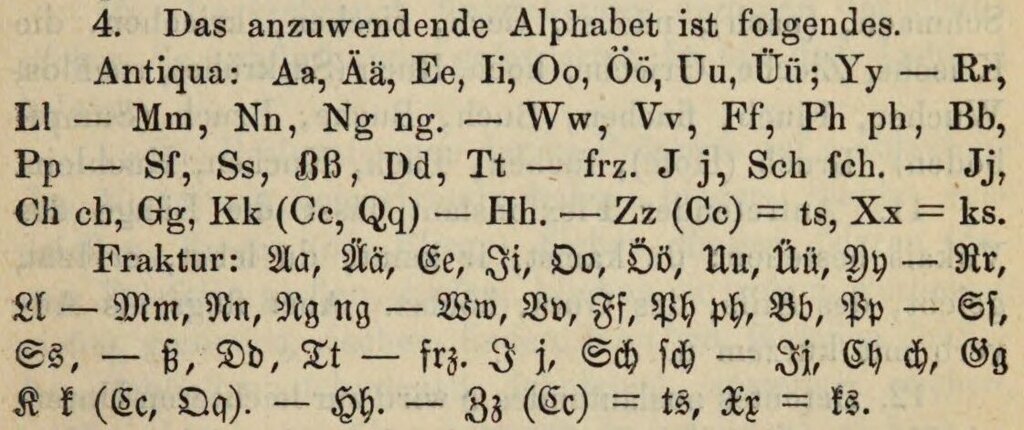
The first three are the Umlauts. Those two dots change the sound of the vowel underneath.
- Ä, ä (A-umlaut): This sounds like the 'e' in "bed." Try saying Mädchen (girl) or Käse (cheese).
- Ö, ö (O-umlaut): This sound doesn't exist in English. To make it, form your lips like you're about to say "oh," but say "ee" instead. You can also try saying "burn" with a British accent and rounded lips. Examples include schön (beautiful) and Öl (oil).
- Ü, ü (U-umlaut): This is another sound new to English speakers. Round your lips as if you're whistling or saying "oo," then try to say "ee." Words with this sound include für (for) and Tür (door).
The fourth special character is the ß, called the Eszett or scharfes S (sharp S). It simply represents a double 's' sound, like in "miss." You'll find it after long vowels or diphthongs, like in the word Straße (street) or heiß (hot).
Interestingly, Switzerland stopped using the ß in the 20th century, and they just write 'ss' instead. If you can't type ß, it's always acceptable to substitute it with 'ss'.
Key Sounds and Combinations
Some German letters and letter combinations have pronunciations that might surprise an English speaker. Here are some of the most common ones to watch out for.
One of the first things you'll notice is that there are no silent letters in German. If you see a letter, you pronounce it. This makes reading much more straightforward than in English or French.
Tricky Consonants
- ch: This has two sounds. After the vowels a, o, or u, it's a harsh, throaty sound from the back of your throat, like in the Scottish word "loch." An example is Bach (stream). After any other vowel or consonant, it's a much softer sound, like a hissing cat, made by pushing air through the top of your mouth. An example is ich (I).
- j: In German, 'j' is always pronounced like the 'y' in "yes." For example, ja (yes) is pronounced "yah."
- s: When 's' appears at the beginning of a word before a vowel, it makes a 'z' sound, as in Sonne (sun). Otherwise, it makes a standard 's' sound, as in Haus (house).
- v: This letter is almost always pronounced like an 'f', as in Vater (father).
- w: The German 'w' sounds like the English 'v'. The word Wasser (water) is pronounced "vasser."
Vowel Combinations (Diphthongs)
These combinations of two vowels create a single, new sound.
- ei: This combination sounds like the English word "eye" or the 'i' in "ice." An example is mein (my).
- ie: Pronounced like a long 'ee' sound, as in the word "see." An example is die (the).
- au: Sounds like the 'ow' in "cow." For example, Haus (house).
- eu and äu: Both of these combinations make the same sound, similar to 'oy' in "toy." Examples are neu (new) and Häuser (houses).
Let's review these new sounds.
Ready to test what you've learned?
The German special characters ä, ö, and ü are collectively known as what?
How is the German letter 'j' pronounced?
Mastering these letters and sounds is the first big step. With practice, they'll become second nature, and you'll be able to read and pronounce German with confidence.