Introduction to the German Language
German Alphabet
The German Alphabet
The German alphabet, or das deutsche Alphabet, looks very familiar. It uses the same 26 letters as English. For the most part, they even sound the same. This makes getting started with German spelling and reading much easier than you might think.
Understanding the German alphabet is crucial for accurate pronunciation and comprehension.
Let's look at the letters and how to say their names. Knowing the name of the letter helps when you need to spell something out.
| Letter | German Name | Pronunciation Guide |
|---|---|---|
| A a | Ah | Like the 'a' in "father" |
| B b | Beh | Like the 'b' in "bear" |
| C c | Tseh | Like "tsay" |
| D d | Deh | Like the 'd' in "day" |
| E e | Eh | Like the 'e' in "hey" |
| F f | Eff | Like the 'f' in "fish" |
| G g | Geh | Like the 'g' in "go" |
| H h | Hah | Like the 'h' in "hat" |
| I i | Ih | Like the 'ee' in "see" |
| J j | Yot | Like the 'y' in "yes" |
| K k | Kah | Like the 'k' in "king" |
| L l | El | Like the 'l' in "love" |
| M m | Em | Like the 'm' in "man" |
| N n | En | Like the 'n' in "no" |
| O o | Oh | Like the 'o' in "open" |
| P p | Peh | Like the 'p' in "pen" |
| Q q | Kuh | Like "coo" |
| R r | Er | Pronounced in the throat |
| S s | Es | Like the 's' in "sun" |
| T t | Teh | Like the 't' in "ten" |
| U u | Uh | Like the 'oo' in "moon" |
| V v | Fau | Like the 'f' in "fan" |
| W w | Veh | Like the 'v' in "van" |
| X x | Iks | Like the 'x' in "fox" |
| Y y | Ypsilon | Like "ip-si-lon" |
| Z z | Tzett | Like "tset" |
The Special Characters
Besides the standard 26 letters, German has four special characters you'll need to know. Three of these are vowels with two dots above them, called Umlauts. The fourth is a unique consonant.
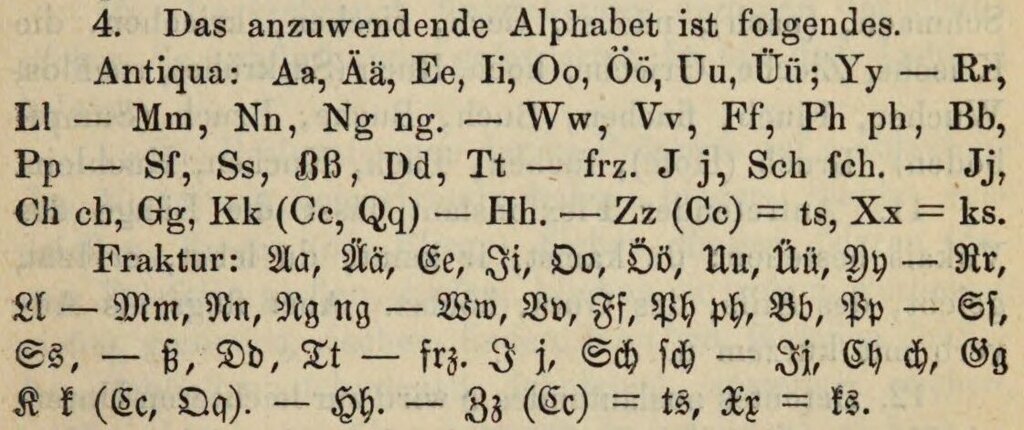
The Umlauts change the sound of the vowel. Think of them as entirely new letters, not just variations.
Ä/ä (A-Umlaut) This sounds like the "e" in "bed." It's a short, flat sound. An example is the word Mädchen (girl).
Ö/ö (O-Umlaut) This sound doesn't exist in English. To make it, say "eh" as in "bed," but round your lips as if you were about to say "oh." Try it with the word schön (beautiful).
Ü/ü (U-Umlaut) This is another sound that's new for English speakers. Say "ee" as in "see," but keep your lips rounded like you're whistling. You can hear it in the word fünf (five).
ß (Eszett or scharfes S) The Eszett looks like a capital B with a tail, but it's actually just a sharp "s" sound, like the "ss" in "hiss." It only appears after long vowels or diphthongs. For example, Straße (street). It has no capital form, so if a word starts with it (which is extremely rare) or is in all caps, it's written as SS.
Key Pronunciation Differences
One of the best things about German is its phonetic consistency. Unlike English, letters in German almost always make the same sound. Once you learn the rules, you can pronounce most words correctly just by looking at them.
If you see it, you say it. German pronunciation is very predictable.
A few consonants and vowel pairs are famously tricky for beginners. Here are the most important ones to watch out for:
| Letter(s) | German Sound | English Equivalent | Example Word |
|---|---|---|---|
| J j | /y/ | The 'y' in "yes" | Ja (yes) |
| V v | /f/ | The 'f' in "fan" | Vater (father) |
| W w | /v/ | The 'v' in "van" | Wasser (water) |
| Z z | /ts/ | The 'ts' in "cats" | Zeit (time) |
| ei | /ai/ | The 'i' in "ice" | drei (three) |
| ie | /ee/ | The 'ee' in "see" | sie (she/they) |
Getting these down will help you sound more natural right away. Pay special attention to W and V, as they are the reverse of what you'd expect in English.
Now that you've seen the letters and their sounds, let's review.
Ready to test your knowledge?
What are the three German vowels with two dots above them (Ä, Ö, Ü) collectively called?
The German character 'ß' (Eszett) represents which sound?
Mastering the alphabet is the first big step. With these sounds as your foundation, you're ready to start building your German vocabulary.