Introduction to the English Language
Origins of English
The Family Tree of English
The English language didn't appear out of thin air. It has a long and complicated family history, like most people. If we trace its ancestry back far enough, we arrive at a single, ancient source: Proto-Indo-European, or PIE for short.
PIE was spoken thousands of years ago, likely around the Pontic-Caspian steppe in Eastern Europe. We don't have any written records of it. Instead, linguists have carefully reconstructed it by comparing its many descendant languages, from Hindi and Persian to Greek and Spanish. They looked for common patterns in words and grammar, working backward to figure out what the original parent language must have been like.
Over millennia, groups of PIE speakers migrated across Europe and Asia. As these groups separated, their languages drifted apart, slowly changing into new forms. One of these branches became Proto-Germanic.
Proto-Germanic is the direct ancestor of English, German, Dutch, and the Scandinavian languages. It developed its own distinct sounds and vocabulary, separating it from other Indo-European branches like Italic (which led to Latin) or Hellenic (which led to Greek).
Proto-Germanic itself wasn't a single, uniform language for long. It split into three main groups: East Germanic (now extinct), North Germanic (leading to Old Norse and modern Scandinavian languages), and West Germanic. English belongs to this last group.
A New Home, A New Language
For centuries, the island of Britain was a Roman province. The local Celtic-speaking population lived under Roman rule, and Latin was the language of government and the military. But in the early 5th century, the Roman Empire crumbled, and its legions withdrew from Britain.
This departure left a power vacuum. The native Britons were vulnerable to raids from the Picts in the north and the Scotti from Ireland. To defend themselves, some British leaders supposedly invited mercenaries from mainland Europe to help.
These weren't just any mercenaries. They were speakers of West Germanic dialects: the Angles, the Saxons, and the Jutes. They came from areas that are now parts of modern-day Denmark and Germany.
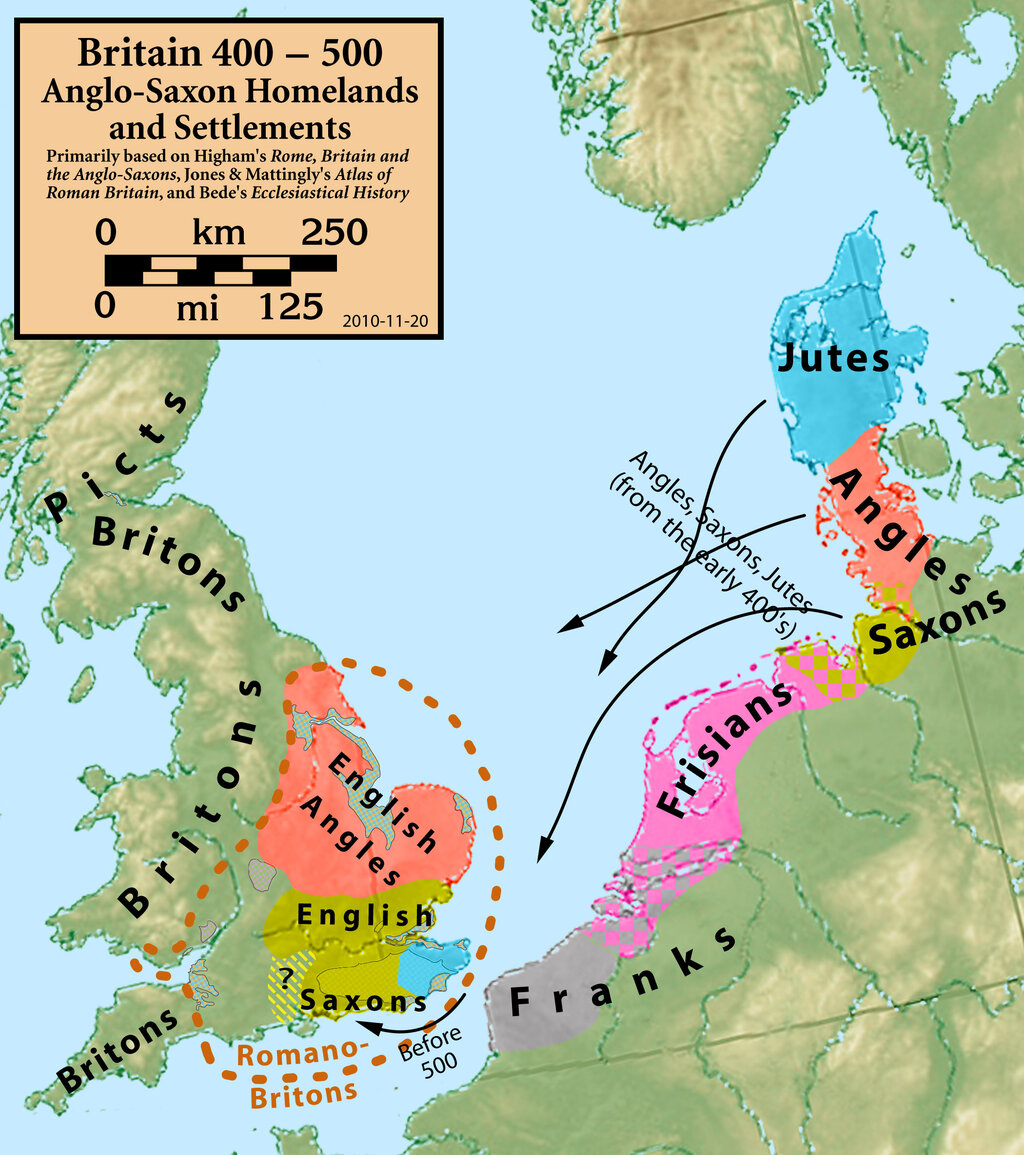
What started as a mercenary mission turned into a full-scale migration. Over the next century, these Germanic tribes arrived in large numbers, settling, farming, and eventually pushing the native Celtic-speaking Britons to the western and northern fringes of the island—into what we now know as Wales, Cornwall, and Scotland.
The dialects these settlers brought with them began to merge and evolve in their new home. This blend of West Germanic dialects in Britain is what we now call Old English or Anglo-Saxon.
The Old English (OE) period can be regarded as starting around AD 450, with the arrival of West Germanic settlers (Angles, Saxons and Jutes) in southern Britain.
Lingering Influences
Although the Germanic dialects formed the foundation of Old English, they didn't exist in a vacuum. The languages that were already in Britain left their mark.
The influence from the native Celtic languages is surprisingly small, mostly surviving in place names. Many English rivers still bear Celtic names, like Thames, Avon, and Trent. London (Londinium) itself is a name with pre-Roman roots.
Latin had a more significant impact. Some Latin words were borrowed by Germanic tribes on the continent before they even migrated, related to trade and Roman goods. Words like wine, street, and cheese entered the language this way.
Later, another wave of Latin influence arrived with the Christianization of the Anglo-Saxons in the late 6th century. Monks and missionaries introduced words related to religion and learning, such as priest, mass, and school. This borrowing enriched the vocabulary of Old English, adding layers of sophistication to its Germanic core.
Let's review the origins of English.
What is the reconstructed, ancient parent language from which English, along with languages like Greek, Hindi, and Spanish, is believed to have descended?
English belongs to which branch of the Proto-Germanic language family?