Introduction to the English Language
Origins of English
The Ancestor of Tongues
English, along with hundreds of other languages spoken from India to Ireland, belongs to a massive linguistic family. Linguists call its shared ancestor Proto-Indo-European, or PIE. We have no written records of PIE. It was spoken thousands of years ago, long before writing was common, and died out before it could be documented. So how do we know it existed? By looking at its children.
Think of it like spotting family resemblances. The English word father is pater in Latin, patḗr in Greek, and pitṛ́ in Sanskrit. The similarities are too striking to be a coincidence. By comparing these “daughter” languages, linguists can reconstruct the vocabulary and grammar of the parent tongue.
Everyone agrees on one key point: the Indo-European languages descend from a common ancestor, a mother tongue called Proto-Indo-European, or PIE.
This process, called the comparative method, has allowed us to piece together a picture of PIE. From this single origin, waves of migration spread the language across Europe and Asia, where it evolved into distinct branches.
A Germanic Branch
One of those branches is Germanic. The early Germanic tribes lived in Northern Europe and spoke a language that would eventually split into German, Dutch, Swedish, Norwegian, and, of course, English.
Around the 5th century CE, several of these tribes—the Angles, Saxons, and Jutes—migrated from continental Europe to the island of Britain. Their dialects merged over time to form a new language: Old English, also known as Anglo-Saxon.
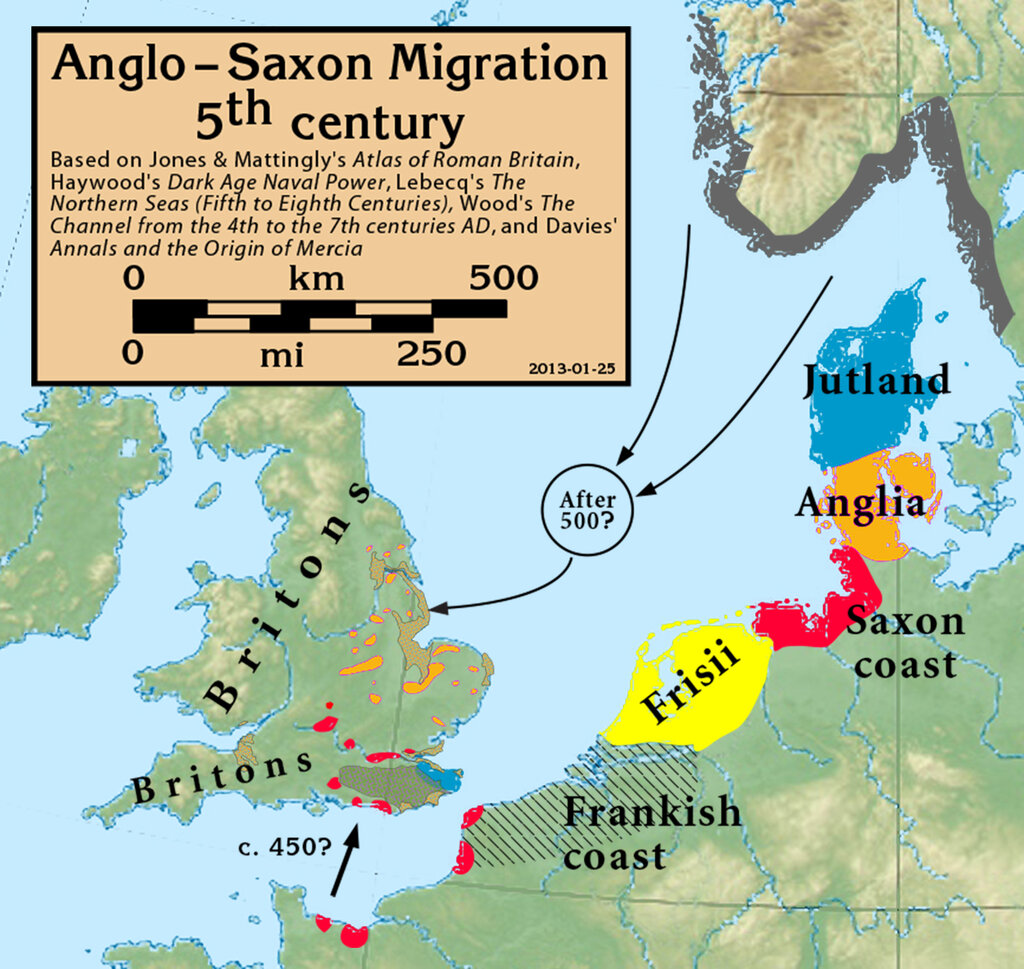
If you were to hear Old English, you probably wouldn't recognize it. Its grammar was more complex than modern English, with noun cases and different verb endings. The vocabulary was almost entirely Germanic, full of words that have since fallen out of use or changed dramatically.
For example, the opening line of the epic poem Beowulf is: Hwæt! We Gardena in geardagum, þeodcyninga, þrym gefrunon, hu ða æþelingas ellen fremedon. Roughly translated, it means: "Listen! We have heard of the glory of the Spear-Danes in days of yore, of the people's kings, how the noble ones performed deeds of courage."
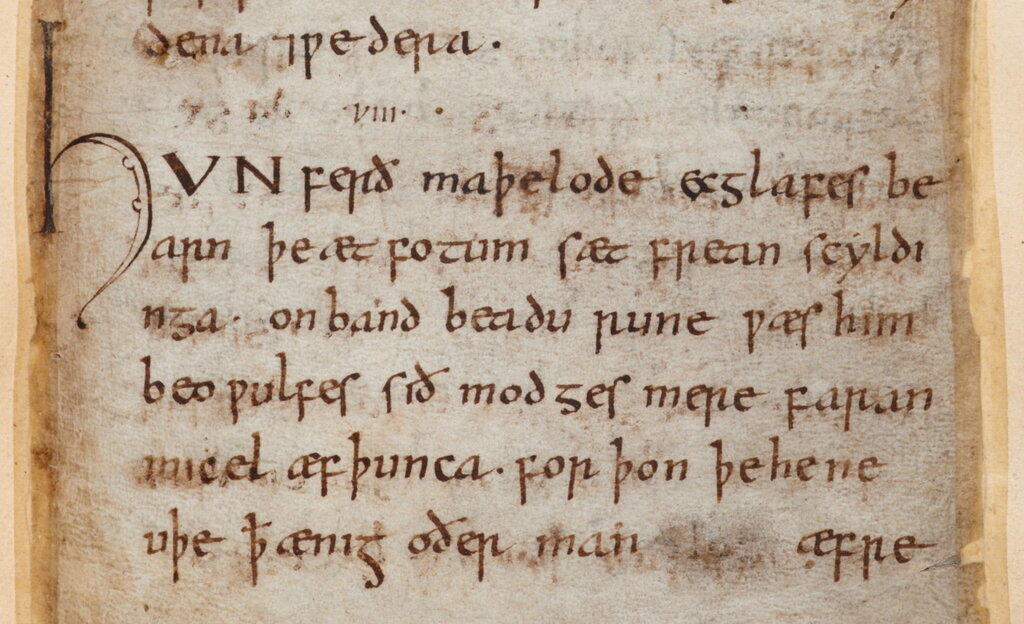
Despite the differences, Old English is the direct ancestor of the language we speak today. Many of our most basic, everyday words come from this period: mann (man), wīf (woman, wife), cild (child), hūs (house), and etan (to eat).
A Great Shift in Sound
Between about 1400 and 1700, English underwent a massive transformation in its sound system. Known as the Great Vowel Shift, this was a chain reaction where the pronunciation of all long vowels gradually changed.
In simple terms, vowels that were pronounced at the back of the mouth moved to the front, and vowels pronounced at the front moved higher up. For example, the vowel sound in the word mouse used to be pronounced like the "oo" in moose. The vowel in geese was pronounced like the "a" in face.
This shift is a major reason why English spelling can seem so illogical. Writing conventions became standardized just as pronunciation was changing, effectively freezing our spelling in a pre-shift state. We still write house and mouse, but we no longer pronounce them hoos and moos.
| Word | Pronunciation Before Shift (approx.) | Modern Pronunciation |
|---|---|---|
| bite | "beet-uh" | "bight" |
| meet | "mate" | "meet" |
| house | "hoos" | "house" |
| about | "ah-boot" | "ah-bout" |
| name | "nahm-uh" | "name" |
The exact cause of the Great Vowel Shift is still debated by linguists. Some suggest it was a social phenomenon, where the upper classes began to distinguish their speech from the lower classes after the Black Death reshuffled society. Whatever the cause, its effects were permanent, creating a huge divide between the sound of English and its written form.
The Rise of a Standard
For most of its history, English had no standard accent. People in Yorkshire spoke very differently from people in London, and neither was considered more "correct" than the other.
This began to change in the late Middle Ages with the rise of London as the center of government, commerce, and culture. The dialect spoken in and around London, Oxford, and Cambridge gained prestige. The invention of the printing press in the 15th century helped solidify this dialect's dominance, as most books were printed in it.
Over centuries, this prestigious accent evolved into what is now known as Received Pronunciation (RP). It became the accent of the elite public schools, the civil service, and the BBC. For a long time, it was taught as "standard" or "proper" English, both in Britain and abroad.
It's crucial to remember that RP is not inherently better or more correct than any other accent. It is a social accent, not a geographical one, and it's spoken by only a small percentage of the British population. Today, there's a much greater appreciation for the rich diversity of accents across the English-speaking world.
Let's review some of the key terms from the history of English.
Now, test your understanding of how English evolved.
How do linguists know about Proto-Indo-European (PIE), a language with no written records?
The language brought to Britain in the 5th century by the Angles, Saxons, and Jutes is known as:
From its deep roots in a long-lost ancestor tongue to the shifts that shaped its modern sounds, the history of English is a story of migration, social change, and constant evolution.