Introduction to Tai Chi
Introduction to Tai Chi Chuan
The Moving Meditation
Tai Chi Chuan, often shortened to Tai Chi, looks like a slow, graceful dance. But beneath its calm surface lies a powerful martial art and a profound system for health. The name itself translates to “Supreme Ultimate Fist,” hinting at its deep philosophical roots in Daoism and its original purpose as a method of self-defense.
Tai Chi is a form of martial arts that focuses on slow, controlled movements and deep breathing.
Unlike hard martial arts that meet force with force, Tai Chi teaches practitioners to yield, redirect, and blend with an opponent's energy. Over centuries, however, its focus has shifted. The same principles that made it an effective fighting style also proved to be incredibly beneficial for physical health and mental clarity. Today, millions practice Tai Chi not for combat, but as a moving meditation to cultivate balance, calm the mind, and gently strengthen the body.
A Family of Styles
The history of Tai Chi is a blend of legend and fact. While stories often credit the Daoist sage Zhang Sanfeng, the verifiable history begins in the 17th century with the Chen family in Henan province. Chen Wangting, a retired general, is credited with creating the first form of Tai Chi, combining his martial arts knowledge with principles of traditional Chinese medicine and Daoist philosophy.
From these roots, several distinct styles, or “families,” of Tai Chi emerged. Each was developed by a master who adapted the art based on their own understanding and physique, creating a unique flavor and focus.
| Style | Founder (Traditional) | Key Characteristics |
|---|---|---|
| Chen | Chen Wangting | Oldest style; alternates between slow, soft movements and fast, explosive bursts. |
| Yang | Yang Luchan | Most popular style; features slow, large, even, and graceful movements. |
| Wu | Wu Quanyou | Compact and deliberate, with smaller frames and a slight forward lean. |
| Sun | Sun Lutang | Youngest style; combines elements of other internal arts with agile steps and high stances. |
Though they differ in appearance, all styles share the same core principles passed down from the Chen family.
The Gentle Giant: Yang Style
The Yang style is by far the most widely practiced form of Tai Chi in the world today. It was developed by Yang Luchan, who famously learned the art from the Chen family. Yang Luchan was a formidable martial artist, but his grandson, Yang Chengfu, is largely responsible for popularizing the style as a health practice in the early 20th century.
Yang Chengfu smoothed out the explosive movements and evened the tempo, creating a form that was accessible to a wider range of people, regardless of age or athletic ability. This is the version most people recognize as Tai Chi.
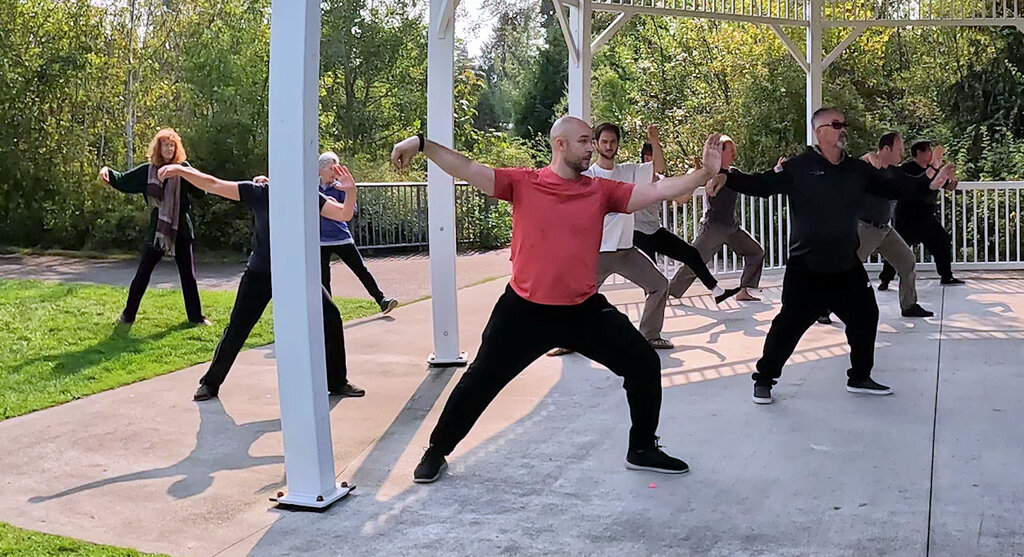
Its key characteristics are large, open postures and a slow, continuous, flowing rhythm. This makes it an excellent starting point for beginners, as it helps develop a strong foundation in the art's fundamental principles.
Core Principles
To practice Tai Chi is to practice its principles. They are the invisible threads that weave the movements together into a holistic exercise for the mind and body. While there are many subtle concepts, three are essential for any beginner.
Relaxation (Sōng): This isn't about being limp. It's an active release of unnecessary tension from the muscles and joints. This allows for fluid movement and the free circulation of energy, or Qi.
True relaxation allows you to feel grounded and connected to the earth, sinking your weight while remaining light and agile.
Balance: Tai Chi is a constant play of shifting weight. You learn to maintain your center of gravity through every turn and transition. This develops not just physical stability, but also mental and emotional equilibrium.
This practice of finding your center in movement is a skill that translates directly into daily life.
Mind-Body Integration: In Tai Chi, the mind leads the body. Every movement is intentional and guided by focused awareness. The goal is to quiet the internal chatter and create a state where your mind, body, and breath work in perfect harmony.
By focusing on these principles, the simple act of moving becomes a profound practice of self-awareness and cultivation.
What is the direct translation of "Tai Chi Chuan"?
According to verifiable history, who is credited with creating the first form of Tai Chi?
These foundational ideas provide the starting point for a journey into Tai Chi. It's an art that is simple to begin but can take a lifetime to master, offering new layers of depth at every stage.