Introduction to Systems Thinking
Introduction to Systems Thinking
Seeing the Bigger Picture
Have you ever been stuck in a traffic jam and wondered why everything has ground to a halt? Maybe you blame the car directly in front of you. But the real cause is rarely so simple. A single accident miles ahead, a poorly timed traffic light, or even just a high volume of cars all trying to merge at once can create a ripple effect, slowing everyone down. This is the essence of a system. It's a collection of interconnected parts where the whole is more complex than the sum of its pieces.
Systems thinking is the practice of seeing and understanding these systems. Instead of focusing on individual events or single causes, it encourages us to look for the connections, relationships, and patterns that link everything together. It's a shift from linear, cause-and-effect thinking (A causes B) to seeing a web of influences where A affects B, B affects C, and C might loop back to affect A again.
Systems thinking attends to the connections between things, events and ideas.
This holistic perspective is crucial for tackling complex problems. Whether in business, environmental science, or social policy, the most challenging issues are rarely isolated. They are systemic. By understanding the underlying structure of the system, we can find more effective, long-lasting solutions instead of just treating symptoms.
Key Principles
To start thinking in systems, we need to grasp a few core ideas. These principles act as a new lens through which to view the world.
Holism
noun
The idea that the properties of a system cannot be explained by its components alone. The system as a whole determines how its parts behave.
Think of a bicycle. You can lay out all its parts on the ground: the frame, wheels, chain, and handlebars. You can understand each part perfectly. But you don't have a bicycle until they are assembled and working together. The bicycle is a property of the whole system, not of any individual part. Holism reminds us to step back and see the entire entity, not just its fragments.
Interdependence is the natural consequence of holism. It means the parts of a system are mutually reliant. A change in one part can have surprising effects on another, even if they seem distant. In a business, the marketing team’s decision to run a big sale directly impacts the inventory team, the customer service department, and the shipping warehouse. They are all interdependent.
One of the most powerful concepts in systems thinking is the feedback loop. This is when the output of an action circles back to become an input, influencing future actions.
There are two main types of feedback loops:
-
Reinforcing Loops: These amplify change, creating exponential growth or decline. Think of a snowball rolling down a hill; it gets bigger and bigger, faster and faster. A viral social media post is another example. The more shares it gets, the more people see it, leading to even more shares.
-
Balancing Loops: These stabilize a system and resist change. They work to keep a system within a desired range. A thermostat is a classic example. When the room gets too hot, the thermostat turns the heat off. When it gets too cold, it turns it back on, maintaining a stable temperature.
Recognizing which loops are at play is a fundamental skill in systems thinking. It helps explain why some systems get stuck in a rut (a balancing loop) while others suddenly take off (a reinforcing loop).
Systems Thinking in Action
The principles of systems thinking aren't just theoretical. They have practical applications across many fields.
| Field | Application of Systems Thinking |
|---|---|
| Ecology | Understanding how species, climate, and geography interact within an ecosystem. A change in one predator population can affect the entire food web. |
| Business | Analyzing how different departments (sales, manufacturing, HR) influence each other to improve overall company performance and avoid unintended consequences. |
| Public Health | Addressing health issues like obesity by examining the interplay of food systems, urban design, education, and economic policy, rather than just focusing on individual behavior. |
| Engineering | Designing complex products like airplanes or software by considering how all the components must integrate and function together under various conditions. |
In each case, systems thinking provides a powerful framework for understanding complexity and intervening more effectively. It shifts the focus from blaming individuals to improving the structure of the system itself.
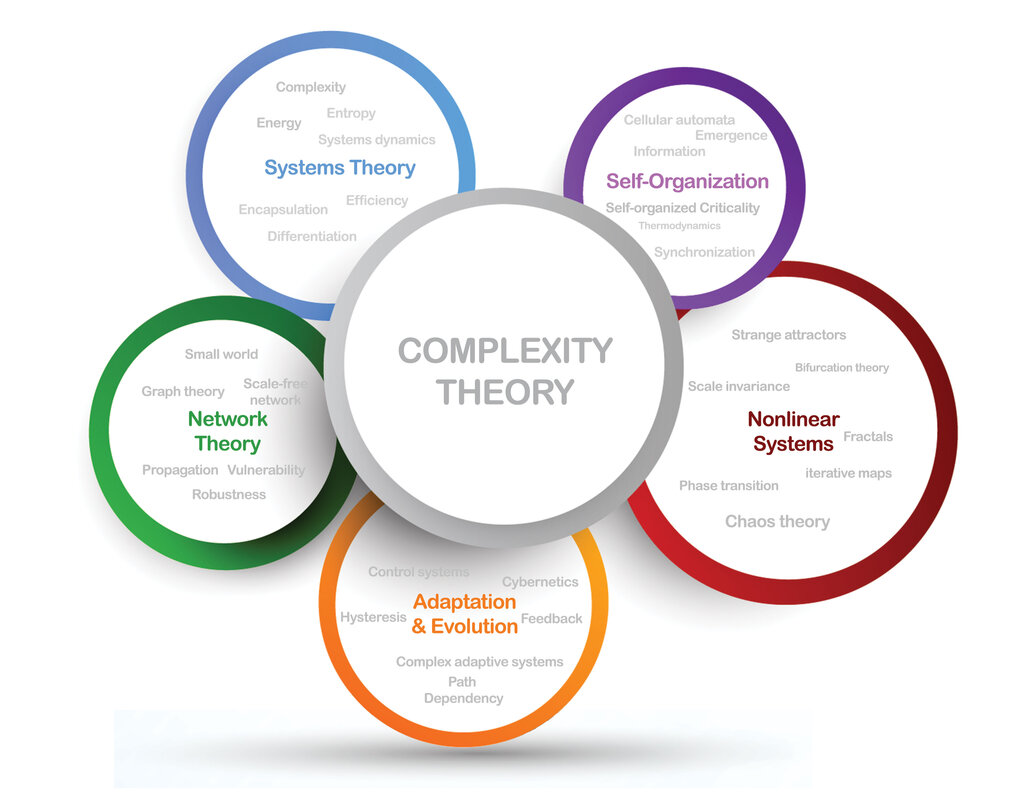
As we move forward, we'll see how these foundational ideas can be used to map out systems and identify leverage points for meaningful change. For now, the key takeaway is the shift in perspective: from looking at the pieces to seeing the whole.
Which of the following best describes the core idea of systems thinking?
A social media post that goes viral, gaining more shares as more people see it, is an example of a: