Introduction to String Theory
Introduction to String Theory
Beyond Points and Particles
For centuries, physics has told us that the universe is built from tiny, point-like particles. Electrons, quarks, photons—these are the fundamental Lego bricks of reality. The Standard Model of particle physics, our best map of this subatomic world, treats them as dimensionless dots. But what if that's not the full story?
String theory proposes a radical new idea. It suggests that if you could zoom in on an electron to an unimaginable scale, you wouldn't find a point. Instead, you'd see a tiny, vibrating loop of energy. This is the core concept: the fundamental constituents of the universe aren't particles, but one-dimensional objects called strings.
In string theory, every fundamental particle is just a different manifestation of one basic object: a string.
These aren't strings like the kind you'd use to tie a package. They are incredibly small, far smaller than anything we can observe with current technology. They can be open-ended, like a piece of thread, or closed loops, like a rubber band.
A Cosmic Symphony
So, if everything is made of strings, why do we see so many different kinds of particles? The answer lies in how the strings vibrate. Think of a guitar string. By plucking it in different ways, you can produce a variety of distinct musical notes. The underlying string is the same, but its vibrational pattern changes.
String theory applies this same logic to the universe. A string vibrating in one specific pattern might appear to us as an electron. A different vibration makes the string look like a photon. Yet another makes it a quark. All the particles and forces we see in nature are just different “notes” played on these fundamental strings.
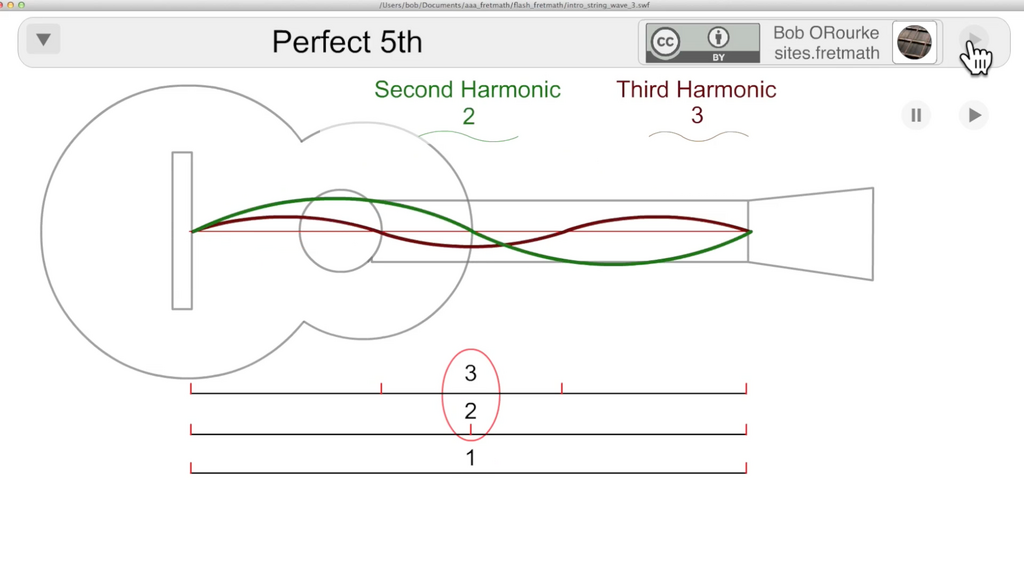
This idea is incredibly powerful. It means the dizzying variety of particles in the universe isn't arbitrary. It's all part of a unified whole, a kind of cosmic symphony. Every particle, from the ones that make up your body to the ones carrying light from distant stars, is a different tune played on the same type of string.
The Quest for One Theory
String theory didn't appear out of nowhere. It was born from a major puzzle in physics: the clash between our two best theories of the universe. General relativity, Einstein's theory, masterfully describes gravity and the large-scale structure of the cosmos—planets, stars, and galaxies. Quantum mechanics, on the other hand, governs the bizarre world of the very small.
Both theories work perfectly in their own domains, but they break down when combined. Trying to describe gravity on a quantum scale results in mathematical nonsense. For decades, physicists have been searching for a unified theory, a single framework that can describe all of nature's forces, from the smallest subatomic particle to the largest galaxy cluster. This is often called a “theory of everything.”
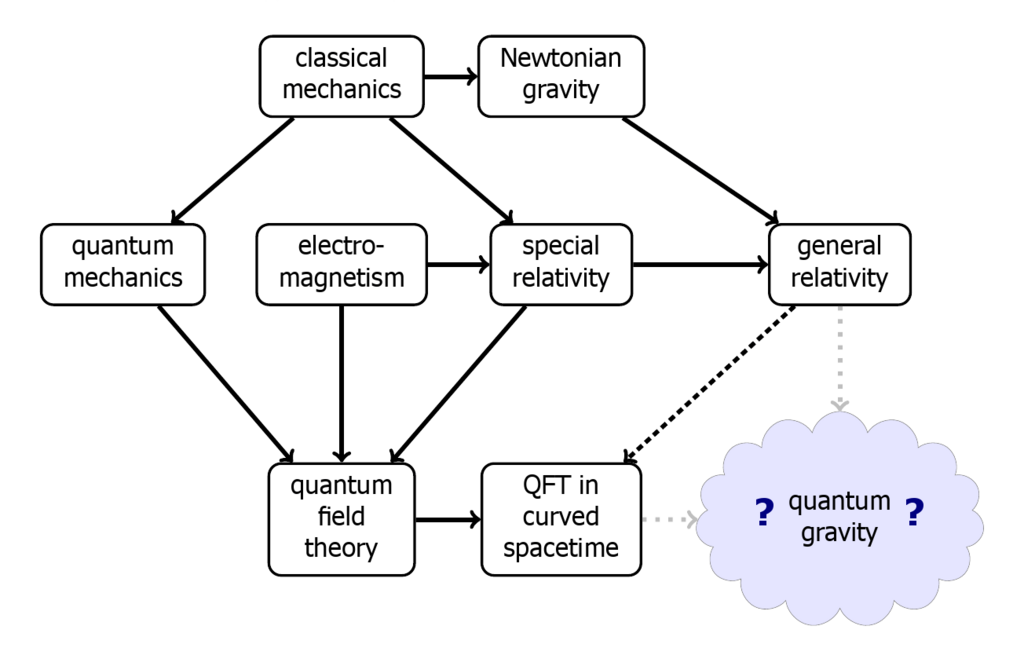
String theory emerged in the 1960s and 70s as an attempt to describe the strong nuclear force. It wasn't very successful at that, but physicists soon realized it had a remarkable property. One of its vibrational modes corresponded perfectly to the graviton, the hypothetical particle that carries the force of gravity.
Suddenly, string theory wasn't just another particle model. It was a candidate for a theory of quantum gravity, a framework that naturally included both gravity and the quantum particles of the Standard Model. This is the central motivation behind it: the potential to finally write down a single, elegant equation to describe the entire universe.
Among the attempts to unify quantum theory and gravity, string theory has attracted the most attention.
Of course, string theory is still very much a work in progress. It makes predictions, like the existence of extra dimensions of space, that we can't yet test. But it remains one of the most promising and profound ideas in modern physics, offering a glimpse of a deeper, simpler reality underlying the world we see.