Introduction to String Theory
Introduction to String Theory
Strings Instead of Dots
For centuries, physicists have pictured the smallest bits of our universe as tiny, zero-dimensional points. Electrons, photons, quarks — all were seen as infinitesimally small dots. String theory challenges this fundamental picture. It suggests that if you could zoom in on any of these particles, you wouldn't find a point. Instead, you'd find a tiny, vibrating, one-dimensional loop of energy: a string.
In string theory, a leading approach to that unification, particles are in actuality one-dimensional objects, small vibrating loops or strands.
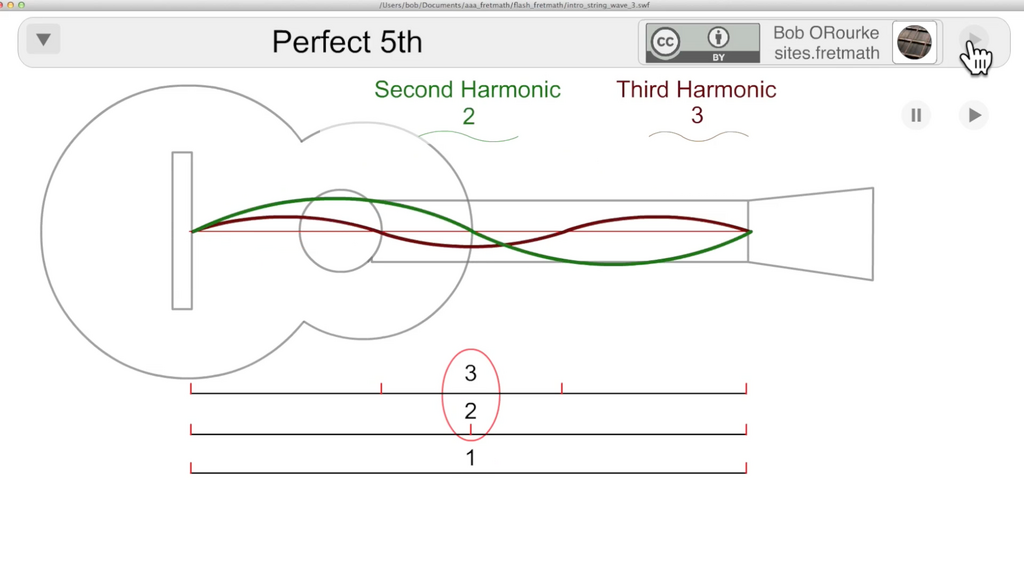
This might seem like a small change, but its implications are enormous. Think of a guitar string. By plucking it in different ways, you can produce a variety of distinct musical notes. A C note and an F note are just different vibrational patterns of the same string.
String theory proposes that the universe works in a similar way. One vibrational pattern of a fundamental string might appear to us as an electron. A different vibration of the exact same kind of string could manifest as a photon. Another, a quark. Every particle and force we see in nature, from light to gravity, is simply a different 'note' played on these unimaginably small strings. This elegant idea is the central motivation behind string theory: to explain all the universe's complexity with one simple building block.
Unifying the Universe
The quest for string theory began as an attempt to solve the biggest puzzle in modern physics. We have two incredibly successful theories that describe the universe. General relativity perfectly explains gravity and the large-scale cosmos of stars and galaxies. Quantum mechanics flawlessly describes the other three fundamental forces (electromagnetism, and the strong and weak nuclear forces) and the bizarre world of subatomic particles.
The problem is, these two theories are incompatible. They are written in different mathematical languages and break down when applied to situations where both are needed, like the center of a black hole or the moment of the Big Bang. Physicists have long sought a single, overarching “theory of everything” that could unite them.
String theory is the most promising candidate. By replacing point-particles with strings, it smooths out the mathematical infinities that arise when trying to combine gravity and quantum mechanics. One of its vibrational modes naturally corresponds to the graviton, the hypothetical particle that carries the force of gravity. No other theory has managed to incorporate gravity so seamlessly into the quantum world.
Hidden Dimensions and Superpartners
String theory comes with some mind-bending requirements. For its mathematics to be consistent, the universe must have more dimensions than the three of space (length, width, height) and one of time that we experience. Most versions of the theory require a total of ten spacetime dimensions.
So where are these extra six dimensions? The theory suggests they are curled up, or “compactified,” to a size so minuscule that we cannot perceive them. Imagine a garden hose. From far away, it looks like a one-dimensional line. But for an ant walking on its surface, it clearly has a second dimension: the circular path around its circumference. In the same way, each point in our familiar space could contain a tiny, curled-up, six-dimensional shape.
For the theory's equations to be mathematically consistent, a string has to vibrate in 10 spacetime dimensions, which implies that six extra dimensions exist that are too small to have yet been detected.
Another key component of string theory is an idea called supersymmetry. This principle proposes a fundamental symmetry between the two basic classes of particles: fermions and bosons. Fermions are the particles that make up matter, like electrons and quarks. Bosons are the particles that carry forces, like photons. Supersymmetry predicts that every known fermion has a corresponding boson “superpartner,” and every boson has a fermion superpartner.
supersymmetry
noun
A principle in physics that proposes a relationship between two basic classes of elementary particles: bosons and fermions. It posits that every particle has a corresponding "superpartner" with a different spin.
Though none of these superpartners have been discovered yet, the concept is mathematically elegant and helps solve other theoretical problems. Together, the ideas of vibrating strings, extra dimensions, and supersymmetry form the foundation of a theory that attempts to provide a complete and unified description of our universe.
Time to check your understanding.
What is the core idea that string theory introduces to replace the concept of zero-dimensional point-particles?
String theory is a leading candidate for a 'theory of everything' because it attempts to unite which two major, but currently incompatible, theories of physics?