Introduction to String Theory
Introduction to String Theory
Beyond the Point Particle
For a long time, physicists have described the fundamental particles of our universe—electrons, quarks, photons—as tiny, zero-dimensional points. This model, the Standard Model of particle physics, has been incredibly successful. It beautifully explains three of the four fundamental forces of nature: the strong force, the weak force, and electromagnetism. But it has a glaring omission: gravity.
General relativity, Einstein's theory of gravity, works perfectly on large scales, like planets and galaxies. Quantum mechanics works perfectly on small scales, the realm of particles. The problem is that these two theories don't play well together. When you try to describe gravity on a quantum scale, the math breaks down and produces nonsensical infinities.
String theory offers a radical solution. What if the fundamental constituents of the universe aren't points at all? What if they are unimaginably small, one-dimensional loops of vibrating energy, like tiny rubber bands?
String theory is a fascinating physical model in which all particles are replaced by one-dimensional objects known as strings.
This simple change has profound consequences. By replacing point particles with strings, the problematic infinities that arise in quantum gravity calculations magically disappear. The interactions are no longer concentrated at a single, infinitely small point but are spread out along the string, smoothing out the math.
Cosmic Symphony
If all particles are just strings, why do they appear so different? Why is an electron an electron and a photon a photon?
String theory's answer is elegant: a string can vibrate in different patterns, or modes. Just as a violin string can produce different musical notes by vibrating at different frequencies, a fundamental string can appear as different particles depending on its vibrational pattern. One pattern of vibration gives us an electron. Another gives us a photon. A third gives us a quark. All the particles and forces we see in the universe are just different "notes" of a single underlying object: the string.
This is a profound shift in perspective. The diversity of the cosmos is not due to a zoo of different fundamental points, but to the rich musical possibilities of these tiny, vibrating strands of energy.
In this view, the universe is a grand symphony of vibrating strings.
Most excitingly, one specific vibrational mode of a closed string (a loop) has exactly the properties of the graviton. The graviton is the hypothetical quantum particle that carries the gravitational force. No other theory predicts the existence of the graviton so naturally.
In string theory, gravity isn't an afterthought you have to force into the model. It's a built-in, unavoidable consequence of the theory itself. The same framework that describes an electron also describes the force that holds galaxies together.
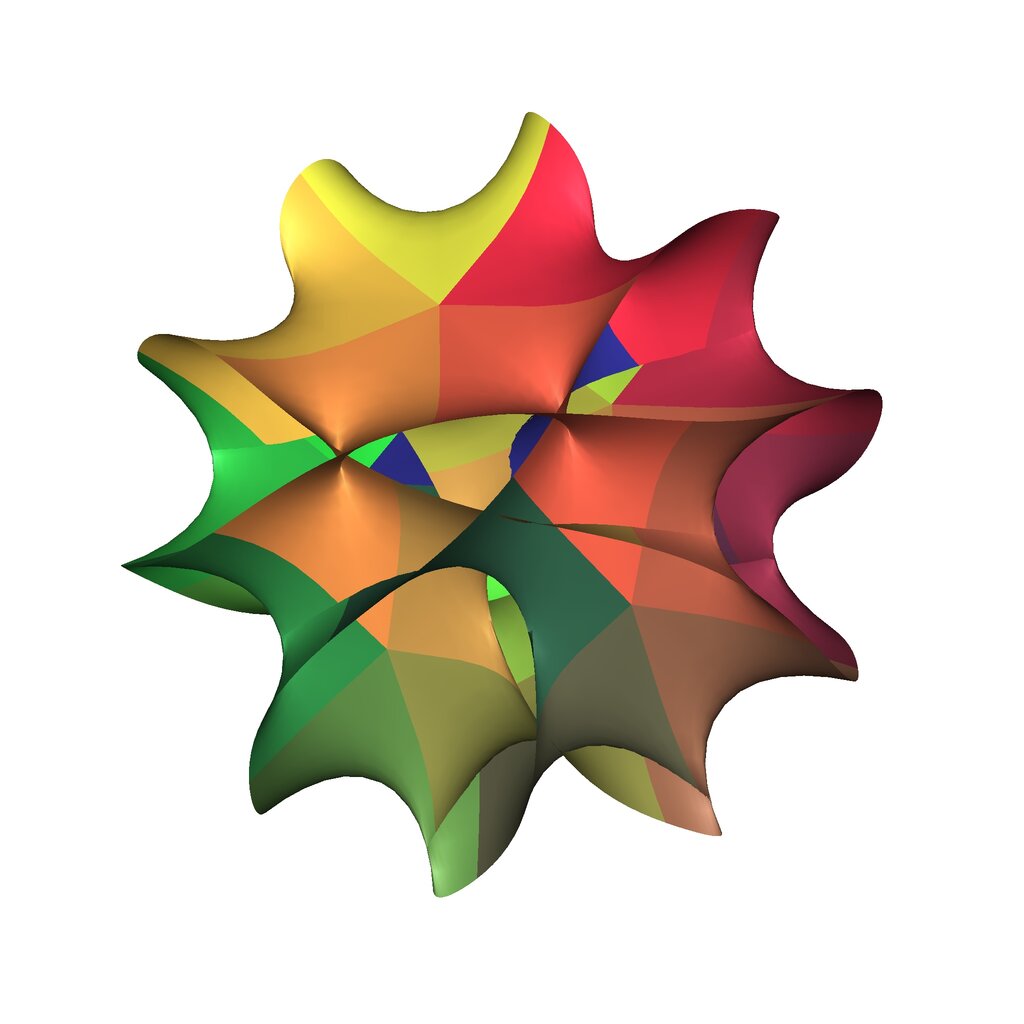
Hidden Dimensions
There's a catch. For the mathematics of string theory to work consistently, the universe must have more spatial dimensions than the three we experience (length, width, and height). Most versions of string theory require ten spacetime dimensions: nine of space and one of time.
So where are these extra six dimensions? The theory suggests they are curled up, or "compactified," to a size so minuscule that we cannot detect them with our current technology. Imagine a garden hose. From far away, it looks like a one-dimensional line. But for an ant walking on its surface, it clearly has a second dimension: the circular path around its circumference.
In the same way, each point in our familiar three-dimensional space could be a tiny, six-dimensional shape. These hidden dimensions are not just a mathematical curiosity; their specific geometry determines the vibrational patterns of the strings. In other words, the shape of these curled-up dimensions dictates the fundamental laws of physics and the types of particles that can exist in our universe.
The extra dimensions give the strings enough vibrational options to explain all of physics.
String theory is still a work in progress, and it remains untestable by current experiments. However, it provides a mathematically consistent framework that unites general relativity and quantum mechanics, offering a compelling glimpse into what a final "theory of everything" might look like.
Let's check your understanding of these new ideas.
What is the primary problem in modern physics that string theory aims to solve?
In string theory, different fundamental particles (like electrons and quarks) are understood to be what?
While it's a complex topic, the core ideas of string theory provide a new way of thinking about the fundamental nature of reality.